

Posted on July 16 2026
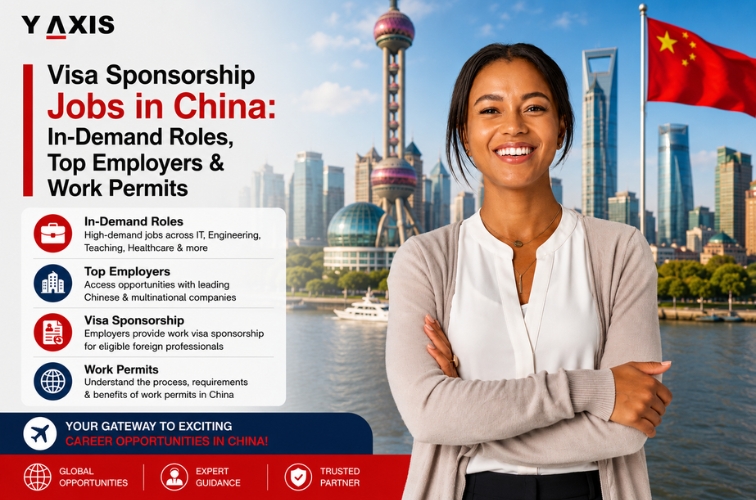
Visa Sponsorship Jobs in China: In-Demand Roles, Top Employers & Work Permits

By , Editor
Updated July 18 2026
China is one of the world's largest economies and a global hub for technology, manufacturing, finance, and education. As the country pushes ahead in artificial intelligence, electric vehicles, biotechnology, and advanced manufacturing, the demand for skilled foreign professionals continues to grow. Over 1.1 million foreigners are legally employed in China, and nearly 60% of them secured their jobs through employer-provided visa sponsorship.
Chinese companies and multinational corporations operating in cities like Shanghai, Beijing, Shenzhen, and Guangzhou actively hire international talent in IT, engineering, education, finance, and healthcare. To make hiring easier, China offers employer-sponsored work visas such as the Z Visa, the R Visa for high-end talent, and the newly launched K Visa for STEM professionals.
For Indian professionals, China offers competitive salaries, low living costs compared to Western countries, and exposure to some of the world's most advanced industries. This guide explains everything you need to know about visa sponsorship jobs in China, including in-demand occupations, top employers, salaries, eligibility requirements, and the step-by-step visa process.
*Want to work in China? Sign up with Y-Axis for end to end assistance.
Why Apply for Visa Sponsorship Jobs in China?
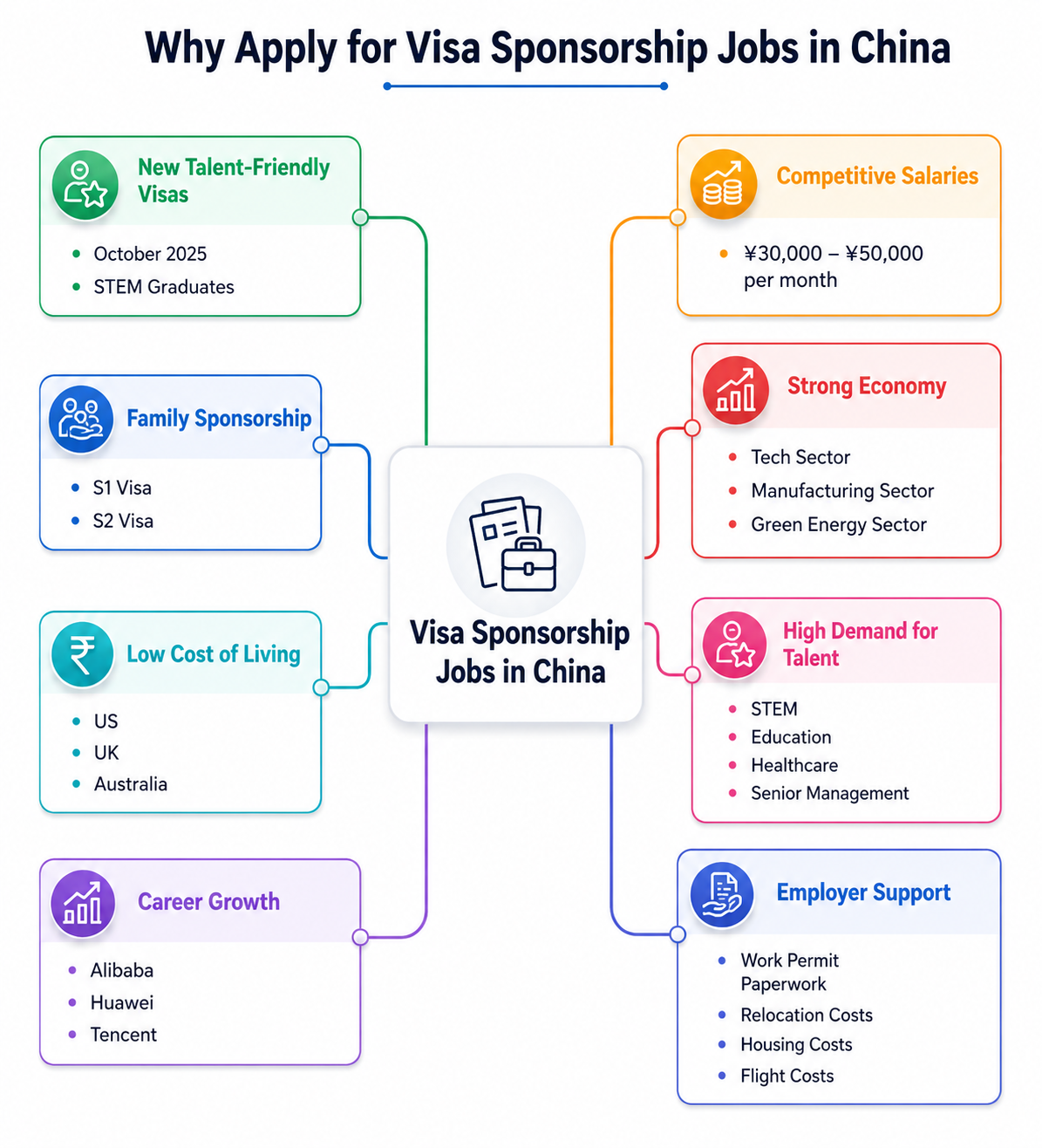
- Competitive salaries: Foreign professionals in China often earn ¥30,000–¥50,000 per month in mid-level roles, well above local averages.
- Strong economy: China is the world's second-largest economy with booming tech, manufacturing, and green energy sectors.
- High demand for foreign talent: Labour shortages exist in STEM, education, healthcare, and senior management roles.
- Employer support: Sponsoring employers handle work permit paperwork and often cover relocation, housing, and flight costs.
- Career growth: Working in China gives you experience with global giants like Alibaba, Huawei, Tencent, and leading multinationals.
- Low cost of living: Daily expenses in China are lower than in the US, UK, or Australia, helping you save more.
- Family sponsorship: Work visa holders can bring their spouse and children on S1/S2 dependent visas.
- New talent-friendly visas: The K Visa (launched October 2025) lets STEM graduates enter China without a prior job offer.
What are Visa Sponsorship Jobs in China?
Visa sponsorship jobs in China are positions where a Chinese employer legally supports your work authorization. Foreigners cannot simply move to China and start working; they need a job offer from a company registered in China. The employer first obtains a Notification Letter of Foreigner's Work Permit from the local authorities. With this letter, you apply for a Z Visa (work visa) at the Chinese embassy in your country.
After you arrive, the employer converts your visa into a work permit and residence permit. Sponsorship means the company vouches for you, manages the official paperwork, and remains responsible for your legal employment status. Any qualified foreign professional with a bachelor's degree and at least two years of relevant work experience can apply.
*Want to apply for China work visa? Let Y-Axis assist you with the process.
In-Demand Visa Sponsorship Jobs in China
China offers a wide range of visa sponsorship opportunities for skilled international professionals, particularly in sectors facing talent shortages and supporting the country's economic growth. Industries such as IT, education, manufacturing, healthcare, logistics, finance, and life sciences actively recruit foreign workers with specialized skills and experience. The table below highlights the most in-demand sectors in China, the key job roles employers are hiring for, and their average annual salary ranges.
| In-Demand Sector | In-Demand Job Roles | Average Annual Salary (CNY) |
|---|---|---|
| IT & Technology | Software Engineer, AI / Machine Learning Engineer, Data Scientist | ¥300,000–¥1,000,000 |
| Education | English Teacher (ESL), International School Teacher | ¥240,000–¥480,000 |
| Manufacturing & Engineering | Mechanical Engineer, Electrical / Automation Engineer | ¥250,000–¥550,000 |
| Consumer & E-commerce | Marketing Manager | ¥360,000–¥700,000 |
| Banking & Finance | Finance Manager | ¥400,000–¥800,000 |
| Healthcare | Medical Doctor (International Clinics) | ¥600,000–¥1,200,000 |
| Logistics | Supply Chain Manager | ¥350,000–¥700,000 |
| Hospitality | Hotel Manager | ¥400,000–¥900,000 |
| Media & Communications | Translator / Copywriter | ¥200,000–¥350,000 |
| Life Sciences | R&D Scientist (Biotech/Pharma) | ¥400,000–¥900,000 |
*Read more......
What are the Most In-Demand Jobs in China for the Next 10 Years?
Highest Paying Jobs in China
Finance, technology, and senior management are the highest-paying sectors in China. Multinational companies and large Chinese firms pay premium salaries to attract experienced foreign professionals, especially in Shanghai, Beijing, and Shenzhen. Below are the top-paying roles based on 2026 salary guides.
| Job Title | Average Annual Salary (CNY) | Average Annual Salary (INR)* |
|---|---|---|
| CEO / Country Manager | ¥2,000,000 | ₹2.81 crore |
| General Counsel | ¥1,800,000 | ₹2.53 crore |
| Strategy Consultant (Senior) | ¥1,500,000 | ₹2.11 crore |
| Head of Digital Transformation | ¥1,400,000 | ₹1.97 crore |
| Investment Banker | ¥1,200,000 | ₹1.69 crore |
| Finance Director | ¥1,000,000 | ₹1.41 crore |
| Medical Specialist | ¥900,000 | ₹1.26 crore |
| Marketing Director | ¥850,000 | ₹1.19 crore |
| AI Engineer | ¥800,000 | ₹1.12 crore |
| Supply Chain Director | ¥750,000 | ₹1.05 crore |
| Software Architect | ¥700,000 | ₹98.4 lakh |
| Data Scientist (Senior) | ¥600,000 | ₹84.3 lakh |
Top Companies Offering Visa Sponsorship Jobs in China
Many multinational corporations and leading Chinese companies sponsor work visas to recruit skilled international professionals across technology, manufacturing, healthcare, finance, education, logistics, and hospitality. These employers actively hire foreign talent for roles in engineering, AI, research, teaching, management, supply chain, and business development. The table below highlights some of the top companies in each sector that are known to offer visa sponsorship opportunities in China.
| Industry / Sector | Top Companies Offering Visa Sponsorship Jobs |
|---|---|
| E-commerce & Technology | Alibaba, Tencent, ByteDance, JD.com, Meituan, Xiaomi, Lenovo, NetEase |
| Telecom & Electronics | Huawei, ZTE, OPPO, vivo, TCL Technology, BOE Technology Group |
| Automotive & Electric Vehicles | Tesla (Gigafactory Shanghai), Volkswagen Group China, BMW Brilliance, Mercedes-Benz China, BYD Auto, SAIC Motor, Geely Auto, NIO |
| Engineering & Industrial Manufacturing | Siemens China, Schneider Electric China, ABB China, Bosch China, Honeywell China, Emerson China |
| Chemicals & Materials | BASF China, Covestro China, Dow China, SABIC China, Wanhua Chemical, Sinopec |
| Pharmaceuticals & Healthcare | AstraZeneca China, Pfizer China, Roche China, Novartis China, Johnson & Johnson China, Sanofi China, Bayer China |
| Banking & Finance | HSBC China, Standard Chartered China, Citi China, JPMorgan Chase China, Bank of China, ICBC, DBS Bank China |
| Education | Education First (EF), Quality Schools International (QSI), Dulwich College Beijing, Nord Anglia Education, Harrow International School Beijing, Wellington College International China |
| Hospitality & Tourism | Marriott International, Hilton Hotels, Hyatt Hotels, InterContinental Hotels Group (IHG), Shangri-La Hotels, Accor Hotels |
| Logistics & Supply Chain | DHL China, FedEx China, UPS China, Maersk China, COSCO Shipping, SF Express |
| Consumer Goods & Retail | Procter & Gamble (P&G) China, Unilever China, Nestlé China, L'Oréal China, Nike China, Adidas China |
| Energy & Renewable Energy | State Grid Corporation of China, China Three Gorges Corporation, Goldwind, Envision Energy, Vestas China, Siemens Gamesa China |
*Also, read...
Is a job offer mandatory for China work visa
Eligibility Requirements for Visa Sponsorship Jobs in China
China follows a points-based classification system for foreign workers. Applicants are categorized as:
- Category A: High-end talent (85+ points)
- Category B: Skilled professionals (60–84 points)
- Category C: Temporary or seasonal workers
To qualify for a visa sponsorship job in China, you must generally meet the following requirements:
- Hold a valid passport with at least 6 months' validity and sufficient blank visa pages.
- Obtain a job offer from a company legally registered in China. The employer must secure a Work Permit Notification Letter on your behalf.
- Have a bachelor's degree or higher, which is the standard qualification for Category B work permits. Educational certificates may need to be authenticated or apostilled.
- Possess at least two years of relevant work experience after graduation for most Category B applicants. Category A professionals may be exempt from this requirement.
- Meet the age requirements, which are generally 18–60 years. Exceptions may apply for highly skilled Category A professionals.
- Satisfy language expectations. There is no mandatory Chinese language test, but Mandarin proficiency earns additional points and improves employment prospects. English is sufficient for many multinational companies and teaching positions.
- Pass a medical examination conducted by an authorized hospital or approved medical centre.
- Provide a police clearance certificate to demonstrate a clean criminal record. The certificate must be authenticated or apostilled.
- Apply for a Z Work Visa before travelling to China. After arrival, you must obtain a Work Permit within 15 days and a Residence Permit within 30 days.
Documents Required for a Sponsored Work Visa in China
When applying for a China-sponsored work visa, you will generally need the following documents:
- Valid Passport: Must be valid for at least six months and contain blank visa pages.
- Notification Letter of Work Permit: Issued by the Chinese authorities to confirm employer sponsorship.
- Job Offer Letter or Employment Contract: Specifies your position, salary, and employment duration.
- Completed Visa Application Form (COVA): Submitted online along with a recent passport-size photograph.
- Educational Certificates: Authenticated or apostilled degree certificates proving your qualifications.
- Work Experience Letters: Documents verifying your relevant professional experience, typically at least two years.
- Medical Examination Certificate: Health report issued by an approved medical centre.
- Police Clearance Certificate: Proof of no criminal record, authenticated by the relevant authorities.
- Passport-size Photographs: Must meet the official Chinese visa photo specifications.
- TEFL or TESOL Certificate (for English teachers): Required for most English teaching positions in addition to a recognized degree.
*Also, read...
What are the eligibility requirements for China work visa?
How to Get a Visa Sponsorship Job in China?
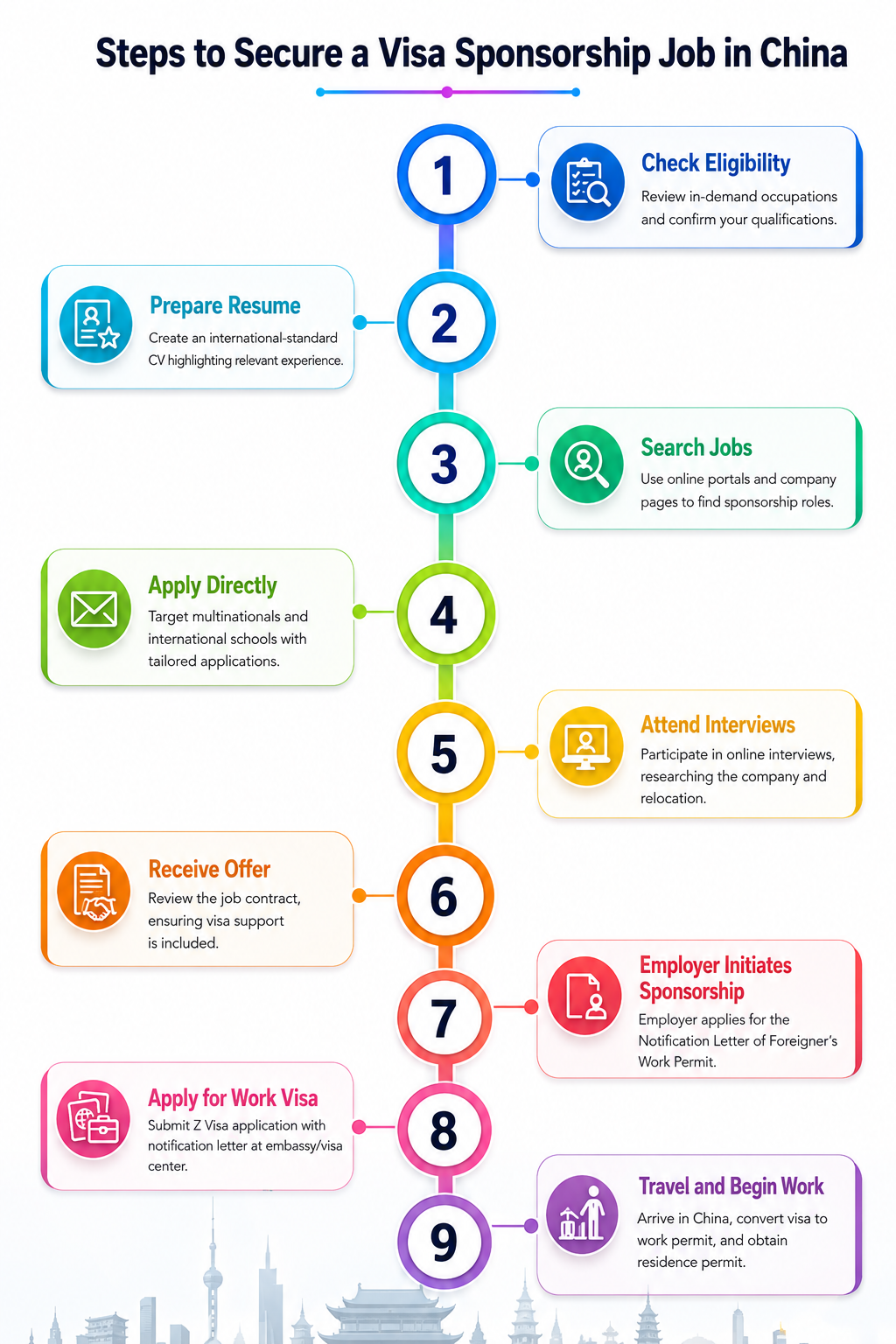
Step 1: Check eligible occupations
Review in-demand fields such as IT, engineering, education, finance, and healthcare, and confirm you meet the degree, experience, and age criteria.
Step 2: Prepare an international-standard resume
Create a clear, achievement-focused CV. Highlight qualifications, certifications (TEFL, CPA, PMP, etc.), and any China or Asia-related experience.
Step 3: Search for sponsorship jobs
Use portals like HiredChina, eChinacities, LinkedIn, Glassdoor, and company career pages. Filter for roles that mention visa sponsorship or foreign candidates.
Step 4: Apply directly to employers
Target multinationals, international schools, and large Chinese companies known to hire foreigners. Tailor each application to the job description
Step 5: Attend interviews
Most first-round interviews are online. Research the company, be ready to discuss relocation, and show flexibility about living in China.
Step 6: Receive job offer
Review the contract carefully salary, housing allowance, flight reimbursement, insurance, and visa support should be clearly stated.
Step 7: Employer initiates sponsorship
Your employer applies for the Notification Letter of Foreigner's Work Permit through the Chinese authorities.
Step 8: Apply for work visa
Submit your Z Visa application with the notification letter at the Chinese embassy or visa centre in India. Processing typically takes a few weeks; the full process from offer to visa can take 1–3 months.
Step 9: Travel and begin employment
After arrival, your employer converts the visa into a work permit within 15 days, and you obtain a residence permit within 30 days. You can then legally live and work in China.
Work Visa Options for Foreign Workers in China
| Visa Type | Purpose | Validity |
|---|---|---|
| Z Visa | Standard employment visa for foreigners with a sponsoring employer | Entry visa; must be converted to a work permit + residence permit (valid 1–5 years) after arrival |
| R Visa | High-level talent and specialists urgently needed by China | 5–10 years, multiple entry |
| K Visa | New visa (from Oct 2025) for young STEM graduates and researchers; no employer sponsor needed | Up to 5 years, multi-entry, 180-day stays |
| M Visa | Business visits, trade, and commercial activities (not employment) | 30–90 days per stay, single or multiple entry |
| S1 / S2 Visa | Dependents (spouse, children) of work visa holders | S1: long-term (180+ days); S2: short-term |
| Work-type Residence Permit | Issued after arrival; allows living and working in China | 1–5 years, renewable |
*Are you looking for step-by-step assistance with overseas immigration? Contact Y-Axis, the world's No. 1 overseas immigration consultancy, for end-to-end assistance!
FAQs
What are visa sponsorship jobs in China?
Visa sponsorship jobs in China are positions where a Chinese employer supports your work authorization. The company obtains a Work Permit Notification Letter from Chinese authorities, which allows you to apply for a Z Visa. After arrival, the employer helps convert it into a work permit and residence permit. Sponsorship means the employer legally vouches for your employment and handles most of the official paperwork.
Can Indians get visa sponsorship jobs in China?
Yes, Indian professionals can get visa sponsorship jobs in China. Indians are hired as English teachers, IT professionals, engineers, doctors, and managers. You need a job offer from a registered Chinese employer, a bachelor's degree, and usually two years of relevant experience. Once the employer sponsors you, you apply for a Z Visa at the Chinese embassy or visa centre in India.
Which companies sponsor foreign workers in China?
Major sponsors include Chinese tech giants like Alibaba, Tencent, Huawei, and ByteDance, and multinationals such as Tesla, Volkswagen, Siemens, BASF, AstraZeneca, and HSBC. Education companies like EF and international schools such as QSI also sponsor foreign teachers. International hotel chains like Marriott and Hilton hire foreign hospitality professionals. Sponsorship depends on the role and the company's current needs.
Which jobs are easiest to get with sponsorship in China?
English teaching is generally the easiest entry route because demand is high across cities and requirements are clear: a bachelor's degree, a TEFL/TESOL certificate, and a clean background check. Other accessible roles include translation, copywriting, marketing for e-commerce companies, and engineering positions in manufacturing hubs. STEM graduates can also use the new K Visa to enter China and explore opportunities.
What are the highest-paying sponsorship jobs in China?
Senior management roles pay the most. Country managers and CEOs earn ¥2,000,000 or more per year, followed by general counsels, strategy consultants, and investment bankers. In technical fields, AI engineers, software architects, and medical specialists earn between ¥700,000 and ¥1,200,000 annually. Finance and technology are the two highest-paying sectors overall, especially in Shanghai, Beijing, and Shenzhen.
What qualifications are required for a China work visa?
The standard requirement is a bachelor's degree plus at least two years of relevant work experience. Your degree must be authenticated or apostilled. China also uses a points system based on salary, education, experience, age, and Mandarin skills. High-end talent (Category A) with strong credentials or high salaries may be exempt from some requirements. Teachers additionally need a TEFL/TESOL certificate.
Do I need work experience for a China work visa?
Yes, in most cases. Category B work permits, the most common type, require at least two years of relevant post-qualification experience. However, exemptions exist for Category A high-end talent, holders of master's degrees from well-known universities in some regions, and applicants under the new K Visa for STEM graduates, which does not require an employer or prior experience.
Is IELTS required for jobs in China?
No, IELTS is not required for a China work visa. There is no mandatory language test for foreign workers. English is sufficient for most multinational, teaching, and tech roles. However, learning basic Mandarin improves your daily life, earns extra points in the work permit system, and significantly widens your job options with local Chinese companies.
How long does China work visa processing take?
The complete process usually takes one to three months. The employer first obtains the Work Permit Notification Letter, which takes a few weeks. Your Z Visa application at the embassy typically takes about four to ten working days. After arrival, the work permit is issued within 15 days and the residence permit within 30 days. Employer efficiency affects the overall timeline.
Can family members accompany me to China?
Yes. Your spouse and dependent children can join you on S1 visas for long-term stays or S2 visas for short visits. After arrival, S1 holders obtain residence permits linked to your work permit validity. You will need marriage and birth certificates, duly authenticated. Note that dependents cannot work in China unless they obtain their own work permits.
Can visa sponsorship lead to permanent residency in China?
Yes, but it is difficult. China's permanent residence (green card) is granted selectively. Common routes include working in China for four consecutive years with high income and tax payments, holding senior positions, or making significant investments. High-end talent under Category A has better chances. Most foreign workers renew their work-type residence permits instead of obtaining PR.
What industries hire foreign workers in China?
Technology, education, engineering, manufacturing, finance, healthcare, hospitality, and logistics hire the most foreigners. AI, biotechnology, fintech, and electric vehicles are strategic sectors with strong demand. International schools and language centres hire teachers, while multinational companies hire managers, engineers, and marketing professionals. Shanghai, Beijing, Shenzhen, and Guangzhou offer the widest range of opportunities.
How can I find visa sponsorship jobs in China?
Use job portals like HiredChina, eChinacities, LinkedIn, and Glassdoor, and apply directly on company career pages. Filter for jobs that mention visa sponsorship or welcome foreign applicants. Networking with professionals already in China and attending industry events also help. Y-Axis job search services can identify suitable openings and help you apply with a strong, tailored profile.
Are healthcare jobs in demand in China?
Yes. International hospitals and clinics in Shanghai, Beijing, and Shenzhen hire foreign doctors, specialists, and healthcare managers to serve expat and affluent local patients. Medical specialists can earn ¥600,000 to ¥1,200,000 per year. Pharmaceutical and biotech companies also hire foreign R&D scientists, medical affairs professionals, and regulatory experts as China's life sciences sector expands rapidly.
Are IT jobs available for foreigners in China?
Yes, IT is one of the strongest sectors for foreigners. Companies seek AI engineers, data scientists, software developers, and cloud specialists, particularly in Shenzhen, Hangzhou, and Beijing. Salaries range from ¥300,000 to over ¥1,000,000 per year. The new K Visa makes it easier for STEM graduates to enter China without a prior job offer and explore tech opportunities.
Can fresh graduates apply for jobs in China?
Standard Category B work permits require two years of experience, which limits fresh graduates. However, the new K Visa, launched in October 2025, allows STEM graduates from recognized universities to enter China without an employer sponsor for work, research, and entrepreneurship. Fresh graduates with strong qualifications may also qualify under points-based exemptions in some free trade zones.
What is the average salary in China for foreigners?
Foreign professionals typically earn ¥240,000 to ¥600,000 per year depending on the role. English teachers earn about ¥240,000–¥360,000, mid-level professionals in multinationals earn ¥360,000–¥600,000, and senior executives earn ¥960,000 or more annually. In INR, mid-level salaries equal roughly ₹50 lakh to ₹84 lakh per year at current exchange rates, which may vary.
What documents are required for a China work visa?
You need a valid passport, the Work Permit Notification Letter, employment contract, completed visa application form, authenticated degree certificates, work experience letters, a medical examination certificate, a police clearance certificate, and photographs. Teachers also need a TEFL/TESOL certificate. All foreign documents generally require authentication or apostille before submission to Chinese authorities.
Can I change employers in China?
Yes, but your work permit is tied to your sponsoring employer. To switch jobs, your new employer must apply for a new work permit, and your existing permit must be cancelled by the old employer. The change should be completed before your current residence permit expires. Changing cities may involve fresh applications under local rules, so plan the transition carefully.
How can Y-Axis help me get a job in China?
Y-Axis provides end-to-end support for your China career plans. Services include professional resume writing, targeted job search assistance, guidance on the Z Visa application, documentation help for degree authentication and police clearance, and interview preparation. Y-Axis career counsellors assess your profile, identify the right opportunities, and guide you through every stage of the overseas job process.
Tags:
Visa sponsorship jobs in China 2026
China work visa sponsorship for Indians
China work permit jobs
In-demand jobs in China with visa sponsorship
China employer-sponsored jobs
China jobs for foreign workers
China work visa for skilled professionals,
Share
Options for you by Y-Axis

Get it on your mobile

Get News alerts

Contact Y-Axis
Latest Article
Popular Post
Trending Article

Posted On October 16 2026
Australia Updates Health Insurance Guidance for Visa Holders: What You Need to Know