


Posted on June 08 2026
Visa Sponsorship Jobs in Canada for Indians – LMIA, Top Employers, In-Demand Jobs & Work Permit Guide

By , Editor & Director
Updated July 07 2026
Canada is one of the top countries for skilled professionals looking to work abroad. The country has a growing economy and needs more workers in sectors such as healthcare, technology, construction, transportation, and skilled trades. To fill these labour shortages, many Canadian employers hire foreign workers and provide visa sponsorship.
For Indian professionals, Canada offers excellent job opportunities and a high quality of life. Whether you are a software developer, nurse, engineer, truck driver, or skilled trades worker, there are many employers looking for qualified international talent. Programs such as the Labour Market Impact Assessment (LMIA), Express Entry, and Provincial Nominee Programs (PNPs) help foreign workers obtain work permits and build a career in Canada.
According to recent labour market data, Canada currently has over 490,000 job vacancies, and the demand for skilled foreign professionals is expected to reach 8.1 million jobs by 2033. This article covers everything you need to know about visa sponsorship jobs in Canada, including in-demand roles, salaries, top hiring companies, eligibility requirements, and how to apply.
*Planning to Work in Canada? Contact Y-Axis for complete guidance
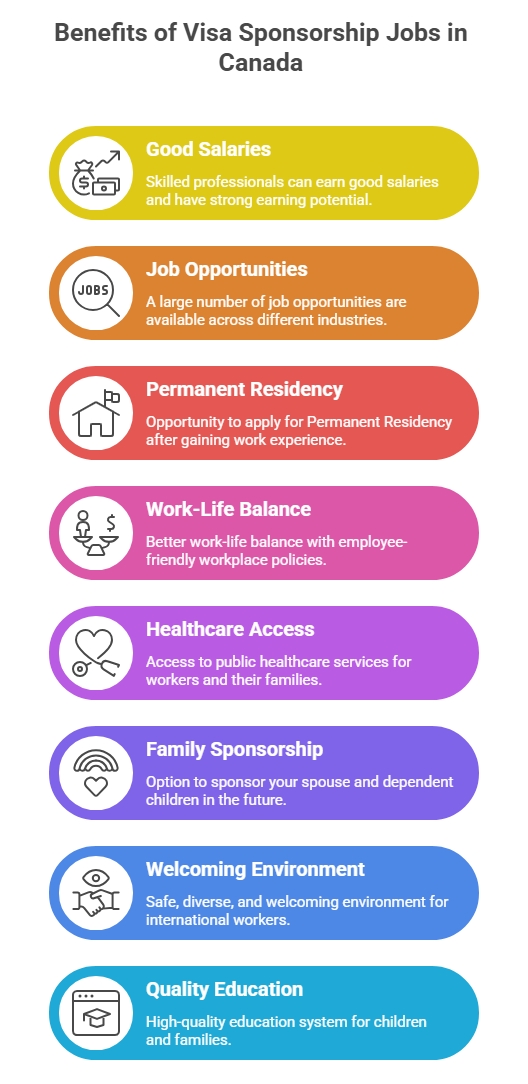
Why Apply for Visa Sponsorship Jobs in Canada?
- Good salaries and strong earning potential for skilled professionals.
- Large number of job opportunities across different industries.
- Opportunity to apply for Permanent Residency after gaining work experience.
- Better work-life balance with employee-friendly workplace policies.
- Access to public healthcare services for workers and their families.
- Option to sponsor your spouse and dependent children in the future.
- Safe, diverse, and welcoming environment for international workers.
- High-quality education system for children and families.
What are Visa Sponsorship Jobs in Canada?
Visa sponsorship jobs in Canada are jobs where a Canadian employer helps a foreign worker get permission to work in the country. Since most foreign workers need a valid work permit, employer sponsorship is often required. In many cases, employers must first get approval from the Canadian government through a Labour Market Impact Assessment (LMIA). This approval shows that there are no suitable Canadian citizens or permanent residents available for the job. After receiving the approval, the employer provides a job offer and supporting documents to the foreign worker. The worker can then apply for a Canadian work permit. Some programs, such as the Global Talent Stream and Intra-Company Transfer program, allow faster processing and may not require an LMIA.
In-demand Jobs in Canada with Visa Sponsorship
The following occupations are currently in high demand across Canada and are commonly sponsored by Canadian employers for foreign workers:
| Sector | Job Titles | Average Annual Salary (CAD) |
|---|---|---|
| Information Technology | Software Developer, Data Scientist, IT Project Manager, Cloud Engineer, Cybersecurity Specialist, AI Engineer, Business Systems Analyst | CAD $90,000 – $135,000 |
| Healthcare | Registered Nurse, Pharmacist, Personal Support Worker, Medical Laboratory Technologist, Physiotherapist, Occupational Therapist | CAD $45,000 – $131,000 |
| Engineering & Construction | Civil Engineer, Construction Manager, Mechanical Engineer, Electrical Engineer, Project Engineer | CAD $75,000 – $120,000 |
| Finance & Accounting | Accountant / CPA, Financial Analyst, Auditor, Tax Consultant, Investment Analyst | CAD $65,000 – $95,000 |
| Human Resources | HR Manager, Talent Acquisition Specialist, Recruitment Consultant, HR Business Partner | CAD $75,000 – $128,000 |
| Marketing & Sales | Marketing Manager, Digital Marketing Specialist, Sales Manager, Brand Manager, Business Development Manager | CAD $60,000 – $120,000 |
| Business & Management | Business Analyst, Operations Manager, Project Coordinator, Management Consultant, Supply Chain Manager | CAD $70,000 – $125,000 |
| Education & Training | Secondary School Teacher, Early Childhood Educator, College Instructor, Special Education Teacher | CAD $50,000 – $100,000 |
| Logistics & Supply Chain | Logistics Coordinator, Procurement Specialist, Supply Chain Analyst, Warehouse Manager | CAD $55,000 – $100,000 |
| Hospitality & Tourism | Hotel Manager, Restaurant Manager, Executive Chef, Food Service Supervisor | CAD $45,000 – $90,000 |
*Searching for jobs in Canada? Find the right one with the help of Y-Axis resume marketing services.
Top Companies Offering Visa Sponsorship Jobs in Canada
The following companies are known to actively hire foreign workers and provide visa sponsorship support in Canada:
| Sector | Companies Offering Visa Sponsorship |
|---|---|
| Information Technology | Shopify, Amazon Canada, Google Canada, CGI Inc., Microsoft Canada, IBM Canada |
| Banking & Finance | RBC (Royal Bank of Canada), Scotiabank, TD Bank, BMO (Bank of Montreal), CIBC, Manulife Financial |
| Oil, Gas & Energy | Suncor Energy, Enbridge Inc., TC Energy, Imperial Oil, Shell Canada, Husky Energy |
| Construction & Engineering | PCL Construction, EllisDon, Graham Group, Bird Construction, Aecon Group, SNC-Lavalin |
| Transportation & Logistics | Bison Transport, Purolator, Canadian National Railway (CN Rail), Canada Post, UPS Canada, FedEx Canada |
| Food Processing & Production | Maple Leaf Foods, Olymel L.P., McCain Foods, Saputo Inc., Cargill Canada, Clearwater Seafoods |
| Retail & Consumer Goods | Loblaw Companies Ltd., Sobeys Inc., Metro Inc., Walmart Canada, Canadian Tire, IKEA Canada |
| Healthcare & Social Services | Telus Health, SE Health, Bayshore Healthcare, Extendicare, CBI Health, Chartwell Retirement Residences |
| Consulting & Professional Services | Deloitte Canada, PwC Canada, KPMG Canada, Accenture Canada, EY Canada, McKinsey & Company Canada |
| Hospitality & Food & Beverage | Tim Hortons, Fairmont Hotels & Resorts, Marriott Canada, Four Seasons Hotels, Compass Group Canada, Recipe Unlimited |
*Read more....
Eligibility Requirements for Visa Sponsorship Jobs in Canada
To qualify for a visa sponsorship job in Canada, you generally need to meet the following requirements:
- You must have a valid passport with sufficient validity for your stay in Canada.
- You must receive a job offer from a Canadian employer willing to sponsor your work permit application.
- You should have the required educational qualifications for the job, such as a diploma, degree, or trade certification.
- Relevant work experience is usually required, depending on the role and industry.
- You may need to prove your English or French language skills through approved language tests.
- You must meet Canada's health requirements and may be required to undergo a medical examination.
- You must provide a Police Clearance Certificate to show that you have no serious criminal record.
- You must complete the biometrics process, including fingerprints and a photograph, as part of your visa application.
Documents Required for a Sponsored Work Visa in Canada
The following documents are generally required when applying for a sponsored work visa in Canada:
- Valid passport
- Job offer letter from a Canadian employer
- LMIA approval or LMIA exemption document, if applicable
- Educational certificates and academic transcripts
- Work experience and employment reference letters
- Medical examination report, if required
- Police Clearance Certificate
- Language test results, if applicable
- Recent passport-size photographs
- Updated resume or CV highlighting your skills and experience
Read more...
What are the minimum requirements to get jobs in Canada?
Visas Eligible for Visa Sponsorship in Canada
Not every Canadian visa type supports employer sponsorship. Canadian work permits fall under two main programmes, the Temporary Foreign Worker Program (TFWP), which requires an LMIA, and the International Mobility Program (IMP), where employers sponsor workers without needing an LMIA. Here is a detailed breakdown of every visa and permit type that is eligible for employer sponsorship:
1. LMIA-Based Work Permits (Temporary Foreign Worker Program)
These permits require the employer to obtain a positive LMIA before the worker can apply.
| Visa / Permit Stream | Who Can Apply |
|---|---|
| High-Wage Worker Stream | Skilled workers in TEER 0, 1, 2, or 3 roles earning at or above the provincial median wage. |
| Low-Wage Worker Stream | Workers in roles earning below the provincial median wage, such as food packing, hospitality, and cleaning occupations. |
| Agricultural Stream | Seasonal farm workers, greenhouse workers, and livestock handlers. |
| Home Childcare Provider Pilot | Workers providing childcare services in a private home. |
| Home Support Worker Pilot | Workers providing in-home care for elderly individuals or persons with disabilities. |
| Global Talent Stream – Category B | Highly skilled technology and STEM professionals hired directly by eligible Canadian employers. |
2. LMIA-Exempt Work Permits (International Mobility Program)
These permits still involve employer sponsorship, but no LMIA is required. The employer must submit an Offer of Employment through the IRCC Employer Portal and pay a CAD $230 compliance fee.
| Visa / Permit Stream | Who Can Apply |
|---|---|
| Intra-Company Transfer (ICT) | Employees being transferred to a Canadian office of a multinational company, including executives, senior managers, and specialised knowledge workers. |
| Global Talent Stream – Category A | Workers referred by a designated Canadian partner organisation for highly specialised roles. |
| CUSMA / USMCA Trade Agreement Workers | Professionals from the United States and Mexico in eligible occupations such as engineers, accountants, and IT professionals. |
| CETA – Canada-EU Trade Agreement | Professionals from European Union countries transferred by a European employer to a Canadian entity. |
| Significant Benefit – Researchers & Academics | International researchers, academics, and artists whose work provides a significant cultural or economic benefit to Canada. |
| Reciprocal Employment | Workers from countries that have reciprocal work permit agreements with Canada. |
| Post-Graduation Work Permit (PGWP) | International graduates of Canadian Designated Learning Institutions (DLIs). This open work permit allows employment with any employer and can support future sponsorship opportunities. |
3. Employer-Supported Permanent Residency Pathways
Some immigration pathways to Permanent Residency also involve employer sponsorship or support:
| Programme | How Employer Plays a Role |
|---|---|
| Provincial Nominee Program (PNP) – Employer Job Offer Streams | Employers in provinces such as Ontario, British Columbia, Alberta, and Manitoba can directly nominate eligible foreign workers for permanent residence through specific PNP streams. |
| Atlantic Immigration Program (AIP) | Designated employers in Atlantic Canada, including Nova Scotia, New Brunswick, Prince Edward Island, and Newfoundland and Labrador, can directly support permanent residence applications without requiring an LMIA. |
| Rural and Northern Immigration Pilot (RNIP) | Employers in participating rural and northern communities can recommend eligible foreign workers for permanent residence. |
| Agri-Food Pilot | Employers in sectors such as meat processing, mushroom production, and greenhouse vegetable farming can support year-round agricultural workers in obtaining permanent residence. |
| Express Entry – Job Offer (for PNP) | Although a job offer no longer adds CRS points directly (as of March 2025), several Provincial Nominee Program streams still require or give preference to candidates with a valid Canadian job offer. |
4. Visas NOT Eligible for Employer Sponsorship
The following visa types do not support employer sponsorship and cannot be used to work in Canada under a sponsored arrangement:
- Visitor Visa (Temporary Resident Visa): does not authorise work in Canada.
- Electronic Travel Authorisation (eTA): for short visits only; no work rights.
- Study Permit: allows limited on-campus and co-op work only; a separate work permit is needed for full-time employment.
- Tourist Visa: no work rights whatsoever.
Important: Always ensure you hold the correct work permit for your role. Working on a visitor visa or study permit (outside permitted conditions) is a violation of Canadian immigration law and can result in removal and a ban from Canada.
LMIA Canada
What is an LMIA?
A Labour Market Impact Assessment (LMIA) is a document that allows a Canadian employer to hire a foreign worker for a specific job. It is an important part of the visa sponsorship process in Canada.
A positive LMIA confirms that:
- The employer needs a foreign worker to fill the job position.
- No suitable Canadian citizen or permanent resident is available for the role.
Once the LMIA is approved, the employer provides the LMIA number and a job offer letter to the foreign worker. These documents are then used to apply for a Canadian work permit.
Why is an LMIA Required?
The LMIA helps protect the Canadian job market. It ensures that employers try to hire Canadian citizens or permanent residents before hiring foreign workers. It also helps make sure that foreign workers receive fair wages and working conditions.
Key Points to Remember About LMIA
- The employer applies and pays for the LMIA, not the foreign worker.
- A positive LMIA does not automatically give you a work permit. You must apply separately.
- Each LMIA is issued for a specific employer, job position, and work location.
- If you change employers, a new LMIA may be required.
- Most LMIAs remain valid for a limited period after approval.
- Genuine employers do not ask workers to pay for an LMIA or a job offer. Be careful of fraud and fake job offers.
*Read more...
Can I get a job in Canada without an LMIA?
How to Get a Visa Sponsorship Job in Canada?
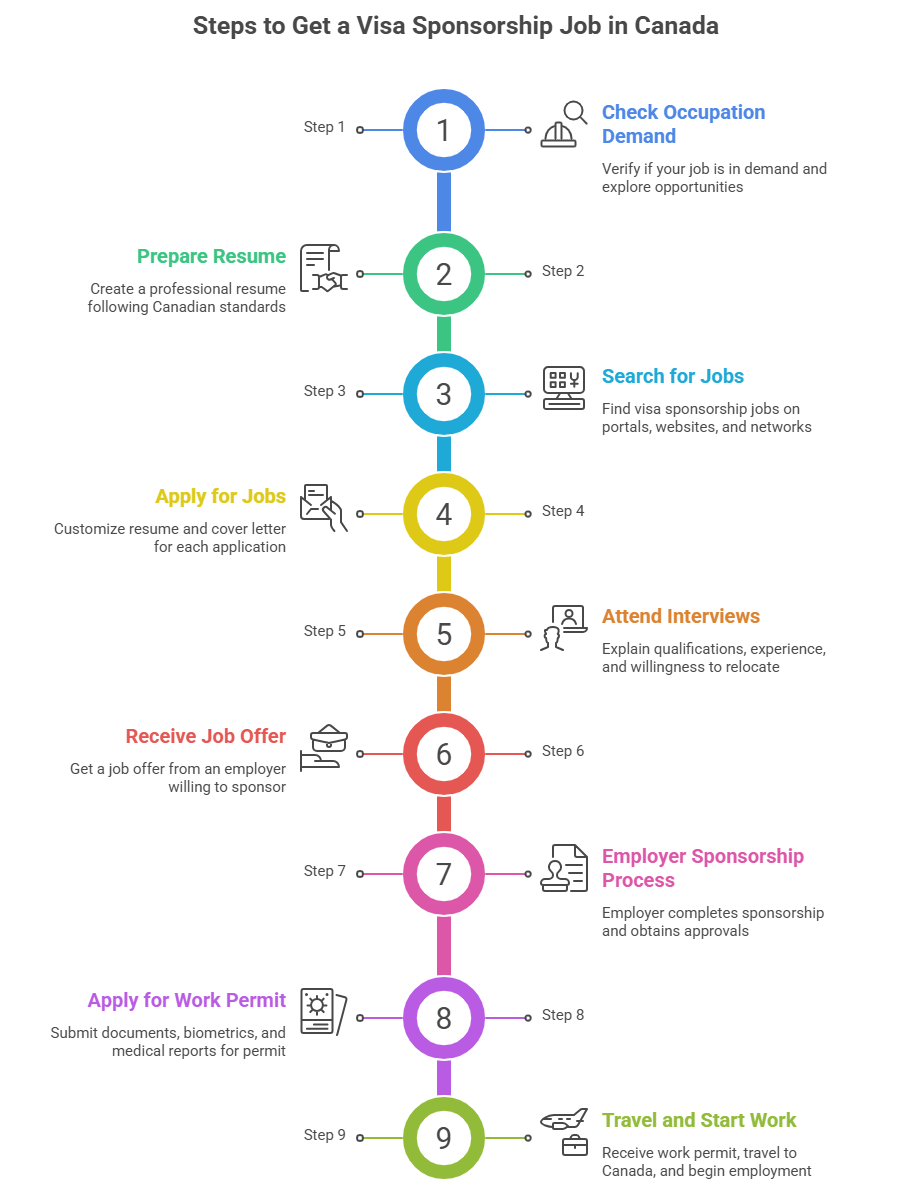
Follow the below steps to get a visa sponsorship jobs in Canada:
Step 1: Check whether your occupation is in demand in Canada and explore available job opportunities.
Step 2: Prepare a professional resume that follows Canadian standards and highlights your skills and work experience.
Step 3: Search for visa sponsorship jobs on job portals, company websites, and professional networking platforms.
Step 4: Apply for suitable jobs and customise your resume and cover letter for each application.
Step 5: Attend interviews and explain your qualifications, experience, and willingness to relocate to Canada.
Step 6: Receive a job offer from a Canadian employer willing to support your work permit application.
Step 7: The employer completes the required sponsorship process and obtains the necessary approvals, if applicable.
Step 8: Apply for your Canadian work permit and submit the required documents, biometrics, and medical reports if needed.
Step 9: Once your work permit is approved, travel to Canada and start working with your employer.
*Read more...
Can I apply for jobs in Canada from India?
Build a Successful Future in Canada with Visa Sponsorship Jobs
Canada remains one of the most promising destinations for skilled professionals seeking international career growth and long-term settlement opportunities. With thousands of job vacancies across industries such as healthcare, IT, engineering, construction, logistics, and skilled trades, visa sponsorship jobs provide a practical pathway for foreign workers to enter the Canadian labour market. By securing a job offer from a Canadian employer, candidates can obtain a work permit, gain valuable international experience, and potentially qualify for Permanent Residency through various immigration pathways. Understanding employer sponsorship requirements, LMIA processes, and eligibility criteria can significantly improve your chances of success. With the right qualifications, skills, and preparation, professionals can take advantage of Canada's strong demand for talent and build a rewarding career in one of the world's most welcoming and immigrant-friendly countries.
*Are you looking for step-by-step assistance with Canada Immigration? Contact Y-Axis, the world’s No. 1 overseas immigration consultancy!
FAQs
What are visa sponsorship jobs in Canada?
Visa sponsorship jobs in Canada are positions where a Canadian employer helps a foreign worker obtain a work permit. The employer typically applies for a Labour Market Impact Assessment (LMIA) under the Temporary Foreign Worker Program (TFWP), proving no qualified Canadian is available. After LMIA approval, the employer provides documents for the worker's work permit application. LMIA-exempt sponsorship is also possible via the International Mobility Program (IMP) for roles like Intra-Company Transfers, Global Talent Stream, and PGWP holders. Canada has 490,000 vacancies now and needs 8.1 million workers by 2033. Contact Y-Axis at 7670800000 for sponsorship job search support.
Can Indians get visa sponsorship jobs in Canada?
Yes. India is among the top source countries for skilled immigrants to Canada. Indian engineers, IT professionals, nurses, accountants, and tradespeople are in high demand. Indian candidates can apply through LMIA-supported work permits, Express Entry, Provincial Nominee Programs (PNP), and the Global Talent Stream (GTS).
Average salary in Canada is CAD $69,800 per year (₹48 lakh). IT roles pay CAD $90,000–$135,000; healthcare CAD $45,000–$131,000; and engineering CAD $75,000–$120,000. Strong English skills, relevant qualifications, and a Canadian-format resume significantly improve chances.
Which companies offer visa sponsorship jobs in Canada?
Major LMIA-approved and visa-sponsoring companies in Canada include:
- IT: Shopify, Amazon Canada, Google Canada, CGI Inc., Microsoft Canada, IBM Canada
- Banking & Finance: RBC, Scotiabank, TD Bank, BMO, CIBC, Manulife
- Oil & Gas: Suncor Energy, Enbridge, TC Energy, Shell Canada
- Construction: PCL Construction, EllisDon, Aecon, SNC-Lavalin
- Transport: Bison Transport, CN Rail, Canada Post, UPS, FedEx Canada
- Food Processing: Maple Leaf Foods, Olymel, McCain Foods, Saputo, Cargill
- Consulting: Deloitte, PwC, KPMG, Accenture, EY, McKinsey Canada
The Government of Canada Open Government Portal lists LMIA-approved employers publicly.
What is an LMIA and why is it important for visa sponsorship in Canada?
A Labour Market Impact Assessment (LMIA) is a government document issued to Canadian employers that confirms:
- A foreign worker is needed to fill the role
- No suitable Canadian citizen or permanent resident is available
A positive LMIA enables the employer to provide the worker with an LMIA number and job offer letter to apply for a work permit.
- The employer applies and pays for the LMIA
- Each LMIA is tied to a specific employer, role, and location
- A new LMIA may be needed when changing employers
- Genuine employers never ask workers to pay for an LMIA
What are the highest-paying visa sponsorship jobs in Canada?
| Occupation | Salary Range (CAD) |
| Anesthesiologist | CAD $300,000–$340,000 |
| Surgeon | CAD $250,000–$350,000 |
| Cardiologist | CAD $250,000–$276,000 |
| CTO / IT Director | CAD $150,000–$250,000 |
| Financial Controller | CAD $150,000–$189,000 |
| Senior Software Engineer | CAD $130,000–$165,000 |
| Data Scientist | CAD $110,000–$145,000 |
What is the Global Talent Stream and how does it help Indians?
The Global Talent Stream (GTS) is an LMIA-exempt pathway under the International Mobility Program that allows Canadian employers to hire highly skilled tech and STEM professionals with work permit decisions in as little as 2 weeks.
- Category A – Referred by a designated Canadian partner for specialized roles
- Category B – Occupations listed on the Global Talent Occupations List
This pathway is especially useful for software engineers, data scientists, cloud engineers, and cybersecurity professionals.
Can visa sponsorship lead to Permanent Residency in Canada?
Yes. Sponsored work permits can lead to Canadian PR through:
- Canadian Experience Class (CEC)
- Provincial Nominee Program (PNP)
- Atlantic Immigration Program (AIP)
- Rural and Northern Immigration Pilot (RNIP)
- Agri-Food Pilot
After one year of Canadian work experience, many workers become eligible for permanent residence pathways.
Which jobs are easiest to get in Canada with visa sponsorship?
The easiest visa sponsorship jobs to obtain in Canada include:
- Registered Nurses
- Personal Support Workers (PSWs)
- Truck Drivers
- Heavy Equipment Operators
- Food Packers
- Machine Operators
- Kitchen Staff
- Food Service Supervisors
- Carpenters
- Electricians
- Plumbers
- Welders
These occupations face persistent labour shortages across Canada and frequently offer employer sponsorship opportunities.
📞 Call: +91-7670800000
📩 Email: info@y-axis.com
🌐 Visit: https://www.y-axis.com
Tags:
Visa sponsorship jobs in Canada 2026
Canada LMIA jobs for Indians
LMIA approved employers Canada
Canada employer sponsored work permit
How to get a sponsored job in Canada
Canada PR through job sponsorship
Global Talent Stream Canada
Share
Options for you by Y-Axis

Get it on your mobile

Get News alerts

Contact Y-Axis
Latest Article
Popular Post
Trending Article
Posted On October 22 2026
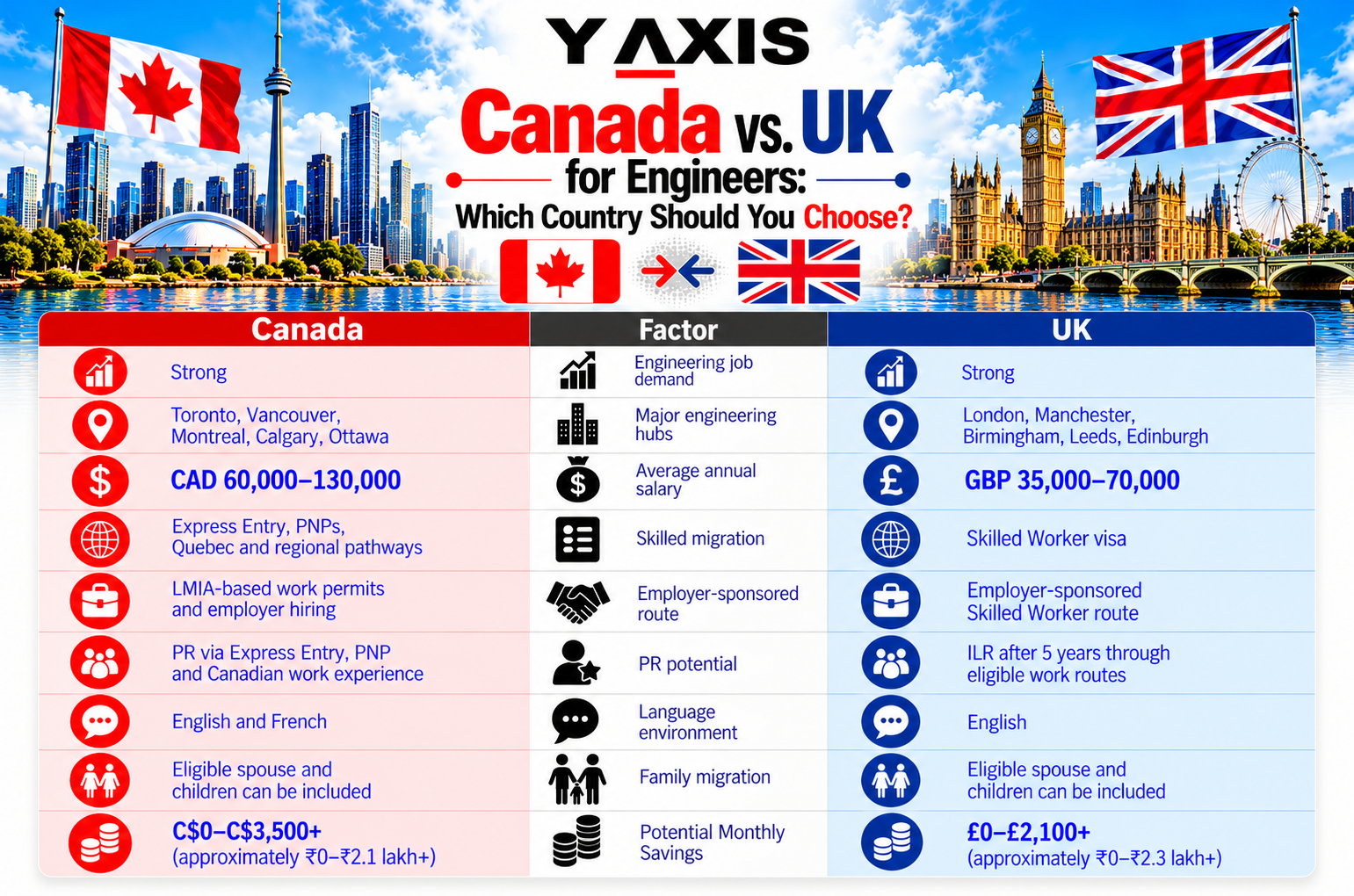
Canada vs. UK for Engineers: Which Country Should You Choose?