

Posted on October 29 2026
UK–India Research Partnership: What the £3 Million Agreement Could Mean for Scientists

By , Editor & Director
Updated October 31 2026
~ Dr. Serah Vinodini Vilvaraj
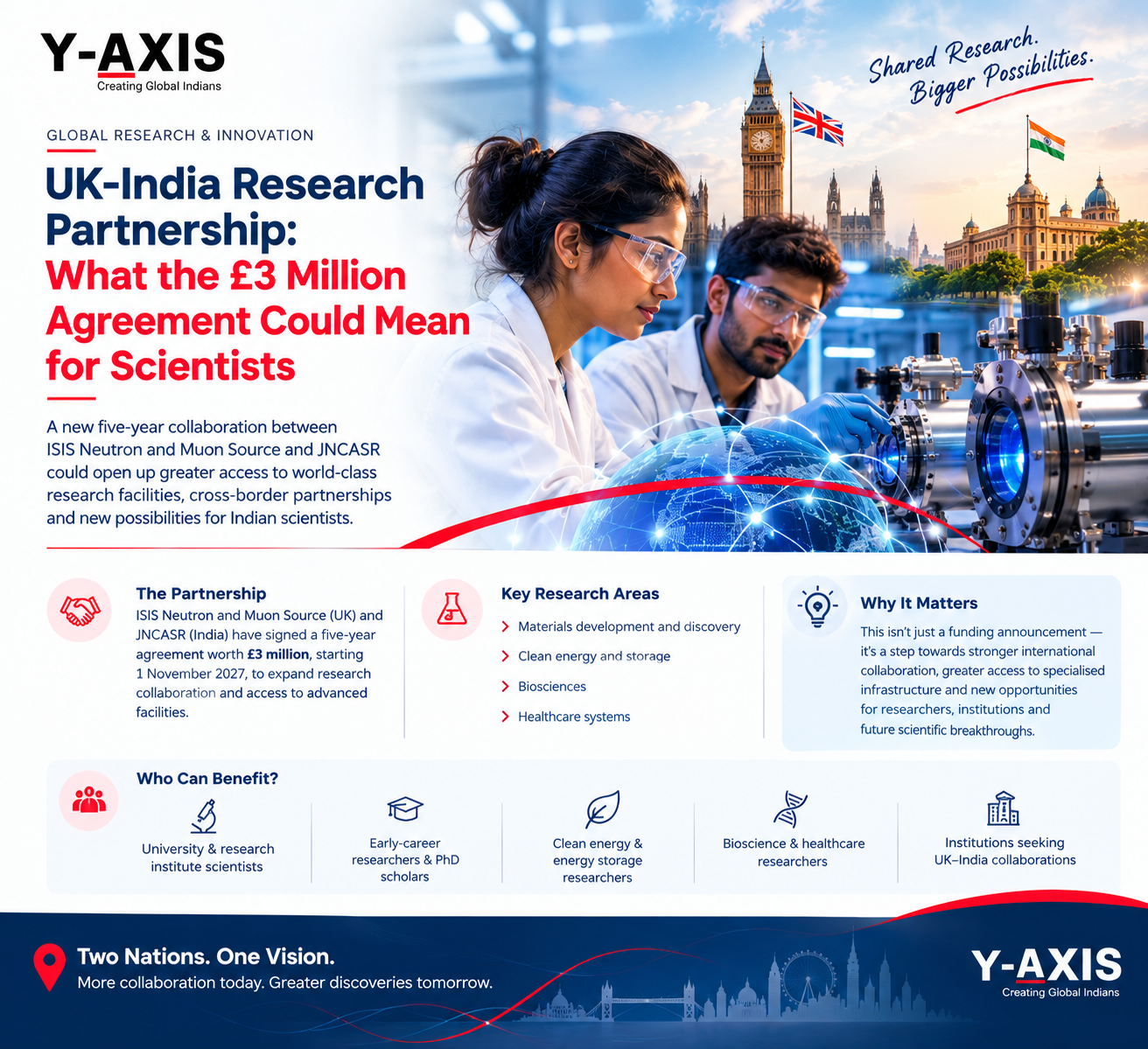
A breakthrough in battery technology, a new material that makes clean energy more efficient, or research that improves how medicines work can begin with a question that existing laboratories cannot fully answer. For scientists, access to the right equipment and international expertise can make the difference between an idea and a discovery. A new £3 million UK–India research agreement aims to strengthen that connection by expanding collaboration between Indian researchers and the ISIS Neutron and Muon Source, a major UK research facility. Signed by ISIS and the Jawaharlal Nehru Centre for Advanced Scientific Research (JNCASR), acting on behalf of India's Department of Science and Technology, the five-year agreement is scheduled to begin on 1 November 2027.
The partnership is designed to support research across areas including clean-energy materials, energy storage, biosciences and healthcare systems. It will also broaden participating institutions and UK–India scientific collaborations. For researchers, the significance goes beyond a bilateral announcement. It highlights how international partnerships can give scientists access to specialised infrastructure, expertise and research networks that may not be available through their home institutions alone. But this is not a newly announced scholarship or an open work-visa programme. The important question is how eligible research teams may be able to participate, what the agreement is expected to support, and what scientists should monitor before making plans.
What has the UK–India agreement announced?
The agreement was announced on 12 October 2026 at the eighth UK–India Science and Innovation Council meeting in Delhi. ISIS published details the following day.
The main details are:
|
Key detail |
What has been announced |
|
UK research facility |
ISIS Neutron and Muon Source |
|
Indian research partner |
Jawaharlal Nehru Centre for Advanced Scientific Research (JNCASR) |
|
Indian government body represented |
Department of Science and Technology (DST) |
|
Investment |
£3 million |
|
Duration |
Five years |
|
Start date |
1 November 2027 |
|
Research focus |
Materials development and discovery, clean energy and storage, biosciences and healthcare systems |
|
Wider objective |
Broader institutional participation and stronger UK–India research collaboration |
The agreement builds on an earlier ISIS–JNCASR partnership that supported collaboration between 2017 and 2023. According to ISIS, that programme increased the number of Indian researchers using the facility and supported training, career development and scientific outputs. The new phase is intended to broaden those activities and expand India's participation in the ISIS research programme.
Why does access to a UK research facility matter?
ISIS is located at the Rutherford Appleton Laboratory near Oxford, England. It uses neutron and muon techniques to investigate materials at the atomic scale, helping scientists understand their structure, properties and behaviour. That may sound highly specialised, but the applications extend into areas with real-world consequences.
Clean energy and battery development: Researchers can investigate the properties of materials used in energy storage, helping them understand how materials behave and how they might be improved.
Healthcare and biosciences: Neutron and muon techniques can contribute to studies of biological materials, pharmaceuticals and systems relevant to health research.
Advanced materials and engineering: Understanding materials at a microscopic level can help scientists investigate metals, polymers, catalysts and other substances used in industrial and technological applications.
ISIS operates a suite of 35 neutron and muon instruments and supports an international research community of more than 3,000 scientists. Access to this kind of infrastructure can complement the capabilities available at a researcher's home institution. For a research team, the potential benefit is not simply travelling to another country. It is being able to conduct experiments, work with specialist scientists and develop findings that could support further research, publications or technological applications.
Who could benefit from the new partnership?
The agreement is intended to support researchers from across India, with wider participation by institutions and research teams. The groups most likely to find the announcement relevant include:
- University and research-institute scientists whose projects require advanced materials characterisation or neutron and muon techniques.
- Early-career researchers and doctoral scientists working with established research teams in relevant fields.
- Clean-energy and energy-storage researchers investigating materials for batteries and other energy technologies.
- Bioscience and healthcare researchers whose experimental work could benefit from specialised facilities.
- Research institutions seeking UK collaborations to strengthen international projects, technical expertise and scientific networks.
However, the agreement does not mean that every scientist in these fields will receive funding or access automatically. Researchers will need to establish whether their proposed work fits the partnership's arrangements and the facility's access requirements. No general individual application scheme, scholarship allocation or guaranteed placement has been announced in the public announcement. Researchers should therefore wait for specific guidance from ISIS, JNCASR or the relevant Indian authorities before treating the agreement as an application opportunity.
Can Indian researchers apply to work in the UK through this agreement?
Not on the basis of the announcement alone. The agreement supports scientific collaboration and access to research infrastructure. It does not establish a new immigration route, guarantee a paid UK position or provide an automatic right to live and work in Britain.
Researchers interested in participating should distinguish between three possible opportunities:
1. Access to research facilities: A research team may seek permission to use ISIS instruments for a suitable scientific experiment through the relevant access arrangements.
2. Collaborative research: Scientists and institutions may work together on projects that combine expertise and resources across the two countries.
3. Employment or funded placements: These require specific positions, fellowships or funding arrangements to be announced separately; the £3 million agreement should not be interpreted as a promise of individual jobs.
Anyone who needs to travel to the UK must also check the appropriate immigration permission for their actual activities. Research access and a research collaboration do not, by themselves, determine which visa or permission is required.
What should researchers do before the programme begins?
The agreement starts in November 2027, so researchers have time to identify suitable projects and monitor announcements.
1. Check whether the research requires ISIS facilities. Review the scientific question, the techniques needed and whether the facility offers the relevant instruments.
2. Speak to the appropriate research or instrument team. ISIS advises prospective users to consult relevant instrument scientists before submitting proposals.
3. Monitor the official access guidance. ISIS has published a general schedule for its future facility-access calls. The next call is scheduled for March 2027, with an April deadline for access between November 2027 and March 2028. However, this general call should not be assumed to be the application mechanism for the new India-specific agreement.
4. Contact the relevant Indian research institution or funding authority. JNCASR and India's Department of Science and Technology are important sources to monitor for programme-specific arrangements.
5. Prepare a clear scientific case. Researchers should be ready to explain their research question, why the specialised facility is necessary, what experiments they propose and how the results could contribute to their field.
Why this matters beyond the UK and India
International research partnerships can influence more than the institutions that sign them. Scientific discoveries often depend on collaboration across borders, access to specialised equipment and the exchange of expertise. For India, the partnership creates a framework for expanding the participation of domestic researchers in an international research facility. For the UK, it strengthens an established scientific relationship and brings research projects and expertise from Indian institutions into the wider ISIS community. The potential benefits also extend to students and early-career scientists who may build professional relationships through collaborative projects. Such experience can help researchers develop their scientific capabilities and international networks, although individual career outcomes will depend on the opportunities available to them.
The real value of the agreement will depend on how effectively it translates funding and access into research opportunities. The announcement establishes the partnership's direction and financial commitment; the next important developments will be the programme details, participation arrangements and research projects that emerge from it. For scientists considering international collaboration, the message is clear: the opportunity to watch is not an automatic route to a UK job or visa, but a developing research partnership that may create new ways for eligible teams to work across borders.
Official Sources
- ISIS Neutron and Muon Source: ISIS–JNCASR sign a new agreement for UK–Indian scientific collaboration — 13 October 2026.
- ISIS Neutron and Muon Source: Direct access and future application calls.
- ISIS Neutron and Muon Source: International research partnerships.
FAQs
1. What is the new UK–India research agreement?
ISIS Neutron and Muon Source and JNCASR, acting on behalf of India's Department of Science and Technology, have signed a five-year agreement worth £3 million to expand UK–India scientific collaboration. It is scheduled to begin on 1 November 2027.
2. Which research areas will the partnership support?
The announced areas include materials development and discovery, materials for clean energy and storage, biosciences and healthcare systems. The wider programme is intended to broaden research participation and institutional collaboration.
3. Can Indian scientists apply directly for the £3 million funding?
The public announcement does not establish a general direct-application scheme for individual researchers. Scientists should monitor ISIS, JNCASR and the Department of Science and Technology for specific participation and funding guidance.
4. Does the agreement offer UK jobs or research visas?
No new job or visa route has been announced under this agreement. It supports research collaboration and access to scientific infrastructure. Any employment, fellowship or travel arrangement would have its own conditions.
5. When does the agreement begin?
The five-year agreement is scheduled to begin on 1 November 2027.
6. How can researchers prepare to participate?
Researchers can identify projects suited to ISIS facilities, consult relevant instrument scientists, monitor official access calls and contact their research institutions about partnership-specific arrangements.
7. Is this opportunity open to researchers from every country?
The new agreement specifically expands the participation of researchers from across India in the UK facility. ISIS has a wider international user community, but eligibility for any particular partnership or access route must be confirmed through its official rules.
Tags:
UK India Research Partnership
Indian Scientists
UK Research Opportunities
ISIS Neutron and Muon Source
JNCASR
Department of Science and Technology
International Research Collaboration
Clean Energy Research
Scientific Careers
Global Indian
Share
Options for you by Y-Axis

Get it on your mobile

Get News alerts

Contact Y-Axis
Latest Article
Popular Post
Trending Article

Posted On November 02 2026
France Reduces Work Permit Restriction to 6 Months and Residence Decisions to 90 Days