

Posted on April 28 2026
Top 10 Countries for AI Specialists to Work Abroad: Salary, Demand & PR Opportunities Compared

By , Editor & Director
Updated May 02 2026
Top 10 Countries for AI Specialists to Work Abroad: Salary, Demand & PR Opportunities Compared
The global demand for Artificial Intelligence professionals is actively growing across countries like Canada, UK, Germany, New Zealand, and Japan, among others. AI specialists, including machine learning engineers, data scientists, AI researchers, NLP engineers, computer vision experts, and AI product managers, are being recruited by top companies across North America, Europe, and the Asia-Pacific region. While countries like Canada and the United States offer direct immigration pathways and the highest salary potential, Germany and the UK have created fast-track visa routes specifically targeting AI and tech talent. Demand for AI talent is being driven by national AI strategies, enterprise digital transformation, and the rapid expansion of AI infrastructure across every major economy.
Quick Facts: Best Countries for AI Specialists from India
- Highest Salary: USA (up to INR 2.16 Cr per year)
- Fastest PR: Canada (1–3 years via Express Entry)
- Easiest Visa: UAE (Employer visa processed in 5–10 business days)
- Best for Indians: Canada and Australia (strong Indian tech communities, IIT/NIT credentials accepted)
- Best for AI Research: USA and Germany (the highest concentration of AI labs and research institutions)
*Want to work abroad as an AI specialist? Let Y-Axis assist you with the process.
Top 10 Countries Hiring Indian AI Specialists: Key Pathways at a Glance
Indian AI professionals are in active demand across Canada, the United States, Germany, Australia, the UK, Singapore, and the UAE. National AI strategies, including Canada's Pan-Canadian AI Strategy, Germany's National AI Strategy 2030, and the UAE's National AI Strategy 2031, are driving unprecedented hiring across both the public and private sectors. Beyond immigration pathway availability, salary potential and long-term settlement options are the primary factors when choosing the right country to relocate abroad as an AI professional.
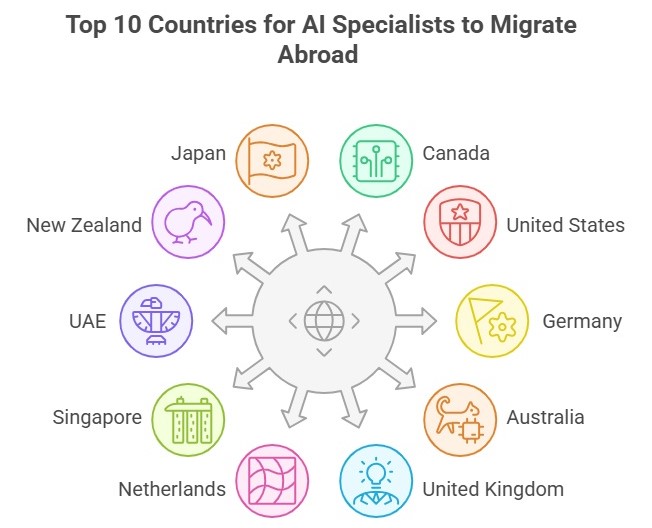
| Country | Why Top Destination | Top Cities / Tech Hubs | In-Demand AI Roles | Fast-Track Hiring | PR / Long-Term Options |
|---|---|---|---|---|---|
| Canada | Pan-Canadian AI Strategy; Vector Institute; Mila Quebec AI Institute | Toronto, Montreal, Vancouver, Ottawa, Calgary | ML Engineer, Data Scientist, AI Researcher, NLP Engineer | Express Entry; PNP Tech Streams | PR in 1–3 years; citizenship after 3 years |
| USA | Highest AI salaries; global AI leader | San Francisco, Seattle, New York, Austin, Boston | AI/ML Engineer, Deep Learning Researcher | H-1B; O-1A; EB-2 NIW | Green Card 5–15 years |
| Germany | AI Strategy 2030; strong industrial AI demand | Munich, Berlin, Hamburg, Frankfurt | AI Engineer, ML Engineer, Robotics AI | EU Blue Card; Chancenkarte | PR in 4 years |
| Australia | AI in mining, healthcare, agriculture | Sydney, Melbourne, Brisbane | Data Scientist, AI Engineer | 482 Visa; 189/190 PR | PR in 2–4 years |
| UK | AI Action Plan; government-backed AI growth | London, Cambridge, Manchester | ML Engineer, AI Scientist | Global Talent Visa | ILR in 3–5 years |
| Singapore | Smart Nation; finance AI hub | Marina Bay, One-North | AI Engineer, Data Scientist | Employment Pass; Tech.Pass | PR in 2–5 years |
| UAE | AI Strategy 2031; tax-free salaries | Dubai, Abu Dhabi | AI Engineer, ML Specialist | Golden Visa | 10-year visa; no PR |
| New Zealand | Growing AI ecosystem; agritech focus | Auckland, Wellington | AI Developer, Data Scientist | AEWV; Green List | PR in 2–5 years |
| Japan | Society 5.0; robotics leadership | Tokyo, Osaka | AI Engineer, Robotics Specialist | J-Skip Visa | PR in 10 years |
*Want to get your resume noticed by international AI employers? Avail Y-Axis Resume Marketing Services to find the right role.
AI Specialist Salary Comparison: How Much Can You Earn Abroad? [2025–2026]
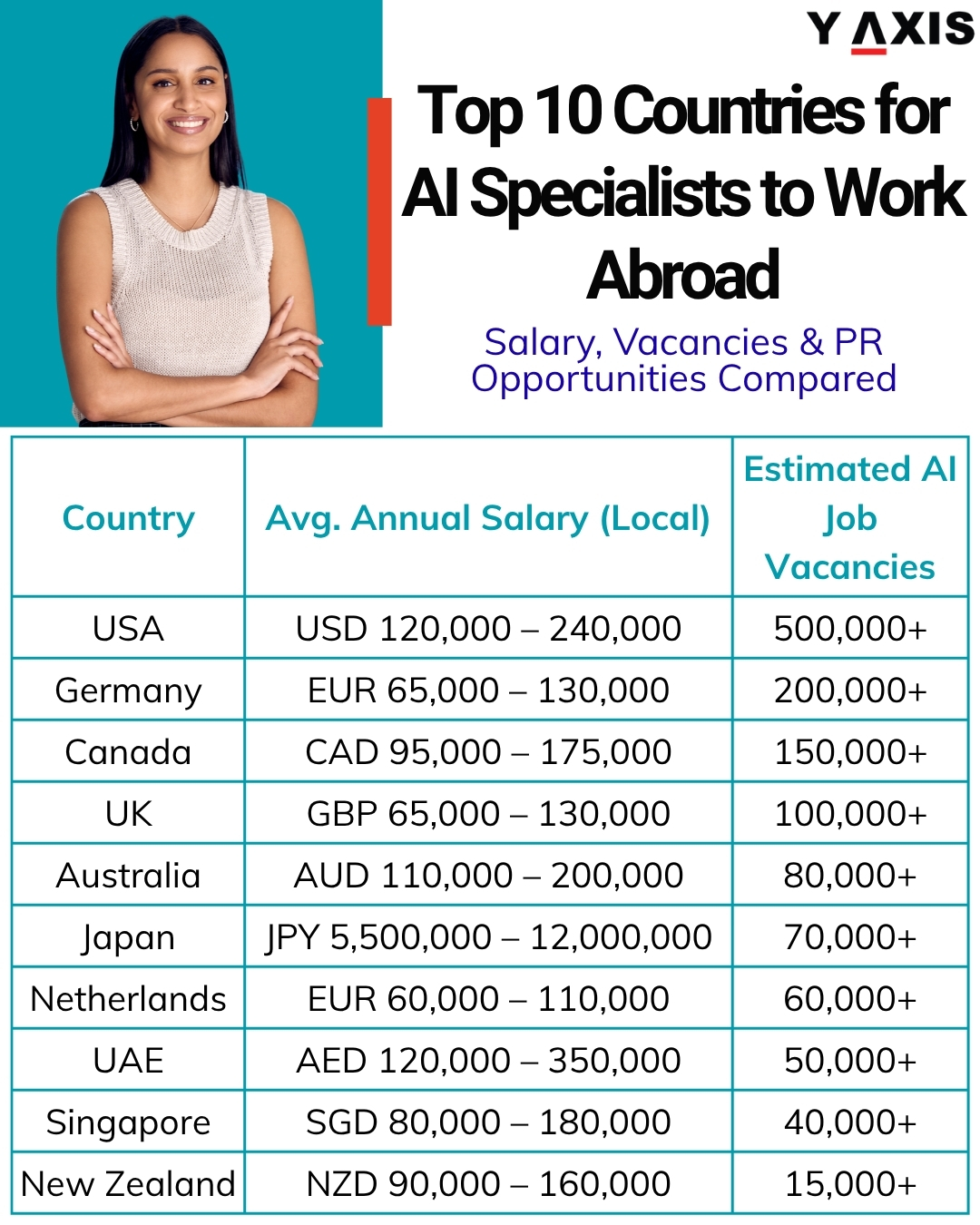
Top countries, including the USA, Canada, Germany, and the UK are actively competing for AI talent due to a global shortage of qualified AI professionals. While the USA offers the highest absolute salaries, countries like Germany and the Netherlands offer strong purchasing power when adjusted for cost of living. Canada and Australia provide a balance of high wages, direct PR pathways, and a large Indian professional community.
| Country | Avg. Annual Salary (Local) | Approx. Annual Salary (INR) | Difficulty Rating | Min. Language Score | Estimated AI Job Vacancies |
|---|---|---|---|---|---|
| United States (USA) | USD 120,000 – 240,000 | ₹1,08,84,000 – ₹2,17,68,000 | High (H-1B lottery) | None (employer preference) | 500,000+ |
| Canada | CAD 95,000 – 175,000 | ₹62,70,000 – ₹1,15,50,000 | Moderate | CLB 7 (IELTS ~6.0) | 150,000+ |
| Germany | EUR 65,000 – 130,000 | ₹69,42,000 – ₹1,38,84,000 | Moderate | A2–B1 German (some roles English) | 200,000+ |
| Australia | AUD 110,000 – 200,000 | ₹59,40,000 – ₹1,08,00,000 | Moderate | IELTS 6.0 | 80,000+ |
| United Kingdom (UK) | GBP 65,000 – 130,000 | ₹68,25,000 – ₹1,36,50,000 | Moderate | B1–B2 English | 100,000+ |
| Netherlands | EUR 60,000 – 110,000 | ₹64,08,000 – ₹1,17,48,000 | Moderate | Dutch/English preferred | 60,000+ |
| Singapore | SGD 80,000 – 180,000 | ₹49,60,000 – ₹1,11,60,000 | Moderate | English (official language) | 40,000+ |
| UAE | AED 120,000 – 350,000 | ₹27,60,000 – ₹80,50,000 | Easy | None (English widely used) | 50,000+ |
| New Zealand | NZD 90,000 – 160,000 | ₹45,90,000 – ₹81,60,000 | Easy–Moderate | IELTS 6.5 | 15,000+ |
| Japan | JPY 5,500,000 – 12,000,000 | ₹29,70,000 – ₹64,80,000 | Moderate | N4/N3 Japanese or English (SSW-2) | 70,000+ |
*Not sure which country suits your AI profile? Sign Up with Y-Axis for end-to-end assistance.
Which Country is Best for Indian AI Specialists? [2025–2026 Comparison]
Choosing the right country depends on your specific AI role, salary expectations, and long-term settlement goals. Here is a direct comparison matrix for Indian AI professionals making the decision in 2025–2026.
| Factor | Canada | USA | Germany | Australia | UK |
|---|---|---|---|---|---|
| PR Timeline | 1–3 years | 5–15 years | 4 years | 2–4 years | 3–5 years |
| Avg. Salary (INR) | ₹62–115 LPA | ₹109–218 LPA | ₹69–139 LPA | ₹59–108 LPA | ₹68–137 LPA |
| Language Requirement | English (CLB 7) | None mandatory | A2 German minimum | IELTS 6.0 | B2 English |
| Family Work Rights | Yes (open work permit for spouse) | Limited (H-4 EAD) | Yes (immediate work rights) | Yes | Yes |
| Indian Community | Very large | Very large | Growing | Large | Large |
| IIT/NIT Credentials Accepted | Yes | Yes | Yes (assessed) | Yes (assessed) | Yes |
AI Specialist Qualifications Recognition: Country-by-Country Guide
Understanding how each country assesses your Indian AI credentials is critical before you apply. Indian professionals holding degrees from IITs, NITs, BITS Pilani, tier-1 private engineering universities, or NSDC-affiliated programmes are generally eligible for recognition across most major destinations.
| Country | Assessment Authority | Credentials Accepted from India | Notes |
|---|---|---|---|
| Canada | WES (World Education Services); provincial universities | IIT, NIT, BITS, and equivalent B.Tech/M.Tech/PhD | No separate tech skills assessment needed; Educational Credential Assessment (ECA) required |
| Australia | ACS (Australian Computer Society) | B.Tech CS/IT, M.Tech, MCA, BCA (case-by-case) | ACS assessment mandatory for most tech visa categories |
| Germany | Anabin / ZAB (Central Office for Foreign Education) | IIT and NIT degrees pre-approved; others assessed case-by-case | Recognition Partnership allows work before full assessment |
| UK | UK ENIC (formerly NARIC) | IIT, NIT, BITS recognised at Bachelor level or above | Global Talent Visa assesses portfolio, not just credentials |
| New Zealand | NZQA (New Zealand Qualifications Authority) | B.Tech/B.E. from recognised Indian institutions | Green List tech roles often don’t require NZQA assessment |
| Singapore | MOM (Ministry of Manpower) | IIT/NIT widely accepted by employers | No formal credential assessment; employer-driven evaluation |
| UAE | UAE Embassy attestation | All degrees require attestation via MEA (India) and UAE Embassy | No specific AI/tech skills assessment body |
Jobs for AI Specialists in Canada
Canada is one of the top global hubs for artificial intelligence research and talent. It has severalworld-class institutions such as the Vector Institute in Toronto, Mila Quebec AI Institute in Montreal, and the Alberta Machine Intelligence Institute (Amii) in Edmonton. Machine learning engineers, data scientists, NLP specialists, and AI researchers are among the most in-demand occupations in Canada, actively sought by both global tech companies and Canadian-grown AI startups. The job market in Canada across provinces like Ontario, British Columbia, and Quebec offer competitive salaries, employer sponsorship, and direct PR pathways for Indian professionals.
Watch: Canada Immigration Update April 2026 | 8 Major Changes Explained
Stay updated with the latest Canada immigration changes in April 2026, including key policy updates, eligibility shifts, and what it means for applicants.
| Factor | Details |
|---|---|
| Program | Federal Skilled Worker Program (FSWP); Canadian Experience Class (CEC); Tech PNP Streams |
| In-Demand AI Roles | Machine Learning Engineer, Data Scientist, AI Research Scientist, NLP Engineer, Computer Vision Specialist, AI Product Manager, Data Engineer, Robotics Software Engineer, AI Ethics Analyst, Cloud AI Architect |
| Work Visa Options | Express Entry (FSWP, CEC); Provincial Nominee Program (PNP) — Ontario Tech; BC Tech Pilot; LMIA-backed Work Permit; Intra-Company Transfer |
| Required Qualifications | IIT, NIT, BITS or equivalent B.Tech/M.Tech/PhD in CS/AI/Data Science; WES Educational Credential Assessment (ECA); CLB 7 English (IELTS ~6.0); minimum 1 year skilled work experience |
| Fast-Track Hiring | IRCC category-based Express Entry draws (STEM); Ontario Tech Stream (OINP); BC PNP Tech Pilot; AI-focused talent attraction under Pan-Canadian AI Strategy |
| Long-Term Stay Options | PR via Express Entry or PNP in 1–3 years; Canadian citizenship after 3 years of permanent residence |
| Family Sponsorship | Spouses eligible for open work permits; dependent children eligible for free public schooling |
*Want to apply for a Canada work visa? Let Y-Axis guide you with the process.
Jobs for AI Specialists in the USA
The United States remains the world's largest employer of AI specialists, with Silicon Valley, Seattle, New York, and Boston hosting many AI companies, research labs, and startups globally. AI/ML engineers, deep learning researchers, AI product managers, and data scientists are among the highest-paying jobs in the USA. Investment in AI infrastructure including data centres, autonomous systems, and generative AI platforms is steadily generating sustained demand across the US job market. Indian professionals, including IIT and NIT graduates, are among the most represented international tech talent in the USA.
Watch: US Visa Success Story | How I Got My US Visa with Y-Axis Support
Discover a real success story of securing a US visa with expert guidance, including key steps, tips, and insights for applicants.
| Factor | Details |
|---|---|
| Program | H-1B Specialty Occupation Visa; O-1A Extraordinary Ability Visa; EB-2 National Interest Waiver (NIW); EB-1A |
| In-Demand AI Roles | AI/ML Engineer, Deep Learning Researcher, LLM Engineer, Generative AI Specialist, Data Scientist, Computer Vision Engineer, AI Product Manager, Robotics Engineer, NLP Scientist, AI Infrastructure Engineer |
| Work Visa Options | H-1B (annual lottery, cap 85,000); O-1A (no cap); L-1A (intra-company transfer); EB-2 NIW (self-petition); TN Visa (for Canadians & Mexicans) |
| Required Qualifications | Bachelor’s degree (minimum) in CS/AI/Statistics or related field; H-1B requires employer sponsorship; O-1A requires proof of extraordinary achievements; EB-2 NIW requires advanced degree and national interest justification |
| Fast-Track Hiring | O-1A (no lottery, fastest for top talent); EB-2 NIW (no employer needed); major tech companies run global hiring pipelines |
| Long-Term Stay Options | Green Card via EB-2/EB-1 (5–15+ years backlog for Indian applicants); O-1A → EB-1A pathway; US citizenship after 5 years of Green Card |
| Family Sponsorship | H-4 visas for dependents; H-4 EAD for eligible spouses; Green Card holders can sponsor spouse and children under 21 |
*Want to apply for a USA work visa? Connect with Y-Axis for expert guidance.
Jobs for AI Specialists in Germany
Germany is accelerating its AI ambitions under the National AI Strategy 2030. The German government has investment about €5 billion for AI research, infrastructure, and talent. The Deutsche Forschungszentrum für Künstliche Intelligenz (DFKI) — one of the world's largest AI research centres is based in Germany. Other major employers including SAP, BMW, Siemens, Bosch, and Deutsche Telekom, running large-scale AI hiring programmes offer some of the highest-paying jobs in Germany. AI engineers, machine learning specialists, and data scientists are among the most in-demand jobs in Germany, with the newly updated Skilled Immigration Act (FEG) and the Work and Stay Agency (WSA, launched 2026) significantly simplifying the path for Indian professionals to work in Germany's job market.
| Factor | Details |
|---|---|
| Program | Skilled Immigration Act (FEG); EU Blue Card; Chancenkarte (Opportunity Card); Recognition Partnership Visa |
| In-Demand AI Roles | Machine Learning Engineer, AI Research Scientist, Data Scientist, NLP Engineer, Computer Vision Engineer, Robotics AI Developer, AI Software Architect, Data Engineer, AI Product Specialist, Autonomous Systems Engineer |
| Work Visa Options | Skilled Worker Visa; EU Blue Card (salary threshold applies); Chancenkarte (job seeker visa); Recognition Partnership Visa (start work before full recognition) |
| Required Qualifications | IIT, NIT, BITS or equivalent B.Tech/M.Tech in AI/CS/Data Science; degree recognition via Anabin or ZAB; A2–B1 German preferred (English accepted in many roles); EU Blue Card salary threshold ~EUR 43,800/year |
| Fast-Track Hiring | Work and Stay Agency (WSA) reduces processing time; Recognition Partnership allows early work start; India–Germany recruitment agreements; employer-led global hiring |
| Long-Term Stay Options | Permanent Residence after 4 years; EU Blue Card → PR in 21–27 months (with B1 German); citizenship possible after 5 years |
| Family Sponsorship | Spouses and children eligible; spouses can work immediately; children get free public education; integration support available |
*Want to apply for a Germany work visa? Let Y-Axis help you with the process.
Jobs for AI Specialists in Australia
Australia's National AI Centre (NAIC) and the government's $41.2 million AI investment under the National AI Strategy are driving sustained demand for AI professionals. The country has a high demand for AI specialists across healthcare, mining, agriculture, and financial services. Data scientists, AI/ML engineers, and NLP researchers are listed under the Core Skills Occupation List (CSOL), making them the most in-demand jobs in Australia. The Australian Computer Society (ACS) is the primary skills assessment body for Indian IT and AI professionals, and IIT, NIT, and equivalent Indian degrees which are widely recognised across the Australian job market.
| Factor | Details |
|---|---|
| Program | ACS Skills Assessment; Core Skills Occupation List (CSOL); Skills in Demand Visa (Subclass 482) |
| In-Demand AI Roles | Data Scientist, Machine Learning Engineer, AI/ML Research Scientist, NLP Engineer, AI Systems Analyst, Data Engineer, AI Ethics Analyst, Computer Vision Developer, Robotics Software Engineer, AI Product Manager |
| Work Visa Options | 482 Skills in Demand Visa (Core Skills Stream); 189 Skilled Independent Visa; 190 Skilled Nominated Visa; 491 Skilled Work Regional Visa; 186 Employer Nomination Scheme |
| Required Qualifications | IIT, NIT, BITS or equivalent B.Tech/M.Tech/MCA; ACS skills assessment required; IELTS 6.0 or equivalent; occupation listed on CSOL; minimum 1 year relevant experience for Subclass 482 |
| Fast-Track Hiring | State nomination (Subclass 190/491); employer-sponsored Subclass 482 (faster processing); regional sponsorship adds extra points; state tech streams (NSW, Victoria, Queensland) |
| Long-Term Stay Options | 189/190 → direct PR in 2–4 years; 491 → 191 PR after 3 years; 482 → 186 PR after 2 years with same employer |
| Family Sponsorship | Spouse and children can be included; spouse gets full work rights; dependents can accompany the primary applicant |
*Want to apply for an Australia work visa? Let Y-Axis assist you with the process.
Jobs for AI Specialists in the United Kingdom
The UK job market has positioned itself as a global AI superpower through the AI Action Plan 2025. This is a £14 billion private sector AI investment commitment, by the UK AI Safety Institute. Roles including machine learning engineer, AI research scientist, data engineer, and AI product lead are among the highest-paying jobs in the UK tech sector. The Global Talent Visa — specifically the Tech Nation-endorsed pathway — offers a fast and employer-independent immigration route for exceptional Indian AI professionals. The UK Government's Frontier AI Taskforce and partnerships with DeepMind, Wayve, and leading UK universities are generating sustained AI hiring demand.
| Factor | Details |
|---|---|
| Program | Global Talent Visa (Tech/AI); Skilled Worker Visa; Innovator Founder Visa |
| In-Demand AI Roles | ML Engineer, AI Research Scientist, Data Scientist, NLP Engineer, AI Product Manager, Generative AI Developer, AI Policy Analyst, Computer Vision Specialist, Data Engineer, AI Governance Lead |
| Work Visa Options | Global Talent Visa (no job offer; endorsed by DSIT/Royal Academy); Skilled Worker Visa (employer-sponsored); Innovator Founder Visa; Scale-up Visa |
| Required Qualifications | Global Talent: proven leadership/emerging talent (awards, publications, salary, OSS, talks); Skilled Worker: UK sponsor job offer; CS/AI degree; B2 English (from 2026) |
| Fast-Track Hiring | Global Talent (no cap, no employer); Skilled Worker CoS ~3 months; Tech Nation fast-track endorsement for Exceptional Promise |
| Long-Term Stay Options | Global Talent → ILR in 3–5 years; Skilled Worker → ILR in 5 years; citizenship after 6 years total residence |
| Family Sponsorship | Spouses and children can accompany; spouses have full work rights; children eligible for state schooling |
*Want to apply for a UK work visa? Contact Y-Axis to guide you with the steps.
Jobs for AI Specialists in the Netherlands
The Netherlands job market is influenced by ELLIS Amsterdam which is one of Europe's most prestigious AI research institutes. The European AI Act compliance hub makes AI specialists as one of the high demand roles in Netherlands across tech, financial services, and agritech sectors. Employers including ASML, Booking.com, Philips, and ING are running active international AI hiring programmes. AI researchers, data scientists, and ML engineers are among the most in-demand occupations in the Netherlands, with the Highly Skilled Migrant Visa offering a streamlined pathway for non-EU professionals.
| Factor | Details |
|---|---|
| Program | Highly Skilled Migrant Visa (Kennismigrant); EU Blue Card; Single Permit (GVVA) |
| In-Demand AI Roles | AI Research Scientist, Machine Learning Engineer, Data Scientist, NLP Developer, AI Software Engineer, Computer Vision Specialist, Data Engineer, AI Ethics Researcher, Autonomous Systems Developer, Quantitative Analyst (AI) |
| Work Visa Options | Highly Skilled Migrant (HSM) via IND-recognised sponsor; EU Blue Card (higher salary roles); Single Permit (GVVA); Orientation Year Permit (for Dutch graduates) |
| Required Qualifications | Degree in CS/AI/Data Science/Math; IND-recognised sponsor required; salary threshold ~EUR 5,008/month (<30) or ~EUR 6,245/month (30+); Dutch or English preferred |
| Fast-Track Hiring | IND sponsors process in ~5 weeks; major firms (ASML, Booking.com, Philips, Adyen) run global hiring; EU Blue Card shortage thresholds may reduce salary requirements |
| Long-Term Stay Options | Permanent Residence after 5 years; EU Long-Term Resident status enables mobility across EU; citizenship after long-term residence |
| Family Sponsorship | Spouses and children can join; spouses have full work rights; access to public healthcare and education |
*Want to apply for a Netherlands work visa? Let Y-Axis guide you with the process.
Jobs for AI Specialists in Singapore
Smart Nation initiative and the national AI strategy AI Singapore (AISG) have made the Singapore job market one of the leading AI hub in Southeast Asia. Roles in AI engineering, data science, and machine learning are among the highest-paying jobs in Singapore's technology sector. The Monetary Authority of Singapore (MAS) AI in Finance programme, the National Supercomputing Centre (NSCC), and Singapore's thriving startup ecosystem generate strong demand for AI talent. The Tech.Pass and ONE Pass schemes offer employer-independent entry for top-tier Indian AI professionals.
| Factor | Details |
|---|---|
| Program | Employment Pass (EP); Tech.Pass; ONE Pass (Overseas Networks and Expertise) |
| In-Demand AI Roles | AI/ML Engineer, Data Scientist, ML Researcher, NLP Specialist, AI Governance Analyst, Data Engineer, Quantitative Developer, Computer Vision Specialist, AI Product Manager, Generative AI Developer |
| Work Visa Options | Employment Pass (min. SGD 5,000/month); Tech.Pass (expert/entrepreneur route); ONE Pass (top global talent); S Pass (mid-level roles) |
| Required Qualifications | Degree in CS/AI/Data Science or related field; EP requires job offer from Singapore employer; Tech.Pass requires 5+ years leadership or strong track record; English proficiency expected |
| Fast-Track Hiring | MOM IPA approval ~10 business days; AISG Fast Lane Talent; IMDA hiring partnerships; Global Investor Programme for AI entrepreneurs |
| Long-Term Stay Options | PR possible after 2–5 years; citizenship after minimum 2 years as PR; EP/Tech.Pass subject to quota and selection criteria |
| Family Sponsorship | EP holders earning SGD 6,000+ can sponsor family; Tech.Pass/ONE Pass allow full sponsorship; Dependant Pass holders can apply for work authorisation |
*Want to apply for a Singapore work visa? Contact Y-Axis to consult the experts.
Jobs for AI Specialists in the UAE
The UAE's National AI Strategy 2031 has positioned the country as a global AI leader, with the Mohamed Bin Zayed University of Artificial Intelligence (MBZUAI) — the world's first graduate-level AI university based in Abu Dhabi. AI engineers, data scientists, and AI policy advisors are among the most in-demand occupations in the UAE, across sectors including smart cities, healthcare AI, fintech, and defence. Indians constitute the largest expatriate workforce in the UAE job market, and employer-sponsored visa processing is among the fastest globally for AI professionals.
| Factor | Details |
|---|---|
| Program | MOHRE Employment Visa; UAE Golden Visa (AI/Tech); Green Visa |
| In-Demand AI Roles | AI Engineer, Data Scientist, Machine Learning Engineer, Generative AI Developer, AI Policy Advisor, Smart City AI Specialist, Fintech AI Analyst, Computer Vision Engineer, Autonomous Systems Developer, AI Product Manager |
| Work Visa Options | Employer-sponsored Employment Visa; Golden Visa (10-year) for top AI talent; Green Visa (5-year) for skilled professionals; Free Zone Work Permit |
| Required Qualifications | Degree in CS/AI/Data Science; UAE Embassy attestation via MEA; 2–5 years AI experience; employer must have valid UAE licence; no mandatory language test |
| Fast-Track Hiring | MOHRE processing 5–10 days; Golden Visa ~2–3 weeks; ADIO tech programmes; GITEX hiring events; MBZUAI partnerships |
| Long-Term Stay Options | 2–3 year renewable visa; 5-year Green Visa; 10-year Golden Visa; no direct PR/citizenship pathway |
| Family Sponsorship | Salary-based sponsorship for spouse & children (sons up to 25, unmarried daughters); Golden Visa allows extended family sponsorship; health insurance required |
*Want to apply for a UAE work visa? Let Y-Axis guide you with the process.
Jobs for AI Specialists in New Zealand
New Zealand’s AI and digital economy initiatives, including its National Digital Strategy and Agritech AI investment programme, are driving demand for data scientists and AI/ML developers. Green List technology roles are some of the highest-paying jobs in New Zealand. The country offers streamlined residence pathways for qualified professionals, through the Accredited Employer Work Visa (AEWV). Auckland and Wellington are the primary tech employment hubs in New Zealand job market, with a growing AI startup ecosystem.
| Factor | Details |
|---|---|
| Program | Accredited Employer Work Visa (AEWV); Green List Technology Roles; Skilled Migrant Category (SMC) Resident Visa |
| In-Demand AI Roles | Data Scientist, AI/ML Developer, Software Engineer (AI Specialisation), Data Engineer, Machine Learning Analyst, NLP Developer, AI Product Analyst, Computer Vision Developer |
| Work Visa Options | AEWV; Skilled Migrant Category Resident Visa; Green List Straight to Residence pathway |
| Required Qualifications | Degree in CS/AI/Data Science (NZQF Level 7 via NZQA); 2+ years experience; job offer from accredited employer; IELTS 6.5 or equivalent |
| Fast-Track Hiring | Green List roles prioritised; infrastructure/tech roles fast-tracked; NZ Tech Alliance hiring partnerships; upgraded Immigration Online system |
| Long-Term Stay Options | AEWV → SMC Residence in 2–5 years; Green List → Straight to Residence; PR after 2 years of residency |
| Family Sponsorship | Spouses and children can accompany; spouse eligible for open work visa; children eligible for public schooling |
*Want to apply for a New Zealand work visa? Contact Y-Axis for end-to-end assistance.
Emerging Destination to Watch: Japan
Japan’s Society 5.0 AI strategy and the India-Japan partnership aim to bring 500,000 Indian professionals to support workforce demand in Japan’s job market. The J-Skip Visa (Japan Special Highly Skilled Professional Visa) offers a fast-track immigration route for senior AI researchers and engineers, which are also some of the highest-paying occupations in Japan.
Quick Snapshot
- Visa: J-Skip Visa (for top AI/tech talent); Engineer/Specialist in Humanities Visa; SSW-2
- Language: English accepted for AI roles at international companies; Japanese N4/N3 helps
- Salary: ¥6M–14M/year (approx. ₹32–76 LPA)
- IIT/NIT Accepted: Yes, widely recognised by Japanese employers
- PR: Permanent residence expedited for J-Skip holders (minimum 1–3 years); standard 10-year route applies otherwise
*Interested in a Japan work visa? Let Y-Axis guide you with the process.
Best Country for Your AI Specialisation: Quick Match Guide
The best country for an AI professional depends on specialisation, salary expectations, and long-term settlement goals.
The table below highlights aspects to your best-fit international destination as an AI specialist.
| AI Specialisation | Best Country | Why |
|---|---|---|
| Machine Learning Engineer | USA / Canada | Highest salaries; largest number of ML roles globally |
| Data Scientist | Canada / Australia | Direct PR pathways; IIT/NIT accepted; strong demand |
| NLP / Generative AI Engineer | USA / UK | Highest concentration of LLM and GenAI employers |
| AI Research Scientist | Germany / USA | Top-tier research institutes and labs |
| Computer Vision Specialist | Singapore / Netherlands | Strong manufacturing, robotics, and semiconductor sectors |
| AI Product Manager | UK / Canada | Strong product culture; large Indian diaspora; startup ecosystem |
| Robotics AI Developer | Germany / Japan | High demand in automotive and manufacturing industries |
| AI Ethics / Governance Specialist | Netherlands / UK | EU AI regulations and UK AI governance initiatives |
| Fintech AI Analyst | UAE / Singapore | Advanced fintech ecosystems (MAS, DIFC) |
| Autonomous Systems / Aerospace AI | USA / UK | Major aerospace and defense sector hiring |
Cost of Migrating Abroad as an AI Specialist from India
Migration costs vary significantly by country based on visa fees, credential assessment charges, and language test requirements.
The table below provides approximate cost ranges to help Indian AI professionals plan their budget before taking the first step.
| Country | Visa Fee (INR) | Skills Assessment Fee (INR) | Language Test Fee (INR) | Total Estimated Cost (INR) |
|---|---|---|---|---|
| Canada | ₹20,000 – 25,000 | ₹18,000 – 25,000 (WES ECA) | ₹17,000 – 19,000 (IELTS) | ₹55,000 – 69,000 |
| USA | ₹25,000 – 35,000 (H-1B) | Nil (employer-assessed) | Nil | ₹25,000 – 35,000* |
| Germany | ₹7,500 – 10,000 | ₹10,000 – 18,000 (ZAB/Anabin) | ₹12,000 – 18,000 (Goethe/TestDaF) | ₹29,500 – 46,000 |
| Australia | ₹1,25,000 – 1,60,000 | ₹35,000 – 50,000 (ACS) | ₹17,000 – 19,000 (IELTS) | ₹1,77,000 – 2,29,000 |
| UK | ₹1,85,000 – 2,30,000 | ₹10,000 – 15,000 (UK ENIC) | ₹17,000 – 19,000 (IELTS) | ₹2,12,000 – 2,64,000 |
| UAE | ₹8,000 – 12,000 | ₹5,000 – 10,000 (Attestation) | Nil | ₹13,000 – 22,000 |
| Singapore | ₹12,000 – 18,000 | Nil (employer-assessed) | Nil | ₹12,000 – 18,000 |
| Netherlands | ₹10,000 – 15,000 | ₹8,000 – 15,000 | Nil | ₹18,000 – 30,000 |
| New Zealand | ₹88,000 – 1,10,000 | ₹20,000 – 30,000 (NZQA) | ₹17,000 – 19,000 (IELTS) | ₹1,25,000 – 1,59,000 |
| Japan | ₹6,000 – 10,000 | Nil (employer-assessed) | ₹8,000 – 14,000 (JLPT) | ₹14,000 – 24,000 |
*Note: In the USA, most additional visa costs are typically covered by the employer.
How to Migrate Abroad as an AI Specialist from India?
Migrating abroad as an AI specialist from India requires completing the relevant credential assessment, clearing language proficiency requirements, and securing a work visa in your target country. AI professionals should focus on high-demand specialisations including machine learning, data science, NLP, generative AI, and computer vision, based on qualifications, certifications, and industry experience.
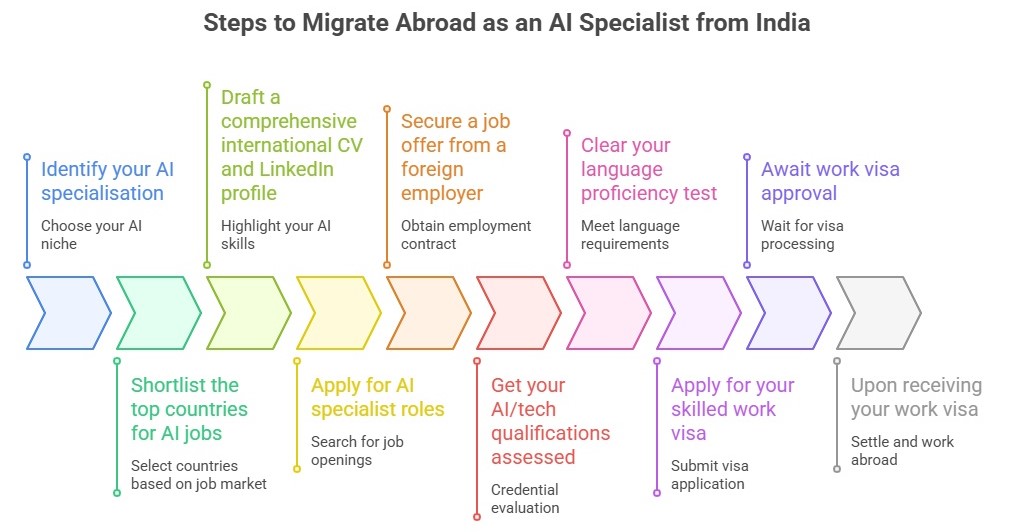
The steps to migrate abroad as an AI specialist from India are as follows:
Step 1: Identify your AI specialisation such as machine learning, data science, NLP, computer vision, robotics, or AI governance.
Step 2: Shortlist the top countries for AI jobs based on salary potential, visa pathway, PR timeline, and your career goals.
Step 3: Draft a comprehensive international CV/resume and LinkedIn profile that highlights your AI skills, tools (Python, TensorFlow, PyTorch, LLMs, cloud platforms), publications, Kaggle rankings, GitHub contributions, and measurable project outcomes.
Step 4: Apply for AI specialist roles on international job search platforms like LinkedIn, Glassdoor, etc.
Step 5: Secure a job offer from a foreign employer required to apply for a skilled work visa.
Step 6: Get your AI/tech qualifications assessed by the relevant authority in your target country ( WES for Canada, ACS for Australia, ZAB for Germany, UK ENIC for the UK, NZQA for New Zealand).
Step 7: Clear your language proficiency test (IELTS/OET/TOEFL) with a score meeting the target country's requirements.
Step 8: Apply for your skilled work visa and submit the required documents such passport, offer letter, degree transcripts, skills assessment result, language test scores, and insurance.
Step 9: Await work visa approval to fly abroad.
Step 10: Upon receiving your work visa, settle and work abroad as an AI specialist.
*Are you looking for step-by-step assistance with overseas immigration? Contact Y-Axis, the world's No. 1 overseas immigration consultancy, for end-to-end assistance!
Planning to work abroad as an AI Specialist? Contact Y-Axis.
FAQs
Which country is easiest for Indian AI specialists to get PR?
Canada offers the fastest and most accessible PR pathway for Indian AI professionals. The Federal Skilled Worker Program (FSWP) under Express Entry allows data scientists, ML engineers, and AI researchers to receive Invitation to Apply (ITA) within 6 months of profile submission. PR is typically achievable in 1–3 years. Australia's Subclass 189/190 visa offers direct PR in 2–4 years for ACS-assessed applicants. Both countries accept IIT, NIT, and equivalent Indian degrees for credential evaluation.
Which country pays the highest salary to AI specialists from India?
The USA offers the highest absolute salaries for AI specialists, ranging from USD 120,000 to USD 240,000 annually — approximately ₹1.09 Cr to ₹2.17 Cr. Senior roles at Google DeepMind, OpenAI, Microsoft, and Meta often exceed USD 300,000 including equity. Germany and Canada follow, offering EUR 65,000–130,000 and CAD 95,000–175,000 respectively. When adjusted for cost of living and purchasing power, Germany and Canada are highly competitive.
Can Indian AI specialists migrate abroad without a US university degree?
Yes. Most top destinations — including Canada, Australia, Germany, UK, Netherlands, UAE, and Singapore — fully accept Indian degrees from IITs, NITs, BITS Pilani, and equivalent universities. Canada requires a WES Educational Credential Assessment. Australia requires an ACS skills assessment. Germany's Anabin database pre-approves IIT and NIT degrees. The UK Global Talent Visa assesses your portfolio of achievements rather than degree institution. Indian AI credentials are widely respected globally.
Is the H-1B visa the only way for Indian AI professionals to work in the USA?
No. While H-1B is the most common route, Indian AI specialists have several alternatives. The O-1A Visa (for extraordinary ability — publications, patents, high salary, awards) has no lottery and no cap. The EB-2 National Interest Waiver (NIW) allows self-petition without employer sponsorship. The L-1A Visa is available for intra-company transfers. Senior AI researchers can target the EB-1A Green Card for exceptional ability. The O-1A + EB-1A path is increasingly popular among Indian AI professionals bypassing the H-1B backlog.
What is the Global Talent Visa in the UK and how can Indian AI professionals qualify?
The UK Global Talent Visa is an employer-independent immigration route for exceptional leaders and emerging talent in digital technology and AI. Endorsement is provided by the Department for Science, Innovation and Technology (DSIT). Indian AI professionals can qualify under Exceptional Talent (established leaders) or Exceptional Promise (emerging talent). Evidence includes conference speaking, peer-reviewed AI publications, high salary benchmarks, open-source contributions, and prior AI company founding. Successful applicants can receive ILR in 3 years (Exceptional Talent) or 5 years (Exceptional Promise).
Which AI roles are most in demand globally in 2025–2026?
Machine Learning Engineers, Generative AI / LLM Engineers, Data Scientists, Computer Vision Specialists, NLP Engineers, AI Product Managers, AI Infrastructure Engineers, and AI Ethics / Governance Specialists are among the most in-demand AI roles globally in 2025–2026. These roles are in active shortage across Canada, USA, Germany, UK, Australia, and the UAE due to the rapid expansion of AI products, national AI strategies, and enterprise digital transformation programmes.
Is UAE a good option for Indian AI specialists without a PR pathway?
Yes, particularly for those prioritising tax-free income and fast visa processing. The UAE offers employer-sponsored visas processed in 5–10 business days, a large Indian professional community, and exceptional AI infrastructure via MBZUAI and Abu Dhabi's AI ecosystem. The UAE Golden Visa (10-year residency) is now accessible to AI specialists meeting salary and expertise criteria. While traditional permanent residency is not available, the Golden Visa provides long-term stability for senior Indian AI professionals.
What is the EU Blue Card and how can Indian AI professionals use it for Germany or the Netherlands?
The EU Blue Card is a residence and work permit for highly qualified non-EU nationals working in EU member states. For shortage occupations — including most AI and tech roles — the salary threshold is reduced to approximately EUR 43,800/year in Germany. The EU Blue Card leads to permanent residency in Germany in 21–27 months (with B1 German), significantly faster than the standard 4-year route. Indian applicants need a recognised degree and a job offer meeting the salary threshold. The EU Blue Card also allows mobility across EU member states.
How long does it take to migrate to Canada as an AI specialist from India?
The typical timeline from profile creation to landing in Canada as an AI specialist is 12–24 months. This includes 2–4 weeks for WES credential evaluation, 1–4 months to receive an Invitation to Apply (ITA) via Express Entry (depending on your CRS score), 6 months for PR application processing after ITA, and 1–2 months for visa stamping and travel arrangements. Category-based draws targeting STEM occupations are reducing ITA timelines for tech professionals in 2025–2026.
What certifications help Indian AI professionals get international jobs faster?
Certifications that significantly strengthen your international AI job profile include: Google Professional Machine Learning Engineer, AWS Certified Machine Learning Specialty, Microsoft Azure AI Engineer Associate, TensorFlow Developer Certificate, deeplearning.ai Specialisations (Coursera), Databricks Certified Associate Developer for Apache Spark, and NVIDIA Deep Learning Institute certifications. For research-focused roles, peer-reviewed publications in NeurIPS, ICML, CVPR, and ICLR carry significant weight with both employers and visa authorities.
Can I migrate to Germany as an AI specialist without knowing German?
Yes, for many AI roles. International companies including SAP, BMW Tech Office, and Zalando hire AI professionals in English-only environments. Germany's Skilled Immigration Act requires A2–B1 German for most standard skilled worker visas, but the EU Blue Card shortage occupation route has more flexibility. The Chancenkarte (Opportunity Card) allows job seekers to enter Germany and search for employment for up to one year — German is not required for entry but helps in day-to-day life. B1 German is required for Permanent Residence.
What is the Tech.Pass in Singapore and who qualifies?
Singapore's Tech.Pass is a fixed-term (2-year, renewable) visa designed for established technology experts, entrepreneurs, and investors. To qualify, applicants must meet at least two of three criteria: a last drawn monthly salary of at least SGD 22,500 (approx. ₹13.95 LPA/month); 5 or more years of cumulative experience in a leading role in a tech company with a valuation of at least USD 500 million; or 5 or more years of experience leading an AI/tech product or team that generated USD 50 million+ in annual revenue. Indian AI founders and senior engineers from global tech firms regularly qualify.
Is New Zealand a good destination for Indian AI professionals in 2025?
New Zealand is an emerging but growing destination for Indian AI professionals, particularly data scientists and AI/ML developers. Green List technology occupations qualify for fast-track processing, and the Skilled Migrant Category Resident Visa offers PR in 2–5 years. Salaries are lower than Canada, USA, or Australia, but the quality of life, work-life balance, and pathway to residency are strong. Auckland and Wellington are the primary tech hiring centres. Indian degrees from IITs and NITs are assessed positively by NZQA.
How does the Australia ACS skills assessment work for Indian AI professionals?
The Australian Computer Society (ACS) skills assessment determines whether your Indian AI qualifications and work experience are comparable to an Australian bachelor's degree or higher in ICT. The process involves submitting your degree certificates, transcripts, employment evidence, and a skills assessment application (fee approx. AUD 500–530). ACS assesses both qualifications and relevant work experience. IIT, NIT, BITS, and equivalent 4-year B.Tech degrees are generally assessed positively. The ACS result is a prerequisite for applying for most Australian skilled migration visa subclasses.
What is the EB-2 National Interest Waiver and can Indian AI researchers use it?
The EB-2 National Interest Waiver (NIW) is a US Green Card self-petition pathway that waives the standard requirement for a job offer and PERM labour certification. To qualify, Indian AI researchers and specialists must demonstrate that their work is in an area of substantial intrinsic merit, that their work benefits the USA broadly, and that waiving the job offer requirement is in the national interest. Indian AI professionals in fields like frontier AI safety, autonomous systems, healthcare AI, and clean energy AI have a strong case. The EB-2 NIW is subject to Indian national backlog but has shorter queues than EB-2 standard and EB-3.
Which countries offer AI-specific immigration pathways or visa streams?
Several countries have created AI-specific or tech-specific immigration pathways. Canada runs IRCC category-based Express Entry draws specifically targeting STEM and tech occupations. The UK Global Talent Visa has a dedicated digital technology and AI endorsement route. Singapore's Tech.Pass and ONE Pass target world-class AI and tech talent. The UAE's Golden Visa specifically lists AI specialists as a priority category under the Ministry of AI. Germany's Chancenkarte and Recognition Partnership accelerate entry for skilled AI professionals. Japan's J-Skip Visa offers an expedited PR route for highly skilled AI researchers.
What is the minimum salary threshold for the UK Skilled Worker Visa for AI roles?
For the UK Skilled Worker Visa, AI and data science roles (Standard Occupational Classification codes covering software developers, data scientists, and AI specialists) must meet a minimum salary of £38,700 per year — or the going rate for that specific occupation, whichever is higher. From January 2026, applicants must also demonstrate B2 English proficiency. For Indian AI professionals with 3+ years of experience, most AI roles in the UK will naturally meet or exceed the salary threshold.
Can Indian AI professionals bring their families when working abroad?
Yes, in most top destinations. Canada: spouses receive open work permits and children receive free public schooling. Australia: spouses and children are included in visa applications with full work rights for spouses. UK: spouses and dependent children under 18 can join Skilled Worker visa holders. Germany: spouses receive immediate work rights and children have free public education access. UAE: Golden Visa and Employment Visa holders meeting salary thresholds can sponsor family. Singapore: EP holders earning SGD 6,000+/month can sponsor dependents.
What is the role of GitHub, Kaggle, and open-source contributions in getting AI jobs abroad?
GitHub contributions, Kaggle rankings, and open-source AI project participation significantly strengthen international job applications for AI professionals. In the UK Global Talent Visa assessment, open-source contributions are formally cited as qualifying evidence under the Exceptional Promise track. For USA O-1A applications, GitHub stars, forks, and documented product adoption can serve as evidence of extraordinary achievement. Australian employers in the tech sector frequently review GitHub profiles as part of technical screening. Kaggle Grandmaster or Master rankings are globally recognised signals of ML engineering excellence.
How can Y-Axis help me migrate abroad as an AI specialist from India?
Tags:
AI jobs for Indians abroad
AI specialists abroad
international AI specialists
foreign AI specialists
best countries for AI specialists
work visa for AI specialists
work abroad
overseas immigration
highest-paying jobs for AI specialists
Share
Options for you by Y-Axis

Get it on your mobile

Get News alerts

Contact Y-Axis
Latest Article
Popular Post
Trending Article
Posted On October 22 2026
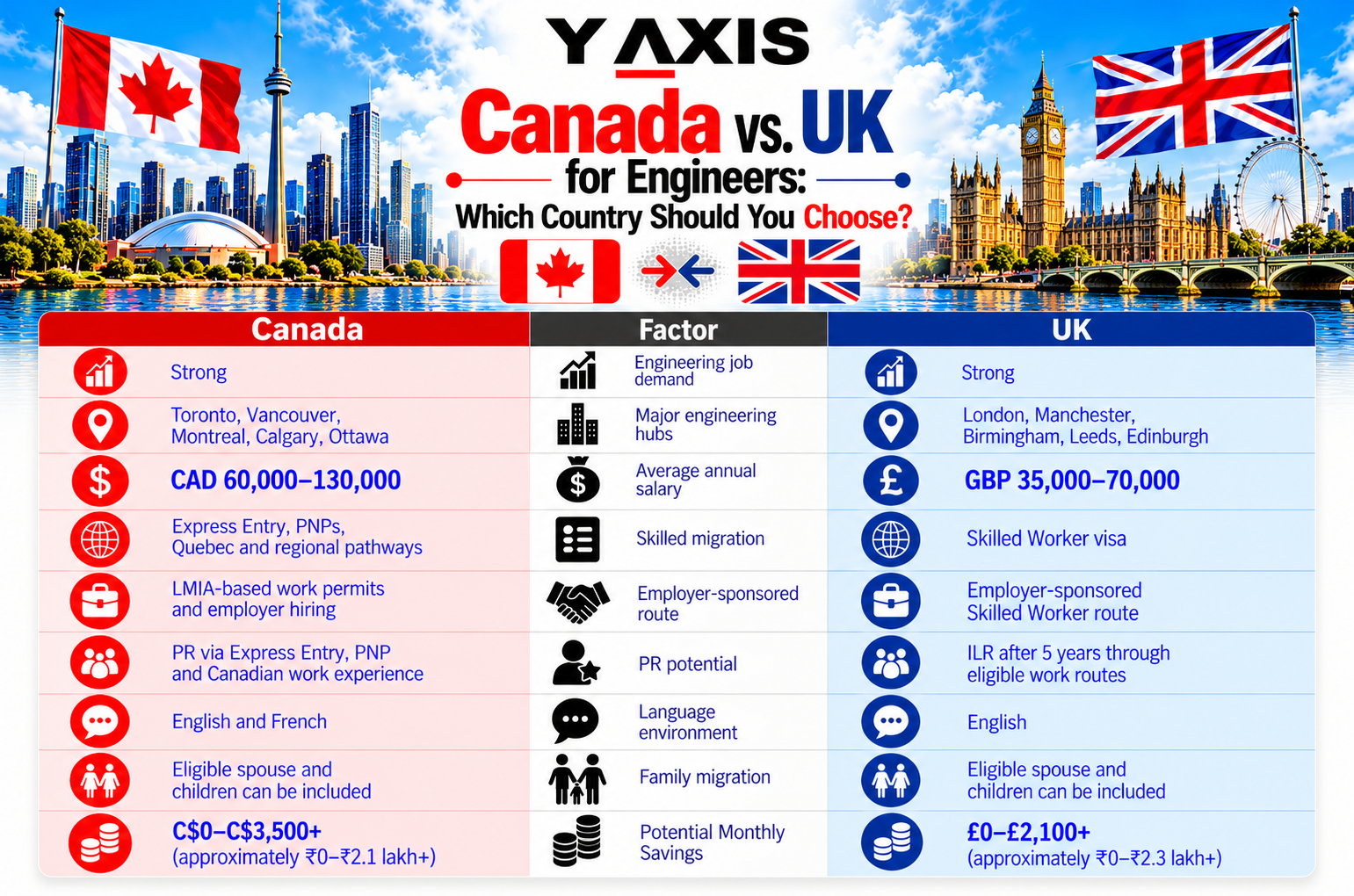
Canada vs. UK for Engineers: Which Country Should You Choose?