

Posted on July 20 2026
Life in the Philippines for Immigrants: Jobs, Housing, Healthcare & PR

By , Editor
Updated July 25 2026
Life for immigrants in the Philippines is shaped by a warm, English-speaking culture, a booming outsourcing and technology sector, and a relaxed island lifestyle. The Philippines is home to one of Asia's largest business process outsourcing (BPO) industries and a growing IT, engineering, and finance sector. It offers competitive pay in tech, BPO, and renewable energy with a low cost of living outside the capital. Metro Manila is booming with jobs in finance, IT, and multinational firms. Cities like Cebu and Davao offer growing tech, BPO, and logistics roles with a lower cost of living. The Philippines suits immigrants who want an English-first work environment, tropical living, and a straightforward path into Asia's outsourcing economy.
Quick Facts About the Philippines
|
Population |
Approximately 114 million |
|
Capital |
Manila |
|
Official Language |
Filipino and English (both official; English widely used in business) |
|
Currency |
Philippine Peso (PHP) |
|
Popular Immigrant Hubs |
Metro Manila (Makati, BGC), Cebu City, Davao City, Clark/Angeles, Iloilo City |
|
Economy |
Strong in BPO/IT services, business process outsourcing, manufacturing, renewable energy, and tourism |
|
Typical Route to Long Stay |
Employer-sponsored 9(g) work visa via Alien Employment Permit (AEP), renewable in 1 to 3-year terms |
|
Permanent Residence |
Selective routes via SIRV (investment), SRRV (retirement, age 40+), or 13(a) marriage to a Filipino citizen |
*Want to settle in the Philippines? Sign up with Y-Axis for end-to-end assistance.
Why Choose the Philippines?
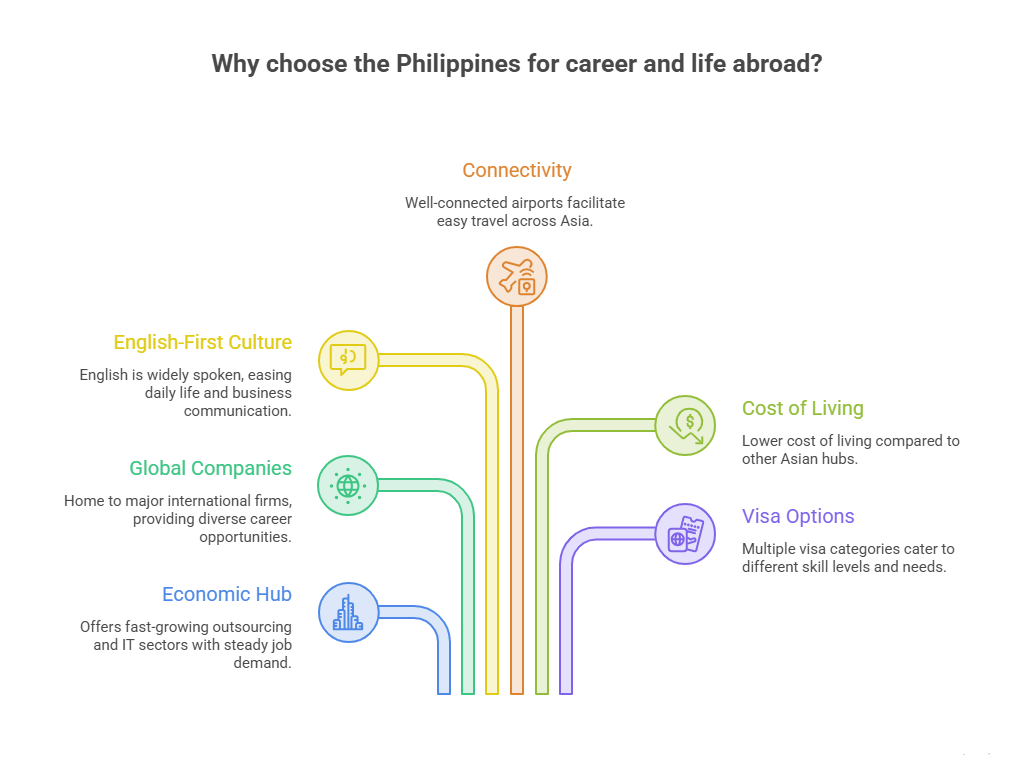
The Philippines offers one of Asia's fastest-growing outsourcing and technology hubs, alongside a genuinely English-first business culture. Global and Filipino companies keep expanding their operations, creating steady demand for skilled professionals in IT, BPO, engineering, and finance.
Here is why you should choose a life in the Philippines:
- Asia's leading BPO and outsourcing hub, alongside a fast-growing IT and shared-services sector
- Home to major global and Filipino firms such as Accenture, Concentrix, Teleperformance, IBM, and JPMorgan GBS
- Growing demand for IT, engineering, finance, and renewable energy professionals from India
- English and Filipino are both official languages, making daily life and business communication easier for Indian professionals
- Well-connected international airports in Manila and Cebu with frequent flights across Asia
- Lower cost of living compared to Singapore, Hong Kong, or Australia
- Multiple visa categories based on skill level, employer type, and investment
*Want to work in the Philippines? Let Y-Axis assist you with the process.
Can I Move to the Philippines as an Indian Immigrant?
Most Indian nationals can move to the Philippines through work, investment, or family immigration routes. You must meet the rules set by Philippine immigration authorities, such as securing a job offer and meeting the requirements set for your visa category.
Here is what you need to do to migrate to the Philippines:
- Secure a valid job offer from a Philippine-registered employer
- Your employer must obtain an Alien Employment Permit (AEP) from the Department of Labor and Employment (DOLE)
- Meet the qualification and labour market test requirements set for your role
- Hold recognised qualifications or relevant work experience for the position
- Pass a medical examination and hold a clean police clearance certificate
- Have a valid passport with at least six months' validity
- Explore family reunification for spouses and children of visa holders
Also, read
Philippines Emerges as a Top Choice for Indian Medical Aspirants – Apply Now
Best Visa Options to Live in the Philippines
The Philippines offers several permits based on your job, investment, or personal circumstances. The table below shows the main visa options for skilled workers and their route to long-term residence.
|
Visa Type |
Best For |
Duration |
Long-Term Pathway |
|
9(g) Pre-Arranged Employment Visa |
Skilled professionals with a confirmed job offer |
1 to 3 years (renewable) |
Renewable indefinitely while employed; does not by itself lead to automatic permanent residence |
|
47(a)(2) Special Non-Immigrant Visa |
Employees of PEZA or BOI-registered companies |
Matches employment contract |
Simplified, faster processing; common fast-track for IT and BPO roles |
|
Provisional Work Permit (PWP) |
Starting work while the 9(g) visa is being processed |
3 months |
Bridges to the 9(g) visa; not a standalone long-term option |
|
SIRV (Special Investor's Resident Visa) |
Investors placing at least USD 75,000 in Philippine enterprises |
Probationary 6 months, then indefinite |
Direct route to indefinite residence while the investment is maintained |
|
SRRV (Special Resident Retiree's Visa) |
Foreign nationals aged 40+ meeting deposit requirements |
Indefinite |
Direct route to indefinite residence; does not permit local employment |
|
13(a) Non-Quota Immigrant Visa |
Spouses of Filipino citizens |
1-year probationary, then permanent |
Direct route to permanent residence; a pathway toward naturalisation |
Also, read...
Philippines Job Market in 2026-30
Best Cities to Live in the Philippines
The Philippines' job market and living conditions vary significantly across cities. Choosing the right location can influence your career opportunities, cost of living, housing expenses, and overall quality of life.
The table below highlights the major Philippine cities and their best qualities for settlement abroad:
|
City |
Best For |
Sightseeing Attractions |
Average Rent |
Job Market |
How Much You Can Save |
|
Manila (Makati/BGC) |
Finance, BPO & multinational HQs |
Intramuros, Rizal Park, Manila Ocean Park |
₱25,000–₱50,000/mo (1BR) |
Strongest, major MNC/BPO hub |
Moderate, higher cost of living |
|
Cebu City |
IT-BPO & tourism |
Magellan's Cross, Cebu Taoist Temple, Mactan Island |
₱15,000–₱25,000/mo (1BR) |
Strong, growing IT Park hub |
Good savings potential |
|
Davao City |
Agribusiness, logistics & renewable energy |
Philippine Eagle Center, Eden Nature Park |
₱10,000–₱18,000/mo (1BR) |
Growing, agribusiness and logistics hub |
Good savings potential |
|
Clark/Angeles (Pampanga) |
Manufacturing, aerospace & logistics |
Clark Museum, SM Clark |
₱12,000–₱22,000/mo (1BR) |
Growing, freeport economic zone |
Good savings potential |
|
Iloilo City |
IT-BPO & real estate services |
Miagao Church, Iloilo River Esplanade |
₱8,000–₱15,000/mo (1BR) |
Growing, emerging BPO hub |
Very good savings potential |
Also, read...
Highest Paying Jobs in the Philippines for Indians
Cost of Living in the Philippines
The Philippines' cost of living changes sharply by city. Manila costs the most, but even Manila costs less than most major Asian business hubs.
Below is a breakdown of average monthly expenses for a single adult in Metro Manila:
|
Rent (1BR apartment, BGC/Makati) |
₱25,000–₱50,000/month |
|
Utilities (electricity, water) |
₱3,000–₱5,500/month |
|
Groceries |
₱6,000–₱10,000/month |
|
Public Transport |
₱1,500–₱2,500/month |
|
Private Health Insurance (HMO, optional) |
₱15,000–₱80,000/year |
|
Dining Out (per meal) |
₱150–₱600 |
|
Mobile & Internet |
₱1,500–₱2,500/month |
|
Entertainment & Leisure |
₱3,000–₱6,000/month |
Is the Philippines Expensive Compared to Other Asian Nations?
No, once you move outside Manila's premium districts, the Philippines offers a lower cost of living than Singapore, Hong Kong, or Bangkok. Rent in cities like Cebu, Davao, and Iloilo costs far less than in Metro Manila's central business districts.
Salaries for skilled foreign professionals in the Philippines are moderate by regional standards, but combined with low daily costs, this helps many immigrants save a reasonable share of their income each month.
Cities outside the top tier, like Iloilo and Dumaguete, cost even less. This makes the Philippines a strong choice for immigrants who want an English-speaking work environment while building savings in a growing economy.
Also, read...
What are the fast-track hiring options in the Philippines for Skilled Professionals?
Work in the Philippines
The Philippines' job market runs on BPO and IT services, manufacturing, renewable energy, and finance. Global and domestic companies keep investing in new offices and facilities across the country.
The table below shows some of the most in-demand jobs in the Philippines for immigrants.
|
Occupation |
Average Annual Salary |
Demand Level |
Average Savings |
|
Software Engineer / IT Developer |
₱540,000–₱1,320,000 |
Very High |
₱150,000–₱400,000/year |
|
BPO Operations / Team Lead Manager |
₱540,000–₱840,000 |
Very High |
₱120,000–₱300,000/year |
|
Renewable Energy / Mining Engineer |
₱600,000–₱1,140,000 |
High |
₱150,000–₱350,000/year |
|
Finance & Accounting (Shared Services) Analyst |
₱420,000–₱720,000 |
High |
₱100,000–₱250,000/year |
|
Healthcare Professional (Nurse/Specialist, Private Hospital) |
₱300,000–₱576,000 |
Moderate–High |
₱70,000–₱180,000/year |
|
International School Teacher |
₱360,000–₱720,000 |
Moderate |
₱80,000–₱200,000/year |
Settling in the Philippines
Once you arrive in the Philippines, you need to find housing, register for healthcare, enrol children in school, and set up banking.
Here is a quick overview of what to expect during your first weeks in the country:
|
Housing |
Healthcare |
Education for Children |
Banking & Financial Essentials |
|
Search via Lamudi or local agents; competitive rental market in Manila and Cebu |
Register for PhilHealth through your employer (mandatory, 5% of salary, split employer/employee); private HMO popular for faster access |
Enrol in international schools in major cities; public schools available with local registration |
Open an account with BDO, BPI, or Metrobank |
|
Landlords typically ask for 1 to 2 months' deposit plus advance rent |
Public system is funded through employer, employee, and government contributions; private HMO covers a wider hospital network |
International schools charge high annual fees; public schools are low-cost but taught in Filipino and English |
An ACR I-Card and passport are usually required to open an account |
|
Allow 1 to 3 weeks to secure a rental in Manila or Cebu |
Enrol with PhilHealth soon after you start work through your employer |
Apply for school places early; international schools have limited seats |
Basic accounts can typically be opened within a few days of arrival |
Watch To Know More: 2.5 Million Jobs in Philippines by 2028 | Steps to Apply for a Job & Visa Explained
Discover the growing job opportunities in the Philippines, with an estimated 2.5 million jobs by 2028. Learn about in-demand occupations, eligibility requirements, the job application process, and the steps to obtain a Philippines work visa.
Permanent Residence in the Philippines
Permanent residence in the Philippines is selective and route-specific rather than based on a simple length-of-stay rule. Work visa holders do not automatically qualify for permanent residence purely through years of employment — long-term residency instead runs through investment, retirement, or marriage routes.
The table below shows the average timeline for the main routes to Philippine permanent residence:
|
Stage |
Requirement |
Approx. Timeline |
|
Work Visa Holder |
Hold a valid 9(g) visa and reside legally; renewable while employed |
Ongoing, renewable every 1–3 years |
|
Permanent Residence — Investment Track (SIRV) |
Maintain a direct investment of at least USD 75,000 in an approved Philippine enterprise |
Indefinite status, approx. 2–3 months after remittance |
|
Permanent Residence — Retirement Track (SRRV) |
Age 40 or above, with a qualifying deposit (amount depends on age and pension status) |
Indefinite status, approx. 20–30 working days |
|
Permanent Residence — Marriage Track (13(a)) |
Valid, subsisting marriage to a Filipino citizen |
1-year probationary period, then permanent |
|
Philippine Citizenship |
Rarely pursued; requires 1 to 10 years of qualifying residence, language proficiency, and renouncing your original nationality |
Case by case |
Dependent Benefits for Immigrants in the Philippines
The Philippines allows eligible visa holders to bring immediate family members. This applies once dependent visa rules are met.
Here are the benefits of securing a Philippines dependent visa:
- Spouses and children of 9(g) visa holders can convert their tourist visa into dependent status, matching the principal applicant's visa validity
- Family members of SIRV and SRRV holders can be included in the same application for an additional fee
- Dependents can access PhilHealth once registered with valid residency documents
- Children can attend local public schools once registered, or international schools for a fee
- Family members can open bank accounts once they hold a valid ACR I-Card
Also, read...
What are the eligibility requirements for a Philippines work visa?
Practical Settlement Checklist for Indians Moving to the Philippines
Moving to the Philippines involves a few key steps. Complete them in order to avoid delays.
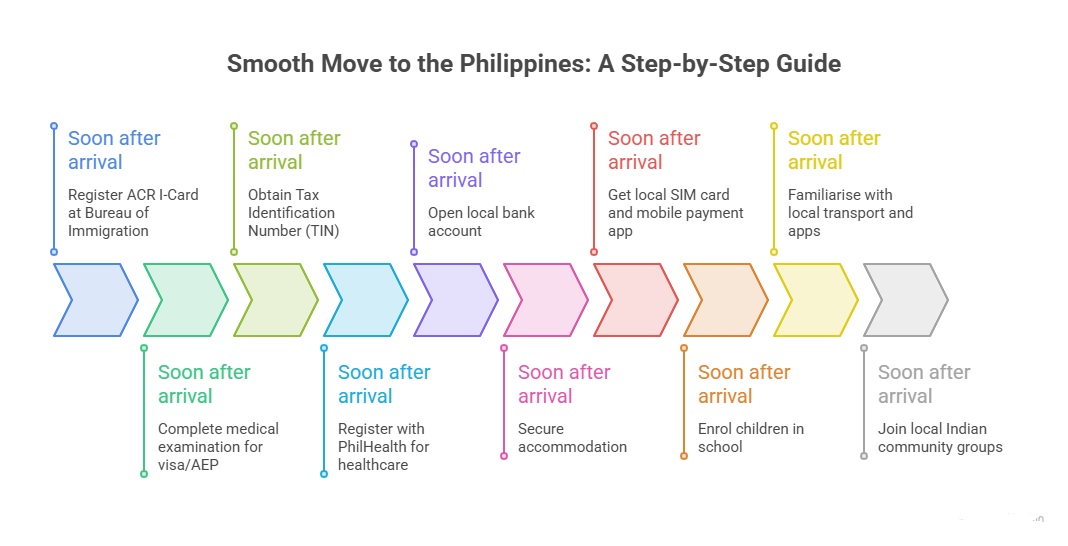
Follow the steps below for a smooth move to the Philippines:
Step 1: Register your ACR I-Card at the Bureau of Immigration soon after arrival, if not already processed through your employer
Step 2: Complete your medical examination for your 9(g) visa or AEP requirements
Step 3: Obtain your Tax Identification Number (TIN) through the Bureau of Internal Revenue
Step 4: Register with PhilHealth through your employer for public healthcare access
Step 5: Open a local bank account with BDO, BPI, or Metrobank
Step 6: Secure accommodation before or shortly after arrival
Step 7: Get a local SIM card and set up a mobile payment app such as GCash or Maya
Step 8: Enrol children in school as early as possible
Step 9: Familiarise yourself with local transport such as Grab, jeepneys, and the MRT/LRT, and download a translation or maps app
Step 10: Join local Indian community groups for support and networking
*Are you looking for step-by-step assistance with overseas immigration? Contact Y-Axis, the world's No. 1 overseas immigration consultancy!
FAQs
What is the easiest way for Indians to move to the Philippines?
For most Indian professionals, the easiest route is the 9(g) Pre-Arranged Employment Visa, supported by an Alien Employment Permit (AEP) from the employer. This route covers most skilled occupations such as IT professionals, engineers, and finance specialists. Applicants must first secure a confirmed job offer from a Philippine-registered employer. The 47(a)(2) Special Non-Immigrant Visa offers faster processing for employees of companies registered with PEZA or the Board of Investments (BOI). Family reunification is also available for eligible spouses and dependent children.
How long does it take to get permanent residency in the Philippines?
Permanent residence in the Philippines depends on the immigration pathway rather than years of employment. A standard 9(g) work visa does not automatically lead to permanent residence. Common permanent residence options include:
- SIRV (Special Investor's Resident Visa): Approximately 2–3 months with a minimum investment of USD 75,000.
- SRRV (Special Resident Retiree's Visa): Around 20–30 working days for eligible applicants aged 40 and above.
- 13(a) Visa: Available for spouses of Filipino citizens, beginning with a one-year probationary period before conversion to permanent residence.
Is healthcare free for immigrants in the Philippines?
The Philippines operates a public healthcare insurance system known as PhilHealth. Employees working for registered Philippine employers are generally enrolled automatically, with approximately 5% of salary contributed jointly by the employee and employer. PhilHealth covers part of hospital and outpatient expenses, but many expatriates also purchase private HMO or international medical insurance for broader coverage. Private HMO plans generally cost between ₱15,000 and ₱80,000 per year, depending on the level of coverage.
What is the average salary for skilled workers in the Philippines?
Salaries vary depending on the profession, experience, and location. Typical annual salary ranges include:
| Occupation | Average Annual Salary |
|---|---|
| Software Engineers & IT Developers | ₱540,000 – ₱1,320,000 |
| Renewable Energy & Mining Engineers | ₱600,000 – ₱1,140,000 |
| BPO Operations Managers & Team Leads | ₱540,000 – ₱840,000 |
| Finance & Accounting Professionals | Varies by role and employer |
Metro Manila generally offers the highest salaries, while IT, engineering, and BPO sectors remain the strongest areas for foreign professionals seeking visa sponsorship.
Can I bring my family to the Philippines on a work visa?
Yes. Most holders of a 9(g) work visa may sponsor their spouse and dependent children by converting their tourist visas into dependent visas. The dependent visa generally remains valid for the same duration as the principal applicant's work visa. Family members may become eligible for PhilHealth coverage after obtaining valid residency documents. Children can attend public schools after registration or enrol in international schools. Applicants under the SIRV and SRRV programmes may also include eligible family members in their applications.
Which city in the Philippines is best for Indian immigrants?
The ideal city depends on your profession and lifestyle preferences. Popular destinations include:
- Manila: Best for finance, BPO, multinational companies, and a large Indian community.
- Cebu City: Strong IT-BPO sector with a lower cost of living than Manila.
- Davao: Growing opportunities in logistics, agriculture, and renewable energy.
- Clark: Popular for manufacturing, aviation, and freeport industries.
Metro Manila offers the widest employment opportunities, while Cebu, Davao, and Clark provide lower living costs with expanding job markets.
How much does it cost to live in the Philippines?
Living costs vary by city. Typical monthly expenses for a single person include:
| Expense | Estimated Monthly Cost |
|---|---|
| One-bedroom apartment (BGC/Makati) | ₱25,000 – ₱50,000 |
| Utilities | ₱3,000 – ₱5,500 |
| Groceries | ₱6,000 – ₱10,000 |
Cities such as Cebu, Davao, and Iloilo generally offer lower living costs while maintaining a comfortable quality of life.
What is the 47(a)(2) visa in the Philippines?
The 47(a)(2) Special Non-Immigrant Visa is designed for foreign employees working for companies registered with the Philippine Economic Zone Authority (PEZA) or the Board of Investments (BOI). It is commonly used by IT, BPO, manufacturing, and technology companies operating within economic zones. Compared to the standard 9(g) visa, this route generally offers simplified processing and quicker approvals for qualifying employers and foreign specialists.
Do I need to speak Filipino to live in the Philippines?
No. English is one of the official languages of the Philippines and is widely spoken in workplaces, government offices, schools, banks, and multinational companies. Most business communication and official documentation are available in English, particularly in Manila, Cebu, and other major cities. Learning basic Filipino can still be helpful for everyday interactions and local community life.
Can I apply for Philippine citizenship after getting permanent residence?
Yes, although it is relatively uncommon. Foreign nationals may become eligible for Philippine citizenship after meeting the legal residence requirements, demonstrating good moral character, and showing proficiency in either Filipino or English. Applicants are generally required to renounce their existing nationality, as the Philippines does not broadly permit dual citizenship for naturalised foreign nationals. Many expatriates instead choose to retain permanent residence through the SIRV, SRRV, or 13(a) visa, as these provide most long-term residency benefits.
Tags:
Philippines immigration
Philippines work visa
Philippines permanent residency
Living in the Philippines
Cost of living in the Philippines
Best cities in the Philippines
Jobs in the Philippines for Indians
Healthcare in the Philippines
Share
Options for you by Y-Axis

Get it on your mobile

Get News alerts

Contact Y-Axis
Latest Article
Popular Post
Trending Article
Posted On October 16 2026
Australia Updates Health Insurance Guidance for Visa Holders: What You Need to Know