

Posted on July 24 2026
Life in Estonia for Immigrants: Jobs, Housing, Healthcare & PR

By , Editor & Director
Updated July 26 2026
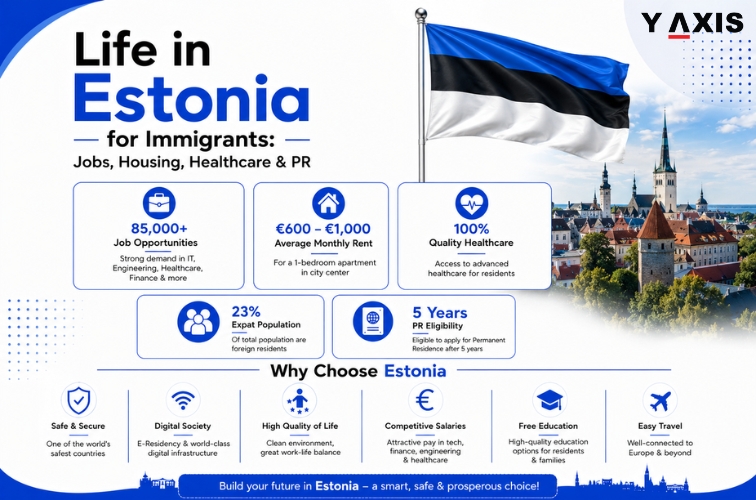
Life for immigrants in Estonia is shaped by a small, highly digital economy, a genuine shortage of skilled workers, and full access to the EU and Schengen Area. Estonia faces persistent labour shortages, and its startup ecosystem now ranks 12th in the world. Tallinn offers the strongest job market in IT, finance, and startups, while Tartu, Pärnu, and Narva offer lower costs of living with growing demand in healthcare, tourism, and manufacturing. Estonia suits immigrants who want EU residency, a genuinely digital-first environment, and a realistic path toward long-term settlement.
Quick Facts About Estonia
|
Population |
Approximately 1.37 million |
|
Capital |
Tallinn |
|
Official Language |
Estonian (English widely used in tech and business) |
|
Currency |
Euro (EUR) |
|
Popular Immigrant Hubs |
Tallinn, Tartu, Pärnu, Narva |
|
Economy |
Over 100,000 job openings expected 2026-2030; strong in IT, engineering, healthcare, and finance |
|
Typical Route to Long Stay |
Employer-sponsored temporary residence permit for employment, valid for up to 5 years, renewable |
|
Permanent Residence |
Long-term residence permit after 5 years of continuous legal residence; citizenship by naturalisation after 8 years, with the last 5 on a permanent basis |
*Want to settle in Estonia? Sign up with Y-Axis for end-to-end assistance.
Why Choose Estonia?
Estonia runs one of Europe's most advanced digital economies. It faces a real shortage of skilled workers. The country offers steady demand in IT, engineering, healthcare, and finance.
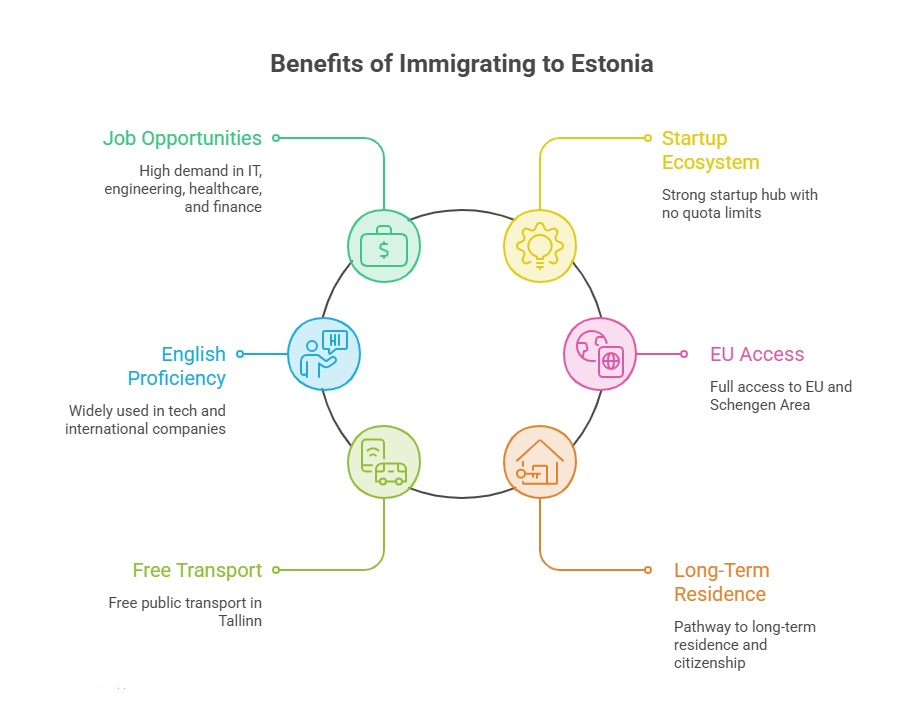
Here is why you should choose a life in Estonia as an immigrant:
- Over 100,000 job openings expected between 2026 and 2030, with an annual shortfall of around 1,400 top specialists and 700 skilled workers
- Ranked 12th in the world in the 2026 StartupBlink Global Startup Ecosystem Index, the strongest startup hub in Eastern Europe and the Baltics
- No annual quota limit for startup founders, developers, IT specialists, and top-level specialists earning at least double Estonia's average salary
- English is widely used in the tech sector and international companies, even though Estonian is the official language
- Full EU and Schengen Area access once you hold a valid Estonian residence permit
- Free public transport for all residents registered in Tallinn, the first EU capital to offer this, since 2013
- A clear pathway to long-term residence after 5 years and citizenship after 8 years
*Want to work in Estonia? Let Y-Axis assist you with the process.
Can I Move to Estonia as an Indian Immigrant?
Most Indian nationals move to Estonia through employer-sponsored work permits. You must meet the requirements set by the Police and Border Guard Board (PBGB), Estonia's immigration authority, including a valid job offer and proof of relevant qualifications.
Here is what you need to do to migrate to Estonia:
- Secure a valid job offer or signed employment contract from an Estonia-based employer
- Confirm your employer is registered in the Estonian Business Register and can show at least 6 months of genuine economic activity, a requirement from 2026
- Your employer applies for a short-term employment registration or a temporary residence permit through the PBGB
- Hold recognised qualifications or relevant work experience for the position
- Apply for your visa at an Estonian consulate or visa centre in India before travelling, if required
- Hold a valid passport, health insurance, and a clean police clearance certificate
- Explore family reunification for your spouse and children once your permit is granted
Also, read...
Is it easy for Indians to obtain an Estonia work visa?
Best Visa Options to Live in Estonia
Estonia offers several permits based on your job, startup plans, or personal circumstances. The table below shows the main visa options for skilled workers and their route to long-term residence.
|
Visa Type |
Best For |
Duration |
Long-Term Pathway |
|
Short-Term Employment Registration |
Work up to 365 days within a 455-day period |
Registered before work starts; fee approximately EUR 130, processed in 15 working days |
Does not count toward long-term residence or citizenship |
|
Temporary Residence Permit for Employment |
Skilled workers with a confirmed job offer exceeding 12 months |
Up to 5 years initially (renewable for up to 10 years at a time) |
Counts toward the 5-year long-term residence and 8-year citizenship eligibility |
|
Highly skilled professionals earning at least approximately EUR 37,152/year (EUR 35,664/year for shortage roles) |
Initially valid up to 27 months |
Counts toward the same residence and citizenship milestones, with strong intra-EU mobility |
|
|
Startup Visa |
Founders and key employees of an Estonia-based startup approved by the Startup Committee |
Up to 5 years; no annual quota limit for approved startups |
Counts toward the same residence and citizenship milestones |
|
Remote workers and freelancers employed by a foreign company or clients |
Up to 1 year |
Does not lead directly to permanent residence |
Also, read...
Best Areas to Live in Estonia
Estonia's job market and living conditions vary across its towns, even though the country is small. Choosing the right area can influence your career opportunities, cost of living, housing expenses, and overall quality of life.
The table below highlights the major Estonian areas and their best qualities for settlement abroad:
|
Area |
Best For |
Sightseeing Attractions |
Average Rent |
Job Market |
How Much You Can Save |
|
Tallinn |
Tech, startups, finance & government |
Old Town, Kadriorg Palace, Telliskivi Creative City |
EUR 700-1,200/mo (1BR) |
Strongest, dense startup and tech hub |
Moderate, higher cost of living |
|
Tartu |
Research, education, biotech & healthcare |
University of Tartu, Town Hall Square |
EUR 400-650/mo (1BR) |
Growing, strong academic and research base |
Good savings potential |
|
Pärnu |
Tourism, hospitality & wellness |
Pärnu Beach, Rannapark |
EUR 350-600/mo (1BR) |
Moderate, seasonal tourism strength |
Good savings potential |
|
Narva |
Manufacturing, logistics & cross-border trade |
Narva Castle, Hermann Bastion |
EUR 250-450/mo (1BR) |
Steady, industrial and logistics base |
Very good savings potential |
Also, read...
Highest Paying Jobs in Estonia for Indians
Cost of Living in Estonia
Estonia's cost of living changes by area. Tallinn costs the most, but Estonia overall still costs less than most major Western European capitals.
Below is a breakdown of average monthly expenses for a single adult in Tallinn:
|
Rent (1BR apartment, city centre) |
EUR 700-1,200/month |
|
Utilities (electricity, water, heating) |
EUR 120-180/month |
|
Groceries |
EUR 200-300/month |
|
Public Transport |
Free for residents registered in Tallinn; EUR 1.50 per journey for non-residents |
|
Private Health Insurance (voluntary, before EHIF coverage begins) |
EUR 170-200/month |
|
Dining Out (per meal) |
EUR 10-20 |
|
Mobile & Internet |
EUR 20-35/month |
|
Entertainment & Leisure |
EUR 80-150/month |
Also, read...
What are the fast-track hiring options in Estonia for Indian Skilled Professionals?
Is Estonia Expensive Compared to Other EU Nations?
No, Estonia's overall cost of living is lower than its Nordic neighbours Finland and Sweden, which run 25 to 35% more expensive, though it costs slightly more than Latvia or Lithuania due to Tallinn's tech-driven wage growth.
Salaries for skilled foreign professionals in Estonia are competitive by Baltic standards, and combined with free public transport in Tallinn and manageable daily costs, this still allows many immigrants to build reasonable savings, particularly outside the capital.
Areas like Tartu, Pärnu, and Narva cost even less than Tallinn. This makes Estonia a strong choice for immigrants who want EU residency and a genuinely digital-first lifestyle while building savings in a labour-short economy.
Also, read...
What are the most in-demand jobs in Estonia for the next 10 years?
Work in Estonia
Estonia's job market runs on IT, cybersecurity, engineering, healthcare, and finance, supported by a well-known startup ecosystem. The country expects over 100,000 job openings between 2026 and 2030, and employers rely heavily on foreign workers to fill them.
The table below shows some of the most in-demand jobs in Estonia for immigrants.
|
Occupation |
Average Annual Salary |
Demand Level |
Average Savings |
|
IT / Software Development |
EUR 45,000-75,000 |
Very High |
EUR 8,000-18,000/year |
|
Cybersecurity / AI Specialist |
EUR 40,000-70,000 |
Very High |
EUR 7,000-16,000/year |
|
Engineering (Automation/Energy) |
EUR 35,000-60,000 |
High |
EUR 6,000-12,000/year |
|
Healthcare Professional (Doctor/Nurse) |
EUR 30,000-70,000+ |
High |
EUR 5,000-14,000/year |
|
Finance & Insurance |
EUR 35,000-55,000 |
High |
EUR 6,000-11,000/year |
|
Manufacturing / Logistics (Narva region) |
EUR 22,000-35,000 |
High |
EUR 3,000-7,000/year |
Also, read...
What are the eligibility requirements for a work visa in Estonia?
Settling in Estonia
Once you arrive in Estonia, you need to find housing, register for healthcare, enrol children in school, and set up banking.
Here is a quick overview of what to expect during your first weeks in the country:
|
Housing |
Healthcare |
Education for Children |
Banking & Financial Essentials |
|
Search via KV.ee, City24, or Kinnisvara24; competitive rental market in Tallinn's city centre and Kalamaja |
Register for EHIF through your employer (13% employer payroll tax) |
Enrol in free state schools, or international schools like the International School of Estonia or Tallinn European School |
Open an account with LHV Pank, Swedbank Estonia, or SEB Estonia |
|
Landlords typically ask for 1 to 2 months' deposit plus advance rent |
EHIF coverage typically begins 1 to 2 months after you start employment |
International schools charge EUR 6,000-12,000/year; state schools are free but taught mainly in Estonian, with growing English-medium options |
A residence permit and Estonian ID code are usually required to open an account |
|
Allow 2 to 4 weeks to secure a rental in Tallinn |
Register with EHIF soon after starting work to activate healthcare coverage |
Apply for school places early; popular international schools have limited seats |
Basic accounts can typically be opened within a few days once documents are ready |
Watch to know more: Estonia Work Visa for Indians | Cost, Time & Job Opportunities
Permanent Residence in Estonia
Permanent residence in Estonia follows a defined, time-based route for most workers, alongside a dedicated Startup Visa track. Legal residence on a temporary residence permit, EU Blue Card, or Startup Visa all count toward the same milestones, provided you genuinely live in Estonia.
The table below shows the average timeline for the main routes to Estonian permanent residence and citizenship:
|
Stage |
Requirement |
Approx. Timeline |
|
Work Permit Holder |
Hold a valid temporary residence permit for employment, EU Blue Card, or Startup Visa; renewable while employed |
Ongoing, renewable |
|
Long-Term Residence Permit (Permanent Residence) |
5 years of continuous legal residence; registered address, valid permit, permanent legal income, health insurance, and Estonian at B1 level (ages 15-65) |
5 years |
|
Estonian Citizenship (Naturalisation) |
At least 8 years of residence, including the last 5 years on a permanent basis; B1 Estonian, a civics exam, and stable income |
8 years, plus processing |
|
Startup Visa Track |
Maintain an approved, active Estonia-based startup; no separate quota limit applies |
Counts toward the same 5-year and 8-year milestones |
|
Marriage to an Estonian Citizen |
Valid marriage or registered partnership with an Estonian citizen; standard residence requirements still apply |
Standard residence timeline applies |
Also, read...
Can I convert my Estonia work visa to PR?
Dependent Benefits for Immigrants in Estonia
Estonia allows eligible visa holders to bring immediate family members. This applies once dependent visa rules are met.
Here are the benefits of securing an Estonia dependent visa:
- Spouses and children of temporary residence permit or EU Blue Card holders can apply for family reunification once the principal applicant secures stable employment
- Family members registered under EHIF once the principal applicant is employed can access Estonia's public healthcare system
- Children of visa holders have the right to attend free state schools
- Family members can open local bank accounts once they hold a valid residence permit
- Each family member generally needs their own qualifying basis for long-term residence, since Estonia does not offer a large-scale investor family-inclusion programme
Also, read...
How to get Estonia work visa from India?
Practical Settlement Checklist for Indians Moving to Estonia
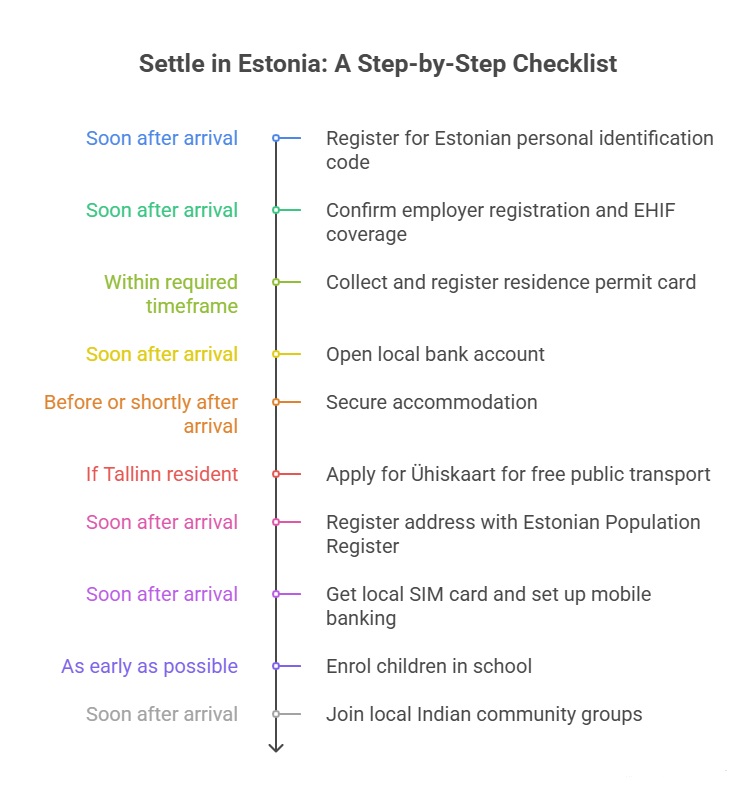
Moving to Estonia involves a few key steps. Complete them in order to avoid delays.
Follow the steps below for a smooth move to Estonia:
Step 1: Register for your Estonian personal identification code at the Police and Border Guard Board soon after arrival
Step 2: Confirm your employer has registered your employment and initiated your EHIF healthcare coverage
Step 3: Complete your residence permit card collection and registration within the required timeframe
Step 4: Open a local bank account with LHV Pank, Swedbank Estonia, or SEB Estonia
Step 5: Secure accommodation before or shortly after arrival
Step 6: Apply for your personalised Ühiskaart for free public transport if you register as a Tallinn resident
Step 7: Register your address with the Estonian Population Register
Step 8: Get a local SIM card and set up mobile banking
Step 9: Enrol children in school as early as possible
Step 10: Join local Indian community groups for support and networking
*Are you looking for step-by-step assistance with overseas immigration? Contact Y-Axis, the world's No. 1 overseas immigration consultancy!
FAQs
What is the easiest way for Indians to move to Estonia?
For most Indian professionals, the easiest route is the temporary residence permit for employment, supported by your employer's application through the Police and Border Guard Board. This covers most skilled roles in IT, engineering, and healthcare. The EU Blue Card is a strong option for highly skilled professionals earning above approximately EUR 37,152 per year, while the Startup Visa suits founders and key employees of Estonia-based startups and has no annual quota limit.
How long does it take to get permanent residency in Estonia?
After 5 years of continuous legal residence in Estonia on a valid residence permit, you may become eligible for a long-term residence permit, provided you meet the B1 Estonian language requirement. Estonian citizenship by naturalisation generally requires 8 years of residence, including the last 5 years on a permanent basis, along with a civics examination and proof of stable income.
Is healthcare free for immigrants in Estonia?
Estonia's public healthcare system is managed by the Estonian Health Insurance Fund (EHIF) and is funded through a 13% employer payroll tax. Once you are employed and registered, you and your eligible dependants can access free or low-cost healthcare. Coverage generally begins within 1 to 2 months after employment starts. Digital Nomad Visa holders must arrange private health insurance.
What is the average salary for skilled workers in Estonia?
Salaries vary depending on occupation and experience. Typical annual salary ranges include:
- IT & Cybersecurity: EUR 40,000–75,000
- Engineering: EUR 35,000–60,000
- Healthcare: EUR 30,000–70,000+
Tallinn generally offers the highest salaries but also has the highest cost of living in Estonia.
Can I bring my family to Estonia on a work visa?
Yes. Most holders of a temporary residence permit or an EU Blue Card can apply for family reunification for their spouse and dependent children after securing stable employment. Eligible family members registered under the principal applicant's EHIF coverage can access Estonia's public healthcare system. Children may attend public schools or international schools, subject to admission requirements.
Which area in Estonia is best for Indian immigrants?
Tallinn is the preferred destination for most Indian immigrants due to its strong job market in IT, startups, finance, and engineering, along with its international community. Tartu is well suited for education and healthcare professionals, while Pärnu and Narva offer lower living costs. The best location depends on your career goals, budget, and lifestyle.
How much does it cost to live in Estonia?
Living costs depend on the city. In Tallinn, a single person can typically expect:
- One-bedroom apartment: EUR 700–1,200 per month
- Utilities: EUR 120–180 per month
- Groceries: EUR 200–300 per month
Living costs are generally lower in cities such as Tartu, Pärnu, and Narva.
What is Estonia's Startup Visa?
The Estonia Startup Visa is designed for founders and key employees of innovative startups approved by the Startup Committee. Unlike most work permits, it has no separate annual quota and can provide residence rights for up to 5 years. Estonia is recognised as one of Europe's leading startup ecosystems.
Do I need to speak Estonian to live in Estonia?
No. English is widely used in Estonia's technology sector and international companies, so many professionals can live and work without speaking Estonian. However, language proficiency becomes important for long-term immigration. Generally:
- A2 level may be required for extending certain employment permits after 5 years.
- B1 level is required for a long-term residence permit.
- B1 level plus a civics examination is required for citizenship by naturalisation.
Can I apply for Estonian citizenship after getting permanent residence?
Yes. After obtaining a long-term residence permit, you may apply for Estonian citizenship by naturalisation once you have completed at least 8 years of residence in Estonia, including the last 5 years on a permanent basis. Applicants must also demonstrate B1-level Estonian language proficiency, pass a civics examination, and meet other legal requirements. Estonia generally does not allow dual citizenship for naturalised citizens.
Tags:
Estonia immigration
Estonia work visa
Estonia permanent residency
Living in Estonia
Cost of living in Estonia
Best areas in Estonia
Jobs in Estonia for Indians
Healthcare in Estonia
Housing in Estonia
Settle in Estonia
Share
Options for you by Y-Axis

Get it on your mobile

Get News alerts

Contact Y-Axis
Latest Article
Popular Post
Trending Article

Posted On September 10 2026
How to Apply for a Greece Work Visa From India