


Posted on September 09 2026
Life in Dubai for Immigrants: Jobs, Visas, Cost of Living & Residency

By , Editor & Director
Updated September 12 2026
Life for immigrants in Dubai is shaped by tax-free salaries, no general work permit quota, and a residency system built around an employer-sponsored work visa or the long-term Golden Visa. Most Indian professionals move to Dubai through a standard employment visa, which needs a confirmed job offer from a UAE-registered employer, since Dubai does not operate a points-based system. The Golden Visa offers 10-year renewable residency for skilled professionals earning a basic salary of AED 30,000 or more, alongside property investors and entrepreneurs. Dubai Marina, Downtown Dubai, Business Bay, and JVC offer the strongest options for professionals, while zero personal income tax, modern infrastructure, and a large Indian community make Dubai attractive for long-term settlement. Long-term residency runs through the Golden Visa, while full UAE citizenship remains reserved for exceptional cases.
Some quick facts about Dubai are as follows:
|
Population |
Approximately 3.9 million (2026), with over 90% of residents being expatriates |
|
Emirate Capital |
Dubai City (Dubai is one of 7 emirates in the UAE; Abu Dhabi is the UAE's federal capital) |
|
Official Language |
Arabic (English is widely used in business and daily life) |
|
Currency |
UAE Dirham (AED) |
|
Popular Immigrant Hubs |
Dubai Marina, Downtown Dubai, Business Bay, JVC, Deira |
|
Economy |
No general work permit quota; employer-sponsored visas and Golden Visa routes; steady demand in technology, finance, healthcare, hospitality, and construction |
|
Typical Route to Long Stay |
Standard employment visa (employer-sponsored) or Golden Visa (10-year, self-sponsored) |
|
Long-Term Residency |
No traditional PR system; Golden Visa offers renewable 10-year residency; UAE citizenship reserved for exceptional merit cases |
*Want to settle in Dubai? Sign up with Y-Axis for end-to-end assistance.
Why Choose Dubai to Migrate Abroad?
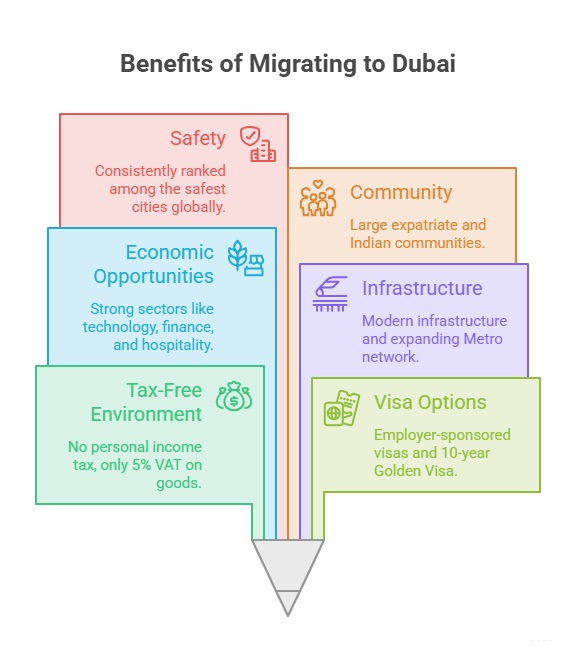
Dubai runs a tax-free, employer-sponsored visa system, with the Golden Visa offering a self-sponsored long-term route for high earners.
Here is why you should choose a life in Dubai:
- No general work permit quota, with a confirmed job offer from a UAE employer the main route to a standard employment visa.
- The Golden Visa offers 10-year renewable residency for professionals earning a basic salary of AED 30,000/month, along with property investors and entrepreneurs.
- Dubai's technology, finance, and hospitality sectors, alongside the DIFC's growing financial hub, offer strong opportunities for skilled professionals.
- Zero personal income tax means your full salary is take-home pay, with only 5% VAT on goods and services.
- Modern infrastructure, an expanding Metro network, and one of the world's largest expatriate and Indian communities.
- Consistently ranked among the safest cities in the world, with a fast-growing job market across technology, real estate, and logistics.
*Want to work in Dubai? Let Y-Axis assist you with the process.
Can I Move to Dubai as an Indian Immigrant?
Most Indian nationals move to Dubai through a standard employer-sponsored work visa, which needs a confirmed job offer, or the Golden Visa for high earners, investors, and entrepreneurs. Dubai does not operate a points-based system for work permits.
The steps to migrate to Dubai as an Indian professional are as follows:
Step 1: Secure a job offer from a UAE-registered employer since most Dubai work permits need this before you apply
Step 2: Select a suitable immigration pathway such as a standard employment visa, Golden Visa, or investor/entrepreneur visa
Step 3: Your employer applies for a work permit (labour approval) through the Ministry of Human Resources and Emiratisation (MOHRE) or the relevant free zone authority
Step 4: Complete your medical fitness test and biometrics for your Emirates ID
Step 5: Get your residence visa stamped in your passport
Step 6: Travel to Dubai once your permit is approved
Step 7: Register for mandatory UAE health insurance and open a local bank account
Also, read...
Highest Paying Job Opportunities in UAE
Best Visa Options to Live in Dubai
Dubai offers several routes depending on your job offer, salary, and profile. The table below shows the main options for skilled workers and their route to long-term residence.
|
Visa Type |
Best For |
Duration |
Long-Term Pathway |
|
Standard Employment Visa |
Job offer from a UAE-licensed employer; no minimum salary set federally |
Typically 2-3 years, renewable |
Renewal tied to employment; Golden Visa if salary/investment criteria met |
|
Golden Visa (Skilled Professional) |
Basic salary of AED 30,000/month in an approved sector |
10 years, renewable |
Self-sponsored, renewable long-term residency |
|
Golden Visa (Property Investor) |
AED 2 million+ in UAE property or an approved bank deposit |
10 years, renewable |
Self-sponsored, renewable long-term residency |
|
Green Visa |
Freelancers, self-employed professionals, and skilled workers without employer sponsorship |
5 years, renewable |
Self-sponsored; renewable if criteria still met |
Also, read...
Best Areas to Live in Dubai
Dubai's job market and living costs vary by area. Choosing the right neighbourhood can influence your commute, cost of living, housing expenses, and overall quality of life.
The table below highlights the major Dubai areas and their best qualities for settlement abroad:
|
Area |
Best For |
Sightseeing |
Average Rent |
Job Market |
How Much You Can Save |
|
Dubai Marina |
Waterfront living & hospitality |
Marina Walk, JBR Beach |
AED 8,000-13,000/mo (1BR) |
Strong, finance & hospitality |
Lower, given highest cost of living |
|
Downtown Dubai |
Corporate HQs & tourism |
Burj Khalifa, Dubai Mall |
AED 9,000-15,000/mo (1BR) |
Strongest overall, highest salaries |
Lower, highest rents |
|
Business Bay |
Business & DIFC-adjacent finance |
Dubai Canal, Museum of the Future |
AED 6,500-10,000/mo (1BR) |
Strong, corporate & finance |
Moderate savings potential |
|
Jumeirah Village Circle (JVC) |
Families & budget-conscious professionals |
Circle Mall, community parks |
AED 4,500-7,000/mo (1BR) |
Good, growing residential hub |
Good savings potential |
|
Deira |
Budget-friendly & trade |
Gold Souk, Dubai Creek |
AED 3,500-6,000/mo (1BR) |
Good, trade & logistics |
Good savings potential |
Note: Rent figures vary by building age, view, and lease terms — confirm current listings before budgeting.
Also, read...
What Are the Most In-Demand Jobs in Dubai for the Next 10 Years?
Cost of Living in Dubai
Dubai's cost of living changes by location. Downtown and Marina cost the most by a wide margin, while areas like JVC, Deira, and Al Furjan remain considerably more affordable.
Below is a breakdown of average monthly expenses for a single adult living outside the most premium areas:
|
Rent (1BR apartment, outside prime area, e.g. JVC/Deira) |
AED 4,500-7,000/month |
|
Utilities (electricity, water & cooling - DEWA) |
AED 600-1,000/month |
|
Groceries |
AED 1,200-1,800/month |
|
Public Transport (Nol card monthly pass) |
AED 300-450/month |
|
Healthcare |
Mandatory private health insurance; basic family plans from AED 700-1,500/year per person; employers typically cover the employee's own policy |
|
Dining Out (per meal) |
AED 40-80 |
|
Mobile & Internet |
AED 300-450/month |
|
Entertainment & Leisure |
AED 800-1,500/month |
Also, read...
What are the Eligibility Requirements for a UAE Work Visa?
Is Dubai Expensive Compared to Abu Dhabi or Doha?
Dubai is roughly 12-13% more expensive than Abu Dhabi and about 12% pricier than Doha in Qatar for overall cost of living, driven mainly by higher rents in prime areas.
Salaries for skilled professionals in Dubai are proportionally strong against costs outside prime neighbourhoods, so many immigrants build meaningful savings, particularly in JVC, Deira, and Business Bay.
Downtown and Marina remain the priciest, though salaries in finance and technology there are also the highest. This makes Dubai a strong choice for tax-free earnings once you move away from the most premium districts.
Work in Dubai
Dubai's job market runs on technology, finance, healthcare, construction, and hospitality, with tax-free salaries and steady hiring across free zones and the mainland.
The table below shows some of the most in-demand jobs in Dubai for immigrants.
|
Occupation |
Average Monthly Salary |
Demand Level |
Average Savings |
|
IT & Technology |
AED 22,000-35,000 |
High |
AED 8,000-15,000/month |
|
Finance & Banking |
AED 20,000-35,000 |
High |
AED 8,000-14,000/month |
|
Healthcare (Nurses & Doctors) |
AED 15,000-30,000 |
Very High |
AED 6,000-12,000/month |
|
Construction & Engineering |
AED 15,000-25,000 |
High |
AED 6,000-10,000/month |
|
Hospitality & Tourism |
AED 8,000-15,000 |
High |
AED 3,000-6,000/month |
|
Retail & Logistics |
AED 6,000-12,000 |
Moderate |
AED 2,000-5,000/month |
Settling in Dubai
Once you arrive in Dubai, you need to complete your Emirates ID, arrange health insurance, enrol children in school, and set up your day-to-day essentials.
Here is a quick overview of what to expect during your first weeks in the country:
|
Housing |
Healthcare |
Education for Children |
Banking & Financial Essentials |
|
Search via Property Finder, Bayut, or Dubizzle; competitive rental market in Marina and Downtown |
Health insurance is mandatory for all residents; register with a DHA-approved clinic once your Emirates ID is issued |
Private schools dominate; British, American, and Indian curriculum options are widely available |
Open an account with Emirates NBD, ADCB, or HSBC UAE |
|
Landlords typically require 1-4 rent cheques upfront, plus a 5% security deposit |
Family members' insurance is the sponsor's responsibility unless the employer extends cover |
Annual fees range from AED 15,000 (Indian curriculum) to AED 90,000+ (British/American curriculum) |
An Emirates ID and salary certificate are required before opening a bank account |
|
Allow several weeks to secure a rental in Marina or Downtown, given high demand |
Register for insurance before or shortly after applying for your Emirates ID |
Apply for school places as early as possible; popular schools have waitlists |
Basic accounts can typically be opened within a few days once your Emirates ID is issued |
Golden Visa and Long-Term Residency in Dubai
Long-term residency in Dubai is generally available through the Golden Visa, a renewable 10-year residence permit that does not require employer sponsorship.
Important note: To qualify through the skilled professional route, you generally need a bachelor's degree recognised by the UAE Ministry of Education, an active UAE employment contract, and a basic monthly salary of AED 30,000 in an approved sector such as healthcare, engineering, IT, finance, education, law, aviation, architecture, or science and research. The property route needs AED 2 million or more in certified property value, and the capital investor route needs an equivalent bank deposit or fund investment. Entrepreneurs generally need an active, revenue-generating business, and government fees run from roughly AED 4,695 to AED 10,140 depending on the route. Processing typically takes a few weeks once documents are complete. UAE citizenship remains reserved for exceptional merit cases, such as investors, scientists, doctors, engineers, and artists nominated by the Rulers' and Crown Princes' Courts, and allows dual nationality. Standard naturalisation after 30 years of continuous residence is technically possible but rarely used in practice.
|
Main Immigration Routes |
Approximate Timeline |
|
Standard Employment Visa Holder |
Renewed every 2-3 years with continuous employment; convertible to a Golden Visa if salary or investment criteria are met |
|
Golden Visa (Skilled Professional or Investor) |
10-year renewable residency; eligibility re-verified at each renewal |
|
Green Visa Holder |
5-year renewable residency for freelancers and self-sponsored professionals |
|
UAE Citizenship (Exceptional Merit) |
Reserved for investors, scientists, doctors, and specialists nominated by Emirati authorities; the standard naturalisation route needs 30 years of continuous residence |
Dependent Benefits for Immigrants in Dubai
Dubai allows eligible visa holders to sponsor immediate family members, generally once their own salary meets the sponsorship threshold.
Here are the benefits of securing a Dubai dependent visa:
- Male residents can sponsor a spouse and children with a minimum salary of AED 4,000/month, or AED 3,000/month plus employer-provided accommodation
- Female residents generally need a minimum salary of AED 10,000/month, or AED 8,000/month with accommodation, to sponsor family
- Dependent children can enrol in Dubai's private schools, including Indian, British, and American curriculum options
- Family members need their own mandatory health insurance, arranged by the sponsor unless the employer extends cover
- Parents can be sponsored at a higher income threshold, generally AED 20,000/month, or AED 10,000/month through the GDRFA humanitarian route
Practical Settlement Checklist for Indians Moving to Dubai
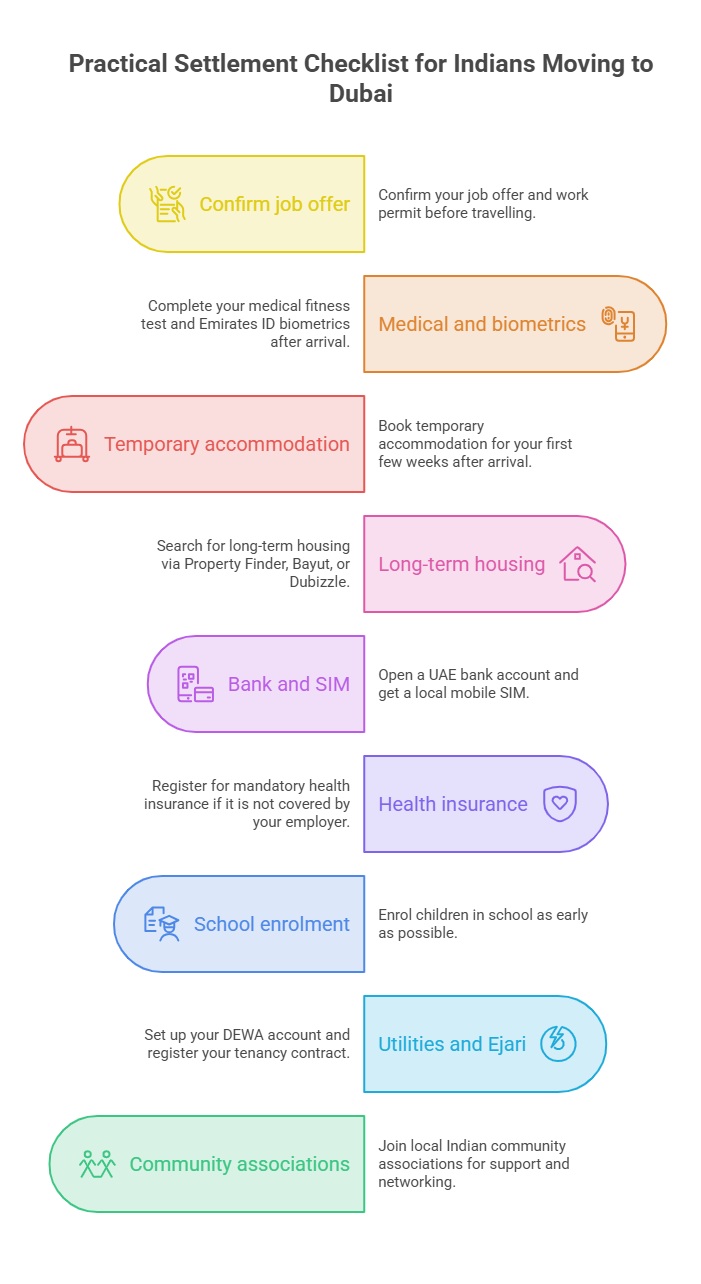
The steps for smooth transition to Dubai for Indians are as follows:
Step 1: Confirm your job offer and work permit before travelling, since Dubai's employment visa route requires this in advance
Step 2: Complete your medical fitness test and Emirates ID biometrics after arrival
Step 3: Book temporary accommodation for your first few weeks after arrival
Step 4: Search for long-term housing via Property Finder, Bayut, or Dubizzle
Step 5: Open a UAE bank account and get a local mobile SIM
Step 6: Register for mandatory health insurance if it is not covered by your employer
Step 7: Enrol children in school as early as possible, given high demand for popular curriculums
Step 8: Set up your DEWA (electricity and water) account and register your tenancy contract (Ejari)
Step 9: Join local Indian community associations for support and networking
*Are you looking for step-by-step assistance with UAE immigration? Contact Y-Axis, the world's No. 1 overseas immigration consultancy!
FAQs
What is the easiest way for Indians to move to Dubai?
Most Indians move through a standard employer-sponsored work visa, which needs a confirmed job offer, or the Golden Visa for high earners, investors, and entrepreneurs. The employment visa route generally requires a job offer secured before you apply, since Dubai does not offer a general points-based work permit route.
Does Dubai have a general work permit quota?
No. Dubai does not operate a general annual quota system for foreign workers. Work permits are issued based on a confirmed job offer from a UAE-licensed employer, processed through MOHRE or the relevant free zone authority, with no fixed national cap on the number of permits issued.
Can I move to Dubai without a job offer?
It is very difficult without a job offer, since the standard employment visa requires confirmed employment before you apply. The Golden Visa offers a self-sponsored alternative for skilled professionals earning AED 30,000/month, property investors, and entrepreneurs, while the Green Visa suits freelancers and self-employed professionals.
Is healthcare free for immigrants in Dubai?
No. Dubai does not have free public healthcare for expatriates. Health insurance is mandatory for all residents, and employers typically cover the employee's own policy. Basic family health insurance plans start from around AED 700 to AED 1,500 per person per year, depending on age and coverage level.
What is the average salary for skilled workers in Dubai?
Salaries vary by sector and seniority. IT professionals typically earn AED 22,000-35,000/month, finance professionals earn AED 20,000-35,000/month, and healthcare workers earn AED 15,000-30,000/month. Dubai has no personal income tax, so the salary on your contract is close to your full take-home pay.
Can I bring my family to Dubai on a work visa?
Yes. Male residents can sponsor a spouse and children with a minimum salary of AED 4,000/month, or AED 3,000/month with employer-provided accommodation. Female residents generally need AED 10,000/month, or AED 8,000/month with accommodation. Dependent children can enrol in Dubai's private schools once sponsored.
Which area in Dubai is best for Indian immigrants?
Downtown Dubai and Dubai Marina offer the strongest job markets and largest international communities, though they come with the highest cost of living. Business Bay suits finance professionals at a slightly lower cost, while JVC and Deira suit budget-conscious families and professionals.
How much does it cost to live in Dubai?
Dubai's cost of living varies sharply by area. In Downtown or Marina, a single person can expect to pay AED 8,000-15,000 for a one-bedroom apartment, while areas like JVC and Deira cost roughly AED 3,500-7,000 for similar housing. Groceries, utilities, and transport add several thousand AED a month on top.
How long does it take to get a Golden Visa in Dubai?
Golden Visa processing typically takes a few weeks once your documents are complete, and government fees run from roughly AED 4,695 to AED 10,140 depending on the route. The skilled professional route needs a basic salary of AED 30,000/month in an approved sector, while the property route needs AED 2 million or more in certified property value.
How can I get UAE citizenship?
UAE citizenship is highly restrictive and generally reserved for exceptional merit cases, such as investors, scientists, doctors, engineers, and artists nominated by the Rulers' and Crown Princes' Courts. A standard naturalisation route exists after 30 years of continuous residence, but it is rarely used in practice. Most long-term residents instead rely on the renewable 10-year Golden Visa.
Tags:
Dubai immigration
Dubai work visa
Dubai Golden Visa
Living in Dubai
Cost of living in Dubai
Best areas in Dubai
Jobs in Dubai for Indians
Healthcare in Dubai
Housing in Dubai
Settle in Dubai
Share
Options for you by Y-Axis

Get it on your mobile

Get News alerts

Contact Y-Axis
Latest Article
Popular Post
Trending Article
Posted On October 22 2026
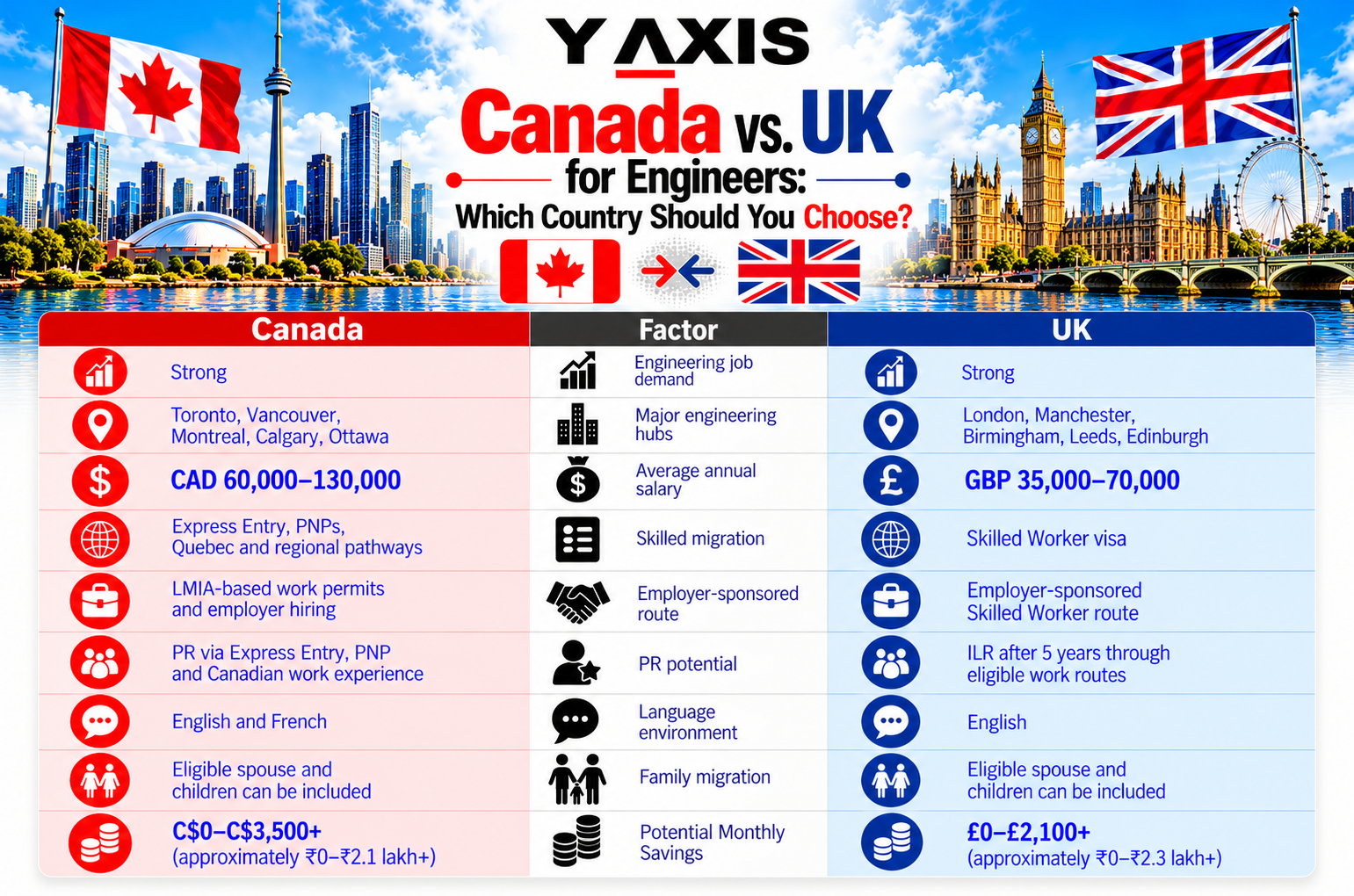
Canada vs. UK for Engineers: Which Country Should You Choose?