


Posted on April 22 2026
How Long Can You Stay in Ireland After Graduation?

By , Editor
Updated April 26 2026
You can stay and work in Ireland after completing your studies through the Third Level Graduate Programme. This programme allows international students, including Indians, to remain in Ireland and look for a job after finishing their degree. The duration of your stay depends on your qualification level. Students who complete a Level 8 (Honours Bachelor’s) degree can stay for up to 12 months. Students who complete a Level 9 (Master’s) or Level 10 (PhD) degree can stay for up to 24 months. This usually starts with an initial 12 months, which can be renewed for another 12 months. During this period, you can search for jobs, attend interviews, and start working, helping you gain valuable international work experience.
*Want to work in Ireland? Contact Y-Axis for complete guidance
What Is the Third Level Graduate Programme in Ireland?
The Third Level Graduate Programme is Ireland’s official post-study work option for international students. It allows students who have completed a degree from an Irish university to stay in Ireland and look for a job, even without having a job offer.
This programme is managed by the Irish Immigration Service (IIS), formerly called INIS. Under this programme, graduates receive a Stamp 1G permission. This is not a visa, but a type of permission that lets you stay in Ireland and work while searching for a job or starting employment in any field.
After you find a job that meets the required salary level, you can apply for a full work permit, such as the Critical Skills Employment Permit or the General Employment Permit. These permits allow you to stay and work in Ireland for a longer period.
Duration of Stay After Studying in Ireland
The length of time you can stay in Ireland after your studies depends on your qualification level. The table below shows the maximum stay allowed under the programme:
| Qualification Level | Duration of Stay |
|---|---|
| NFQ Level 8 (Honours Bachelor’s Degree) | 12 months |
| NFQ Level 9 (Master’s Degree) | Up to 24 months (12 months + 12 months extension) |
| NFQ Level 10 (PhD / Doctorate) | Up to 24 months (12 months + 12 months extension) |
Important points to remember:
- For Level 9 and Level 10 graduates, the second 12 months is not automatic. You need to show proof that you are actively looking for a job, such as attending interviews or registering with job agencies.
- Your total stay in Ireland, including your study period, should not be more than 7 years for Level 8 graduates and 8 years for Level 9 and Level 10
- You must apply for this programme within 6 months of getting your final results, and your student permission must still be valid at the time of application.
*Want to study in Ireland? Contact Y-Axis for end-to-end support
How to Apply for the Third Level Graduate Programme
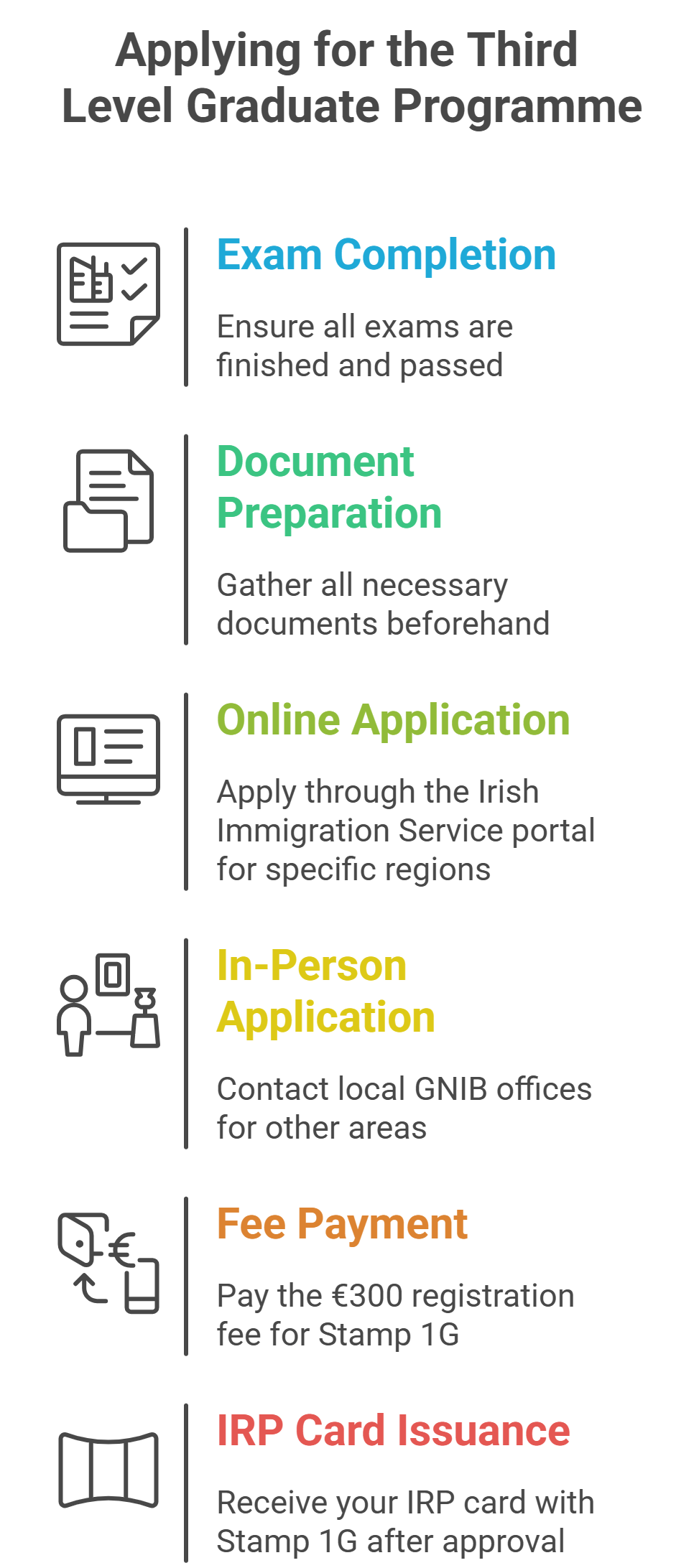
Step 1: Finish all your exams and get official written confirmation from your university or college that you have passed your course.
Step 2: Prepare all the required documents. Keep them ready before you apply.
Step 3: Apply online or in person. Students in Dublin, Meath, Kildare, Wicklow, Cork, and Limerick should apply online through the Irish Immigration Service portal.
Students in other areas should contact their local Garda National Immigration Bureau (GNIB) office.
Step 4: Pay the registration fee. The fee for Stamp 1G is €300.
Step 5: After approval, you will receive your Irish Residence Permit (IRP) card with Stamp 1G. This card allows you to legally stay and work in Ireland.
Tips for Staying and Working in Ireland After Graduation
Staying and working in Ireland after graduation is a great opportunity, but good planning is important. Here are some simple tips to help you:
- Apply within 6 months of your results: Do not delay. Apply for the programme as soon as you get your final results. Make sure your Stamp 2 student permission is still valid when you apply.
- Keep track of your total stay: Your time as a student is also counted. Make sure you do not cross the 7–8 year limit based on your qualification.
- Keep your IRP cards safe: Save all your immigration documents. You may need them later when applying for work permits.
- Build connections while studying: Try to meet people in your field. Attend career fairs and use platforms like LinkedIn to find job opportunities.
- Look for jobs in popular sectors: Ireland has many job opportunities in technology, pharmaceuticals, finance, and healthcare. Many global companies like Google, Meta, and Microsoft have offices in Dublin.
- Check the Critical Skills Occupation List: If your job is on this list, it becomes easier to get a long-term work permit.
- Apply for a PPS Number (PPSN): Once you start working, register for a PPSN with the Department of Social Protection and complete your tax setup.
- Plan your money carefully: Living costs, especially in Dublin, can be high. Plan your budget for rent, travel, food, and insurance.
*Planning to study and work abroad? Contact Y-Axis, the world's No. 1 overseas immigration consultancy, for expert guidance on university selection, post-study work options, and visa applications.
FAQs
Can Indian students stay in Ireland after graduation?
Indian students can stay in Ireland after graduation if they complete a Level 8 or Level 9 degree from a recognised Irish university. They can apply for the Third Level Graduate Programme, which allows them to remain in the country after finishing their studies. This programme helps students find a job or start working in Ireland. Depending on the qualification level, students can stay for 12 to 24 months. This time is very useful to gain international work experience and explore long-term career opportunities.
What is the Stamp 1G permission in Ireland?
Stamp 1G is a special immigration permission given to international students after they complete their studies in Ireland. It allows graduates to stay in the country and work without needing a job offer before applying. With Stamp 1G, you can take up full-time or part-time jobs while also searching for better career opportunities. This permission is part of the Third Level Graduate Programme and is useful for gaining work experience. It also helps you move towards a long-term work permit if you find a suitable job.
How long can I stay in Ireland after completing a master's degree?
If you complete a master’s degree (NFQ Level 9) in Ireland, you can stay in the country for up to 24 months under the graduate programme. Initially, you will be given permission for 12 months. After that, you can apply for another 12-month extension. To get this extension, you must show that you are actively looking for a job, such as attending interviews or applying regularly. This period allows you to find a good job and gain work experience in Ireland.
Do I need a job offer to apply for the Third Level Graduate Programme?
A job offer is not required to apply for the Third Level Graduate Programme. You can apply once you receive official confirmation that you have completed your degree. The programme is designed to give you time to search for a job after your studies. During this period, you can attend interviews, apply for jobs, and even start working. This makes it easier for international students to settle in Ireland and find suitable employment without pressure.
Can I extend my stay in Ireland after the graduate programme ends?
You can stay longer in Ireland after the graduate programme if you find a suitable job. Once you secure a job that meets salary and skill requirements, you can apply for a work permit such as the Critical Skills Employment Permit or the General Employment Permit. These permits allow you to live and work in Ireland for a longer time. This is an important step if you plan to build a long-term career and possibly settle in Ireland.
How much money do I need to show for the Stamp 1G application?
There is no fixed amount mentioned by the authorities for the Stamp 1G application. However, you should show that you have enough money to support yourself while you are looking for a job. It is generally recommended to have around €3,000 to €5,000 in your bank account. This shows that you can manage your living expenses, such as rent, food, and travel, during your job search period in Ireland.
What is the application deadline for the Third Level Graduate Programme?
You must apply for the Third Level Graduate Programme within 6 months of receiving official confirmation that you have completed your degree. It is also important that your current student permission is still valid at the time of application. If you miss this deadline, your application may be rejected, and you could lose the chance to stay in Ireland under this programme. Applying early helps avoid last-minute issues and gives you more time to plan your next steps.
Can I work full-time on Stamp 1G in Ireland?
You can work full-time in Ireland while holding a Stamp 1G permission. This means you can take up jobs without any hourly limit, unlike student permissions. You are also allowed to work in any sector or role while searching for a better job. This gives you the freedom to earn income and gain experience at the same time. However, it is important to focus on finding a job that matches your qualification for long-term career growth.
Can I change jobs during the graduate programme in Ireland?
You can change jobs while you are on the Third Level Graduate Programme. There are no strict restrictions on switching employers or roles during this period. This flexibility allows you to explore different job opportunities and find a role that suits your skills and career goals. However, it is better to focus on jobs related to your field of study, as this will help you later when applying for a long-term work permit in Ireland.
What happens if I do not find a job during the graduate programme?
If you do not find a job during the graduate programme, you may have to leave Ireland once your permission ends. This programme is temporary and mainly designed to help you find work. If you are unable to secure a job that meets work permit requirements, you cannot extend your stay further under this scheme. In such cases, you can explore other options like applying for studies again or looking for opportunities in another country.
Tags:
Stay and work in Ireland after graduation
Ireland post study work visa
Ireland Third Level Graduate Programme
Ireland graduate visa Indian students
Work in Ireland after masters
Ireland stay back option
Post study work permit Ireland
Share
Options for you by Y-Axis

Get it on your mobile

Get News alerts

Contact Y-Axis
Latest Article
Popular Post
Trending Article
Posted On October 16 2026
Australia Updates Health Insurance Guidance for Visa Holders: What You Need to Know