

Posted on October 29 2026
International Graduates Could Generate US$1.7 Trillion: Which Countries Are Winning the Global Talent Race?

By , Editor & Director
Updated October 31 2026
~ Dr. Serah Vinodini Vilvaraj
International education is often measured by tuition fees; university revenue and the money students spend while studying abroad. But a new global study suggests that the biggest economic contribution may come after graduation — when international students enter the workforce, build businesses and apply their skills over decades of employment.
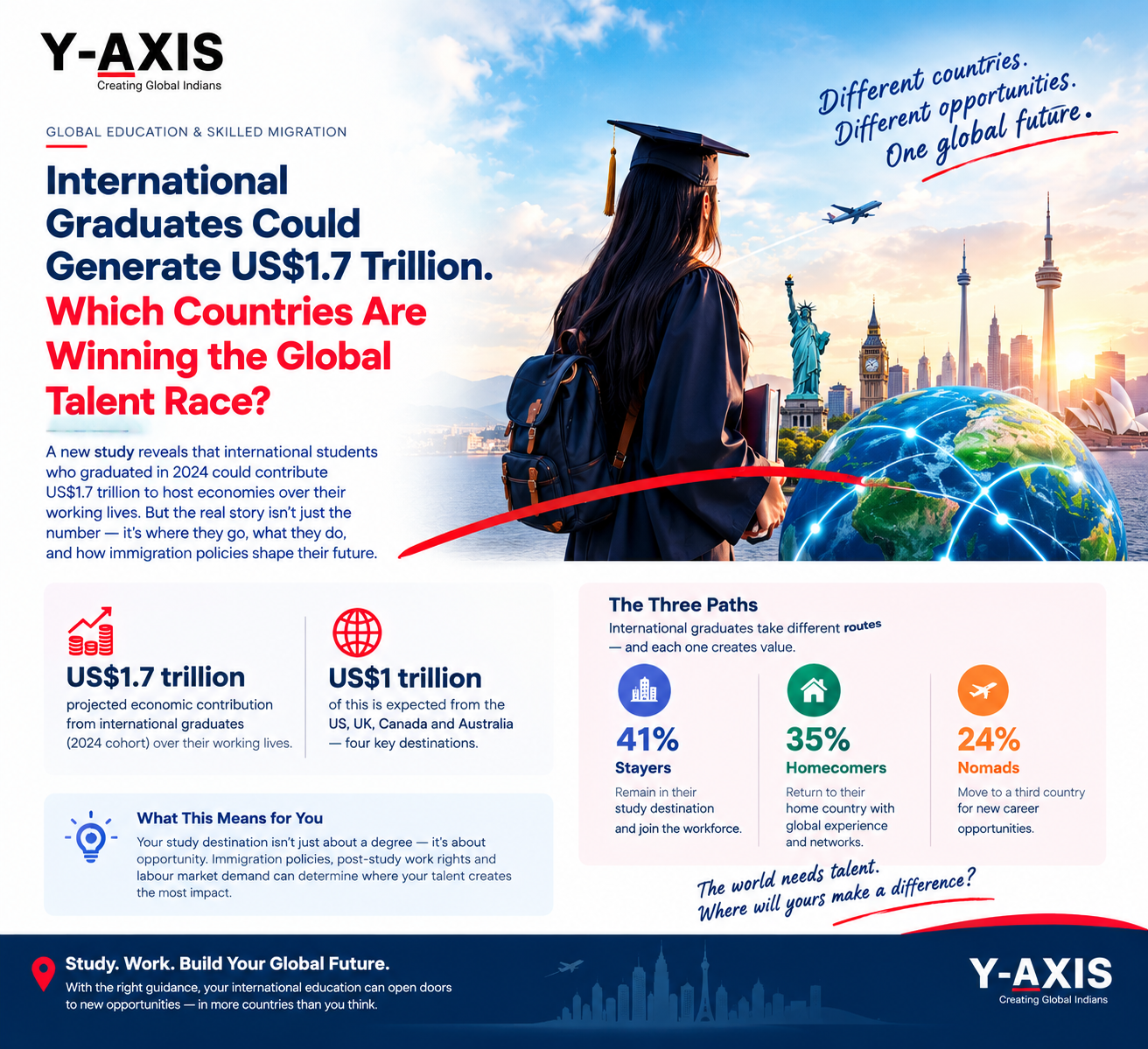
According to Talent Beyond Borders: The Global Impact of International Graduates, a study developed by Study portals and Cambridge IELTS, international students who graduated worldwide in 2024 are projected to generate approximately US$1.7 trillion in economic output over their working lives in the countries where they studied and subsequently work. The United States, the United Kingdom, Canada and Australia are expected to account for approximately US$1 trillion of that projected value. Together, these four destinations host around 35% of the world's international students but capture a disproportionately large share of the projected economic contribution from the 2024 graduating cohort.
The findings raise an important question for students planning an international education: Is the best study destination the country where you earn your degree, or the country where you can build your career afterwards? The answer increasingly depends on employment opportunities, immigration rules and whether graduates can find a viable reason to stay.
What does the US$1.7 trillion figure actually mean?
The report moves beyond the traditional measurement of international education, which tends to focus on tuition fees, accommodation and student spending during a university course. Instead, it estimates the longer-term economic output associated with international graduates who remain in their study destination and enter its workforce.
The researchers estimate that approximately 2.67 million international students graduated in 2024. Around 41% are expected to remain in their study destination after graduation, representing approximately 1.1 million people entering host-country labour markets. This group is projected to generate approximately US$110 billion in economic output in its first year of work, rising to an estimated US$1.7 trillion over its working lifetime.
These are projections, not guaranteed future earnings or government tax revenues. The estimate depends on employment, productivity and graduate-retention patterns, and should not be interpreted as money paid directly to governments or universities. The distinction matters because a country may benefit economically from an international student long after tuition has been paid. A graduate who enters a shortage-affected profession, develops new technology or establishes a business may contribute to the economy for many years.
The three paths international graduates take
The research divides international graduates into three groups: Stayers, Homecomers and Nomads. Each represents a different way international education can influence the global workforce.
|
Graduate pathway |
Share of international graduates |
What it means |
|
Stayers |
41% |
Remain in the country where they studied and join its workforce. |
|
Homecomers |
35% |
Return to their country of origin with international qualifications, experience and networks. |
|
Nomads |
24% |
Move to a third country to pursue employment or other career opportunities. |
Source: Talent Beyond Borders, Studyportals and Cambridge IELTS.
The figures show that international education does not automatically result in graduates remaining permanently in their study destination. Nearly six in ten follow a different path, returning home or moving elsewhere.
For destination countries, retaining graduates can help address skills shortages. For countries of origin, returning graduates can bring back expertise and international connections. For countries attracting mobile professionals, graduates can become a source of talent even if they studied elsewhere. This is why international education and immigration policy are closely connected: the country that provides the qualification does not necessarily become the graduate's long-term home.
Which countries retain the most international graduates?
The study highlights differences in the proportion of graduates who remain in their study destination. Among the destinations reported in the research, Canada has a particularly high retention rate.
|
Study destination |
International graduates who stay |
|
Canada |
66% |
|
Australia |
53% |
|
Germany |
49% |
|
Ireland |
45% |
|
United States |
44% |
|
United Kingdom |
Approximately 40% |
Source: Talent Beyond Borders research findings reported by Cambridge English and Studyportals. Figures are rounded where appropriate.
Canada's reported 66% retention rate is notably higher than those of the other destinations in this comparison. However, these figures describe the cohort and methodology examined in the report; they should not be treated as a guarantee of an individual student's chances of remaining in a country. The report also notes that the 2024 cohort predates some significant changes in international student policies, including Canada's restrictions on study permits. Historical retention rates are therefore useful for comparison, but they are not reliable forecasts of future outcomes under changed immigration rules. For students deciding where to study in 2026 and beyond, the practical question is whether the destination still offers a realistic route from graduation to suitable employment.
Why the United States, UK, Canada and Australia capture so much value
The four leading destinations have established international education systems and attract large numbers of students from abroad. Their universities, employers and research institutions connect graduates with professional opportunities across multiple sectors. The study estimates that these countries together will account for approximately US$1 trillion in lifetime economic output from the international students who graduated in 2024.
However, the figure does not mean that all international graduates in these countries will remain, obtain high-paying jobs or qualify for permanent residence. The ability to turn a degree into a career depends on several factors:
- Post-study work rights: Whether graduates can legally remain and work after completing their qualifications.
- Employer demand: Whether suitable jobs exist in their fields and whether employers are willing and able to recruit international candidates.
- Immigration eligibility: Whether graduates qualify for work permits, employer-sponsored visas or other relevant routes.
- Career progression: Whether they can develop their skills, earn competitive salaries and build long-term professional experience.
A country may attract large numbers of students but lose potential talent if graduates cannot find suitable employment or obtain permission to remain. Conversely, a destination with strong demand for particular skills may benefit from retaining graduates who already understand its institutions and labour market.
Where do international graduates make the biggest difference?
The research identifies several fields in which graduates who remain in their study destination represent a particularly important share of international graduates.
|
Field of study |
Share classified as Stayers |
|
Engineering and Technology |
59% |
|
Computer Science and IT |
56% |
|
Medicine and Health |
48% |
Source: Talent Beyond Borders research findings.
These figures are relevant to countries facing shortages in technical, digital and healthcare occupations. International graduates may already have relevant qualifications and experience with the country where they studied, although professional registration, licensing and immigration requirements can still apply. For students, this does not mean that choosing one of these subjects guarantees a job or visa. Labour demand varies by occupation, location and time, and some professions require additional examinations or registration.
The more useful takeaway is to compare a course with the destination's actual employment and immigration requirements before investing in an overseas qualification.
What happens when graduates return home?
The economic contribution of international education does not stop when graduates leave their study destination. The report estimates that 35% of international graduates return to their country of origin. These Homecomers may bring back technical knowledge, international work experience, research expertise and professional contacts developed overseas. Their contribution can include transferring knowledge to local businesses, establishing companies, strengthening universities and research institutions, and connecting domestic employers with international markets.
For countries seeking to develop advanced industries or improve research capacity, returning graduates can act as a bridge between domestic talent and global expertise. The outcome depends on whether graduates can find relevant jobs, competitive opportunities and suitable professional environments when they return. A foreign qualification alone does not guarantee that their skills will be fully used at home.
Why do some graduates move to a third country?
The remaining 24% of international graduates are classified as Nomads because they move to a country other than their place of study or origin. This group illustrates how international careers can develop across several borders. A person may study in one country, gain initial work experience in another and later move to a third destination offering a suitable role. For these graduates, the decision is not simply about choosing a university. It also involves evaluating professional opportunities, visa eligibility, salary prospects, family considerations and long-term settlement options.
However, an international degree does not automatically confer work rights in another country. Graduates moving to a third destination must still meet that country's visa, employment and qualification requirements. For prospective students, this makes it important to understand whether a qualification is recognised in the countries where they may eventually want to work.
What should international students consider before choosing a destination?
The findings reinforce the importance of looking beyond university rankings and tuition fees when comparing study-abroad options.
Before committing to a course, students should investigate:
1. Post-study work options: Check the current rules, duration of permitted stay and eligibility conditions for graduates.
2. Employment prospects: Review realistic job opportunities in the chosen field rather than relying solely on general claims about skills shortages.
3. Long-term immigration routes: Determine whether relevant work experience could support another visa or residence application, without assuming that progression is automatic.
4. Qualification recognition: Confirm whether the qualification meets professional or licensing requirements in the intended job market.
5. Financial exposure: Compare tuition, living costs and the possibility of needing to leave if employment or visa plans do not work out.
6. Alternative career destinations: Consider whether the qualification and experience could be useful in the home country or another country if the original plan changes.
Students should use official immigration and professional-regulatory websites to verify current conditions. Visa rules can change between the time a student enrols and the time they graduate.
The bigger picture: Countries are competing for talent, not just students
The Talent Beyond Borders findings offer a different way to assess international education. Students contribute to host economies during their studies, but their longer-term contribution can extend through employment, research, entrepreneurship and professional networks.
For governments, the challenge is to turn education into a sustainable talent pipeline while maintaining credible immigration systems. For universities, it means recognising that students' career outcomes matter beyond graduation. For students, it means considering the entire journey — from admission and study costs to employment and the immigration options available afterwards.
The central lesson is that a study destination's value cannot be measured by the degree alone. It also depends on what graduates can realistically do with that degree once their studies end.
The US$1.7 trillion projection captures the potential economic scale of one graduating cohort. The longer-term question is which countries will continue to create the conditions that allow international graduates to contribute - and whether students can build the careers they originally went abroad to pursue.
Sources
- Cambridge English, International students contribute US$1.7 trillion to their host economies through their careers, 15 October 2026.
- Studyportals, Talent Beyond Borders: International graduates' projected economic contribution.
- Cambridge English, Studyportals and Cambridge University Press & Assessment partnership on international graduate impact.
FAQs
1. How much could international graduates contribute to host economies?
The Talent Beyond Borders study estimates that international students who graduated in 2024 could generate approximately US$1.7 trillion in economic output over their working lives in their study destinations, based on the report's assumptions and graduate-retention patterns.
2. Which countries could gain the most from international graduate talent?
The United States, United Kingdom, Canada and Australia are projected to account for approximately US$1 trillion of the total estimated lifetime economic output from the 2024 graduating cohort.
3. What percentage of international graduates stay in their study destination?
The report classifies 41% of international graduates as Stayers, meaning they remain in the country where they studied and join its workforce.
4. What are Homecomers and Nomads in the report?
Homecomers are graduates who return to their country of origin, representing 35% of the graduates covered by the report. Nomads are those who move to a third country, representing 24%.
5. Which country has the highest graduate-retention rate in the comparison?
Canada has a reported retention rate of 66% in the study's comparison, followed by Australia at 53%. These figures reflect the research cohort and should not be interpreted as guarantees for future applicants.
6. Which fields have a high proportion of international graduates staying?
The report identifies Engineering and Technology at 59%, Computer Science and IT at 56%, and Medicine and Health at 48% among graduates classified as Stayers.
7. Does studying abroad guarantee a work visa or permanent residence?
No. A degree does not automatically provide permission to work, remain or settle permanently. Graduates must meet the immigration, employment and any professional-registration requirements of their destination.
8. Can a country benefit if international graduates return home?
Yes. Returning graduates can bring back knowledge, professional experience, research expertise and international networks that may benefit employers, universities and businesses in their home country.
Tags:
International Students
Study Abroad
Graduate Immigration
Global Talent Mobility
Post-Study Work Visa
International Graduates
Canada Immigration
UK Immigration
Australia Immigration
Global Education Trends
Share
Options for you by Y-Axis

Get it on your mobile

Get News alerts

Contact Y-Axis
Latest Article
Popular Post
Trending Article

Posted On November 02 2026
France Reduces Work Permit Restriction to 6 Months and Residence Decisions to 90 Days