


Posted on September 09 2026
How to Apply for a Philippines Work Visa From India

By , Editor & Director
Updated September 12 2026
Applying for a Philippines work visa from India requires you to first secure a job offer from a Philippine employer. The employer applies for an Alien Employment Permit (AEP) through the Department of Labor and Employment (DOLE), which now includes a mandatory 30-day job posting on PhilJobNet. Once DOLE approves the AEP, you can apply for the 9(g) Pre-Arranged Employment Visa at a Philippine Embassy or Consulate in India. Professionals wanting to start work sooner must have their employer request a Provisional Work Permit (PWP), valid for up to three months while the 9(g) visa is processed. The 9(g) visa is officially called the Pre-Arranged Employment Visa, issued by the Bureau of Immigration. After entering the Philippines, you must obtain an ACR I-Card and file an Annual Report between January 1 and March 1 each year. Indian professionals joining PEZA or BOI-registered employers can apply through the faster 47(a)(2) visa instead.
*Want to apply for a Philippines work visa? Let Y-Axis assist you with the process.
How to Apply for a Philippines Work Visa From India?
To apply for a Philippines work visa, foreign professionals should secure a job offer from a Philippine employer. The employer then applies for an Alien Employment Permit on your behalf, before you apply for the 9(g) visa in India and complete post-arrival formalities after you land.
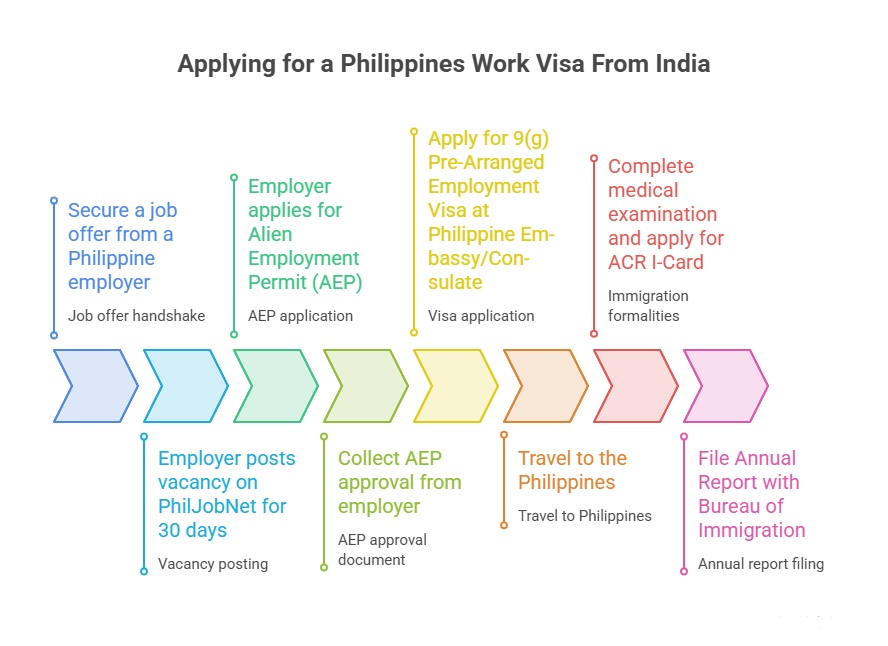
The steps to apply for a Philippines work visa for Indians are as follows:
Step 1: Secure a job offer from a Philippine employer.
Step 2: Your employer posts the vacancy on PhilJobNet for 30 days, as required under DOLE Order No. 248.
Step 3: Your employer applies for the Alien Employment Permit (AEP) through DOLE's Online Application and Payment System.
Step 4: Once approved, collect a copy of the AEP approval from your employer.
Step 5: Apply for the 9(g) Pre-Arranged Employment Visa at the Philippine Embassy or Consulate in India. You can request a Provisional Work Permit if you need to start work sooner.
Step 6: Travel to the Philippines using your approved visa or permit.
Step 7: Complete a medical examination and apply for your ACR I-Card at the Bureau of Immigration.
Step 8: File your Annual Report with the Bureau of Immigration every year between January 1 and March 1.
Also, read...
What are the eligibility requirements for a Philippines work visa?
Requirements for the Philippines Work Visa
Before you apply for a Philippines work visa from India, you must meet certain eligibility conditions and prepare the right documents. The process is largely employer-driven for the standard 9(g) visa, so most conditions relate to your job offer and your sponsoring company. The list below combines the key eligibility conditions and documents required for a Philippines work visa from India.
- A valid job offer or signed employment contract from a Philippine employer.
- Alien Employment Permit (AEP), approved by the Department of Labor and Employment.
- A valid passport with at least 6 months' validity.
- Educational certificates and professional qualifications, translated and notarised if not in English.
- Work experience letters relevant to your job role.
- Passport-size photographs meeting Philippine visa specifications.
- Proof of accommodation in the Philippines.
- Medical examination certificate, confirming fitness to work.
- Police clearance certificate, showing no criminal record.
- Health insurance, generally arranged after arrival.
Also, read...
Philippines Job Market: Trends & Job Opportunities
Cost of Applying for a Philippines Work Visa From India
The total cost of a Philippines work visa from India includes a few separate charges, paid to different authorities at different stages. Most costs relate to the visa fee, the Alien Employment Permit, and document processing before and after arrival.
The table below shows the approximate fee for each stage, based on current 2026 rates.
|
Cost Item |
Fee (INR) |
Notes |
|
9(g) Visa Fee |
INR 38,400 (approx.) |
Payable at the Philippine Embassy or Consulate in India |
|
Alien Employment Permit (AEP) |
INR 13,500 per year |
Paid by employer to DOLE; renewed annually |
|
ACR I-Card |
INR 4,050 (approx.) |
Mandatory after arrival; needed for international travel |
|
Medical Examination |
INR 2,200–4,400 |
Required before or after arrival |
|
Document Translation & Notarisation |
INR 750–3,000 |
Required for documents not in English |
|
Express Processing Fee (BI) |
INR 750–1,800 |
Optional, depending on service requested |
*Are you looking for step-by-step assistance with overseas immigration? Contact Y-Axis, the world's No. 1 overseas immigration consultancy, for end-to-end assistance!
FAQs
Can I apply for a Philippines work visa without a job offer?
No. The standard 9(g) visa route always requires a confirmed job offer, since your employer must first secure an Alien Employment Permit from DOLE. Short-term assignments of up to six months can use the Special Work Permit (SWP) instead, which still needs a job contract but not a full AEP. There is no equivalent no-offer talent visa for the Philippines at present.
What is the processing time for a Philippines work visa from India?
A standard 9(g) visa generally takes 1 to 3 months, though DOLE's 2026 reforms add about 30 days for the mandatory PhilJobNet posting before the AEP can be filed. The Special Work Permit is faster, at 5 to 10 working days. If you need to start work immediately, a Provisional Work Permit takes about 2 to 3 weeks.
What is the 59-day rule after losing my job in the Philippines?
If you resign, are terminated, or change employers, your 9(g) visa must be downgraded to a 9(a) tourist visa at the Bureau of Immigration. You then have 59 days to secure a new employer and AEP, or to leave the country. Missing this window can lead to an overstay fine of PHP 500 per day.
Do I need a medical test for a Philippines work visa?
Yes. A medical examination certificate is a standard requirement for Philippines work visa applicants, confirming that you are fit to work. Depending on your employer and role, this test may be completed before departure or after you arrive in the Philippines.
Can my spouse and children join me in the Philippines?
Yes. Family members of foreign workers can apply for a 9(a) visa as dependents, or a 13(a) visa if related to a Filipino citizen. These are separate from your own work visa and need their own documentation and processing time.
What is the difference between the 9(g) visa and the Special Work Permit (SWP)?
The 9(g) visa is for long-term employment and requires a full Alien Employment Permit from DOLE. The Special Work Permit is a fast-track option for short-term work of up to six months, and does not require an AEP or 9(g) conversion, though it still needs a valid job contract.
Is a Philippines work visa the same as a work permit?
No. The 9(g) visa is your immigration status, allowing you to reside in the Philippines for employment purposes. The Alien Employment Permit (AEP) is a separate document from DOLE that authorises your specific job role, and both are required together for legal employment.
Can I switch employers while on a Philippines work visa?
Changing employers requires your previous employer to notify the Bureau of Immigration and DOLE within 3 working days, and your new employer to file a fresh AEP and 9(g) petition. Working for a different employer without updating your status is not permitted under Philippine immigration rules.
What happens if my Philippines work visa application is rejected?
If your AEP or 9(g) application is rejected, DOLE or the Bureau of Immigration will typically state the reason, such as incomplete documentation or a failed economic needs test. You can usually reapply once the issue is resolved. Since visa fees are generally non-refundable, review requirements carefully with your employer or a visa consultant before applying.
Does a Philippines work visa lead to permanent residency?
Yes, though it typically requires 10 consecutive years of legal residence under the 13(g) visa category. Faster alternatives exist for specific profiles, such as the Special Investor Resident Visa for a minimum investment, or the Special Resident Retiree's Visa for applicants aged 40 and above.
Tags:
Philippines work visa
Philippines 9(g) visa
Philippines work visa from India
Alien Employment Permit
AEP Philippines
work in Philippines
Philippines visa requirements
Philippines immigration for Indians
Share
Options for you by Y-Axis

Get it on your mobile

Get News alerts

Contact Y-Axis
Latest Article
Popular Post
Trending Article
Posted On October 22 2026
Canada vs. UK for Engineers: Which Country Should You Choose?