


Posted on September 02 2026
How to Apply for an Ireland Work Visa From India?

By , Editor & Director
Updated September 05 2026
To apply for an Ireland work visa from India, you first need a job offer from a registered Irish employer. The employer applies for an Employment Permit through the Department of Enterprise, Trade and Employment (DETE). Once the permit is approved, you can apply for an Irish Long Stay 'D' visa online and submit your documents at a visa application centre. An Ireland work visa is officially called an Employment Permit. It is issued by DETE, not by Irish immigration authorities. Indian citizens also need a Long Stay 'D' visa to enter Ireland for work, since India is a visa-required country.
*Want to apply for an Ireland work visa? Let Y-Axis assist you with the steps.
How to Apply for an Ireland Work Visa from India?
Applying for an Ireland work visa requires ypu to secure a job offer in the country and submit visa application via Employment Permits Online System (EPOS). You need to secure an Employment Permit and a Long-term D Visa to legally enter and work in Ireland.
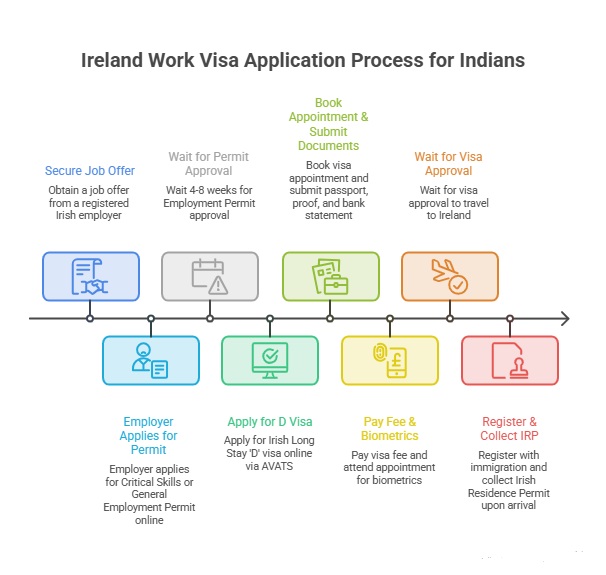
The steps to apply for an Ireland work visa for Indians are as follows:
Step 1: Secure a job offer from an Irish employer registered with Revenue and the Companies Registration Office.
Step 2: The employer applies for the correct Employment Permit, either Critical Skills or General, through DETE's online system.
Step 3: Wait for Employment Permit approval which may take up to 4 to 8 weeks, depending on the permit type.
Step 4: Once your permit is approved, apply for an Irish Long Stay 'D' visa online through the AVATS system.
Step 5: Book an appointment at your nearest Irish visa application centre in India and submit your documents such as passport, employment proof and bank statement among others.
Step 6: Pay the visa fee and attend your appointment for biometric data collection.
Step 7: Wait for visa approval, to travel to Ireland.
Step 8: Register with immigration authorities in Ireland and collect your Irish Residence Permit (IRP) within the required time upon arrival.
Also, read...
Life in Ireland for Immigrants: Jobs, Housing, Healthcare & PR
Requirements for the Ireland Work Visa
Before applying for an Ireland work visa, you need to meet certain eligibility conditions and prepare the right documents. Requirements vary slightly depending on whether you apply for a Critical Skills Employment Permit (CSEP) or a General Employment Permit (GEP). The list below combines the key eligibility conditions and documents required for an Ireland work visa from India.
- A valid job offer from an Irish employer registered with Revenue and the Companies Registration Office.
- Employment Permit approval from the Department of Enterprise, Trade and Employment (DETE).
- Minimum salary threshold (effective March 2026): €40,904 for roles on the Critical Skills Occupations List, or €68,911 for other eligible roles under CSEP; €36,605 for most General Employment Permit roles.
- A relevant degree, diploma, or professional qualification matching the job role.
- A valid passport with at least 6 months' validity and two blank pages.
- Two recent passport-size photographs (35x45mm, white background).
- Proof of relevant work experience, such as payslips, employment letters, or tax statements.
- Completed online visa application form through the AVATS system.
- Proof of sufficient funds to sustain in Ireland.
- For General Employment Permit applications, proof of the employer's Labour Market Needs Test, showing the role could not be filled locally.
Also, read...
Ireland Strengthens Post-Study Work Pathways for International Graduates. Apply Now!
Cost of Applying for an Ireland Work Visa From India
The total cost of an Ireland work visa depends on your permit type, your family situation, and how long you plan to stay. Most applicants pay for three things: the Employment Permit, the entry visa, and residence registration after arrival.
The table below shows the approximate fee for each stage, based on rates effective from March 2026.
|
Cost Item |
Fee (EUR) |
Approx. Fee (INR) |
|
Employment Permit fee (permits over 6 months) |
€1,000 |
~₹91,700 |
|
Employment Permit fee (permits up to 6 months) |
€500 |
~₹45,850 |
|
Irish Long Stay 'D' visa fee (single-entry) |
€60 |
~₹5,500 |
|
IRP (Irish Residence Permit) registration fee |
€300 |
~₹27,500 |
|
Stamp 4 application fee (after 21 months, CSEP) |
€1,000 |
~₹91,700 |
|
Dependant/Spouse Employment Permit (GEP route only) |
€500-€1,000 |
~₹45,850-₹91,700 |
*Are you looking for step-by-step assistance with Ireland immigration? Contact Y-Axis, the world's No. 1 overseas immigration consultancy, for end-to-end assistance!
FAQs
Can I apply for an Ireland work visa without a job offer?
No. You need a confirmed job offer from an Irish employer before applying. Ireland's employment permit system is employer-driven, so you cannot submit an Employment Permit application without a signed job offer and contract. The employer must be registered with Revenue and the Companies Registration Office in Ireland. Without this offer, DETE will not process your application, regardless of your qualifications or work experience.
What is the difference between the Critical Skills and General Employment Permit?
The Critical Skills Employment Permit (CSEP) suits roles on Ireland's Critical Skills Occupations List and needs a minimum salary of €40,904, with no labour market test required. The General Employment Permit (GEP) covers most other occupations, needs at least €36,605, and requires your employer to complete a Labour Market Needs Test first. CSEP also leads to Stamp 4 residency faster, after just 21 months of employment.
How long does it take to get an Ireland work visa from India?
Processing usually takes 4 to 8 weeks for the Employment Permit, followed by another 4 to 8 weeks for the Long Stay 'D' visa, since Indian nationals are not visa-exempt. In total, plan for 3 to 5 months from job offer to arrival in Ireland, including document preparation, permit approval, and visa processing time at your local application centre in India.
Can my spouse and children join me in Ireland?
Yes, but the process depends on your permit type. Spouses of Critical Skills Employment Permit holders can work in Ireland immediately under Stamp 1G, without needing a separate permit. Under the General Employment Permit, spouses need a separate Dependant, Partner, or Spouse Employment Permit before they can legally work. Children under 18 can apply for their own Irish Residence Permit as dependants.
Is a labour market test required for an Ireland work visa?
It depends on your permit type. The Critical Skills Employment Permit does not require a labour market test, saving 4 to 5 weeks of processing time. The General Employment Permit requires your employer to advertise the role for at least 28 days across specific platforms, including JobsIreland and EURES, to prove that no suitable EU candidate is available before hiring you from abroad.
What happens if my Ireland work visa application is refused?
If the Department of Enterprise, Trade and Employment refuses your application, or you withdraw it, you receive a 90% refund of the fee paid. You can reapply once you address the reason for refusal, such as an incomplete application, a salary below the threshold, or a qualification mismatch with the role. Reviewing requirements carefully before applying helps reduce this risk significantly.
Can I apply for permanent residency after getting an Ireland work visa?
Yes. Critical Skills Employment Permit holders can apply for Stamp 4, open work permission not tied to any employer, after 21 months of continuous employment. After five years of legal residence in Ireland, you also become eligible to apply for Irish citizenship by naturalisation, provided you meet the residency, character, and other standard eligibility requirements set by Irish immigration authorities.
Which occupations qualify for the Critical Skills Employment Permit?
Occupations on Ireland's Critical Skills Occupations List include software developers, data scientists, cybersecurity specialists, engineers, doctors, specialist nurses, pharmacists, and financial controllers, among others. This list is reviewed periodically by the Department of Enterprise, Trade and Employment, so always check the current version before applying. Roles not on the list can still qualify if the salary is €68,911 or higher per year.
Do I need to register with immigration after arriving in Ireland?
Yes. After arriving in Ireland, you must register with your local immigration registration office and obtain an Irish Residence Permit (IRP), which costs €300 per person. You should also apply for a PPS number for tax purposes soon after arrival. Registration confirms your legal immigration status and is required before you can access many public services in Ireland, including healthcare.
Can I switch employers while on an Ireland work visa?
It depends on your permit and current status. Employment Permit holders are generally tied to their sponsoring employer and need a new permit application to change jobs legally. Once you hold Stamp 4, typically after 21 months on a Critical Skills Employment Permit, you gain open work permission and can change employers freely without needing a new permit each time you switch.
Tags:
Ireland work visa
Ireland employment permit
Ireland work visa from India
Critical Skills Employment Permit
General Employment Permit
work in Ireland
Ireland visa requirements
Ireland immigration for Indians
Share
Options for you by Y-Axis

Get it on your mobile

Get News alerts

Contact Y-Axis
Latest Article
Popular Post
Trending Article
Posted On October 22 2026
Canada vs. UK for Engineers: Which Country Should You Choose?