


Posted on September 10 2026
How to Apply for a Greece Work Visa From India

By , Editor & Director
Updated September 12 2026
Applying for a Greece work visa from India starts with securing a confirmed job offer from a licensed Greek employer. The employer then submits an electronic authorisation request to the Decentralised Administration through the gov.gr portal, along with the signed employment contract and company registration details. Once this authorisation is approved, you can apply for the National Type D Visa at a Greek Embassy, Consulate, or authorised Visa Application Centre in India. After you land in Greece, you must submit a Single Permit (Type E.4) application, which combines your work and residence rights into one document. You can start working as soon as you receive the certificate of submission, while the physical permit card, valid for three years, follows separately.
*Want to apply for a Greece work visa? Let Y-Axis guide you through the process.
How to Apply for a Greece Work Visa From India?
Foreign professionals need the assistance of their Greek employer to initiate the Greek work visa application process.
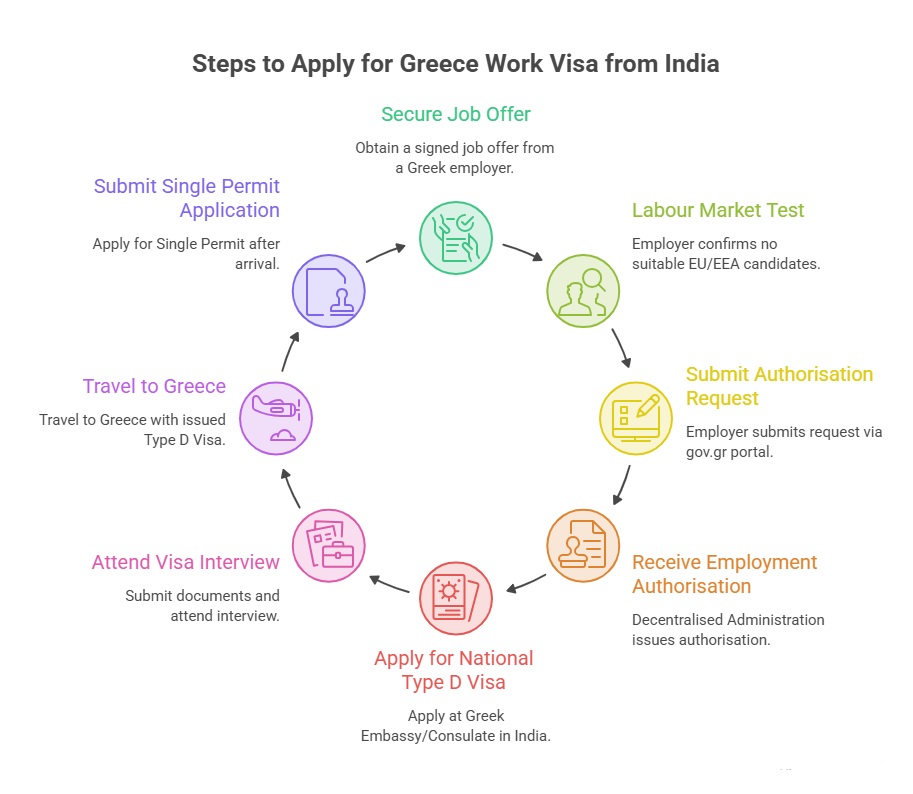
The steps to apply for a Greek work visa for Indians are as follows:
Step 1: Secure a signed job offer or employment contract from a Greek employer, valid for at least six months under Law 5275/2026.
Step 2: Your employer completes a labour market test, confirming that no suitable EU or EEA candidate is available for the role (certain specialised positions are exempt).
Step 3: Your employer submits an electronic authorisation request to the Decentralised Administration through the gov.gr portal, along with company documents, EFKA registration proof, and your passport bio page.
Step 4: Once approved, the Decentralised Administration issues an employment authorisation notice and forwards it electronically to the Greek Embassy or Consulate handling your application.
Step 5: Book an appointment and apply for the National Type D Visa at a Greek Embassy, Consulate, or authorised Visa Application Centre in India.
Step 6: Attend your visa interview and submit supporting documents, including your passport, photographs, insurance, medical certificate, and apostilled police clearance certificate.
Step 7: Travel to Greece once your Type D Visa is issued.
Step 8: Submit your Single Permit (Type E.4) application soon after arrival; you may start work once you receive the certificate of submission.
Also, read...
What are the eligibility requirements for a Greece work visa?
Requirements for the Greece Work Visa
Meeting Greece's requirements depends mostly on your employer's paperwork, since the Single Permit route is employer-led from the start. The list below brings together the eligibility conditions and documents you and your employer will need.
- A signed job offer or employment contract from a Greek employer, running for a minimum of six months.
- Approved employer authorisation from the Decentralised Administration, confirming the Single Permit request.
- A valid passport with at least two blank pages and validity of three months beyond your visa's expiry.
- Educational certificates and professional qualifications, translated if not in English or Greek.
- Relevant work experience letters supporting your job role.
- Two recent passport-size photographs, no older than six months.
- Travel or health insurance valid for the full period of your Type D Visa.
- A medical fitness certificate confirming you are fit to work.
- A police clearance certificate, apostilled by India's Ministry of External Affairs and issued within the last three months.
- Proof of accommodation in Greece, where requested by the consulate.
Also, read...
Greece Job Market: Skill Shortages, Salaries & Jobs Trends
Cost of Applying for a Greece Work Visa From India
Your total spend on a Greece work visa depends on the permit type, your employer's fee, and a few document-related charges along the way. Costs below are shown in euros and their approximate Indian Rupee equivalent, at a rate of roughly ₹110 to the euro.
|
Cost Item |
Fee |
Notes |
|
Employer Authorisation Fee |
€200 (approx. INR 22,000) |
Paid by the employer to the Decentralised Administration for each hire |
|
National Type D Visa Fee |
€60–180 (approx. INR 6,600–19,800) |
Varies by permit category; paid at the Embassy, Consulate, or Visa Application Centre |
|
Single Permit (Type E.4) Fee |
Confirmed at application stage |
Paid after arrival, alongside your Single Permit application in Greece |
|
Medical Examination & Insurance |
INR 3,000–8,000 (approx.) |
Required before or after arrival, depending on employer instructions |
|
Police Clearance & Apostille |
INR 500–2,000 (approx.) |
MEA apostille required for Indian police clearance certificates |
|
Document Translation & Notarisation |
INR 750–3,000 (approx.) |
Needed for documents not in English or Greek |
*Are you looking for step-by-step assistance with overseas immigration? Contact Y-Axis, the world's No. 1 overseas immigration consultancy, for end-to-end assistance!
FAQs
Can I apply for a Greece work visa without a job offer?
Generally no — most employment routes require a confirmed job offer, since your employer must complete the labour market test and authorisation stage first. One exception is the Talent Visa, launched under Law 5275/2026, which lets non-EU nationals holding a Master's degree or higher enter Greece for up to 12 months to search for work without a prior offer. Once they secure a job, this visa converts into a standard work permit.
What is the processing time for a Greece work visa from India?
The full process, from employer authorisation to receiving your Single Permit, typically takes three to six months. Employer authorisation and the Type D Visa stage alone can take several weeks each, and processing speed depends on document accuracy, consulate workload, and Greece's biennial quota limits.
What changed under Greece's Law 5275/2026?
This law, effective from 6 February 2026, merged the separate work permit and residence permit tracks into a single procedure called the Single Permit. It also reduced the minimum employment contract length from 12 months to 6 months, extended permit validity from two years to three, and introduced new routes such as the Talent Visa and Specialised Technical Personnel Visa.
Do I need a medical test for a Greece work visa?
Yes. A medical fitness certificate is a standard requirement, along with travel or health insurance covering your stay. Depending on your employer's instructions, this test can be completed in India before departure or in Greece shortly after you arrive.
Can my spouse and children join me in Greece?
Yes. Once your Single Permit is approved, your spouse and dependent children can apply for family reunification permits. These applications are separate from your own work permit and need their own supporting documents, so it's worth starting them early.
What is the difference between the Type D Visa and the Single Permit?
The Type D Visa is the entry visa that lets you travel to Greece for employment purposes; it does not by itself authorise long-term residence. The Single Permit (Type E.4), applied for after arrival, is the document that combines your work authorisation and residence rights, and it is what you renew every three years.
Can I switch employers while on a Greece work visa?
Yes, but your new employer must repeat the authorisation process, including the labour market test, before you can legally start the new role. Your existing Single Permit remains tied to your original employer and job description until this is updated, so switching without approval can put your status at risk.
What happens if my Greece work visa application is rejected?
If the Decentralised Administration or the consulate rejects your application, they will usually state the reason, such as an incomplete labour market test, missing documents, or contract terms that don't meet the minimum requirements. You can generally reapply once these issues are resolved, though consular fees are typically non-refundable.
Does a Greece work visa lead to permanent residency?
Yes. After five years of continuous legal residence with stable employment, housing, and insurance, and basic Greek language skills at A2 level, you can apply for permanent residency. Naturalisation as a Greek citizen is possible after seven years, but it requires a higher B2 level of Greek along with knowledge of Greek history and culture.
Is Greek language required to get a work visa?
No, Greek is not required for the visa or Single Permit application itself, and most entry-level and technical roles function well in English. Language requirements only come into play later, when applying for permanent residency or citizenship.
Tags:
Greece work visa
Greece Type D visa
Greece work visa from India
Greece Single Permit
E.4 permit Greece
work in Greece
Greece visa requirements
Greece immigration for Indians
Share
Options for you by Y-Axis

Get it on your mobile

Get News alerts

Contact Y-Axis
Latest Article
Popular Post
Trending Article
Posted On October 22 2026
Canada vs. UK for Engineers: Which Country Should You Choose?