

Posted on September 03 2026
How to Apply for a Dubai Work Visa From India: Complete Guide

By , Editor & Director
Updated September 05 2026
To apply for a Dubai work visa from India, you first need a job offer from a UAE-registered employer. The employer applies for a work permit through the Ministry of Human Resources and Emiratisation (MOHRE) and arranges your entry permit. Once you arrive in Dubai, you complete a medical fitness test, register for an Emirates ID, and your employer completes residence visa stamping through the General Directorate of Residency and Foreigners Affairs (GDRFA).
A Dubai work visa is officially an employment residence visa, combining a work permit and a residence permit. It is issued under the sponsorship of a UAE-registered employer, not applied for independently.
*Want to apply for a Dubai work visa? Let Y-Axis assist you with the process.
How to Apply for a Dubai Work Visa From India?
Applying for a Dubai work visa requires you to first secure a job offer from a UAE-registered employer. Your employer then applies for a work permit and entry permit on your behalf, before you complete medical testing and Emirates ID registration in Dubai.
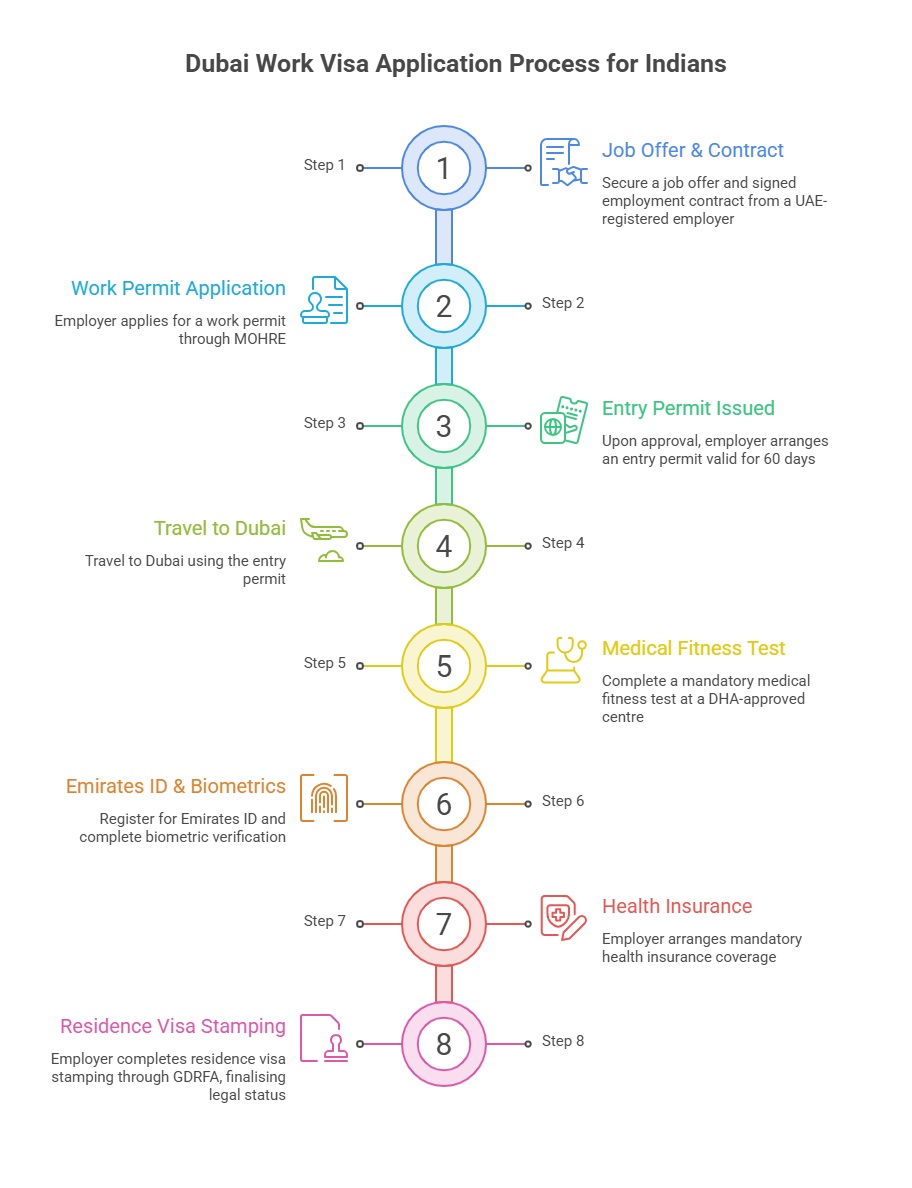
The steps to apply for a Dubai work visa for Indians are as follows:
Step 1: Secure a job offer and signed employment contract from a UAE-registered employer.
Step 2: Your employer applies for a work permit, also called labour approval, through MOHRE.
Step 3: Once approved, your employer arranges your entry permit, valid for entry within 60 days.
Step 4: Travel to Dubai using the entry permit.
Step 5: Complete a mandatory medical fitness test at a DHA-approved test centre.
Step 6: Register for your Emirates ID and complete biometric verification.
Step 7: Your employer arranges your mandatory health insurance coverage.
Step 8: Your employer completes residence visa stamping through GDRFA, finalising your legal work status.
Also, read...
What are the Eligibility Requirements for a UAE Work Visa?
Requirements for the Dubai Work Visa
Before you apply for a Dubai work visa from India, you must meet certain eligibility conditions and prepare the right documents. The process is entirely employer-driven, so most conditions relate to your job offer and your sponsoring company. The list below combines the key eligibility conditions and documents required for a Dubai work visa from India.
- A valid job offer and signed employment contract from a UAE-registered employer, mainland or free zone.
- A minimum educational qualification, generally a bachelor's degree or equivalent, depending on the job category.
- A valid passport with at least 6 months' validity and two blank pages.
- Passport-size photographs with a white background, meeting UAE visa photo specifications.
- Attested educational certificates and professional qualifications.
- Work permit (labour approval) issued by the Ministry of Human Resources and Emiratisation (MOHRE).
- Entry permit, allowing you to travel to the UAE for visa stamping.
- Medical fitness certificate from a Dubai Health Authority (DHA) approved test centre after arrival.
- Emirates ID application and biometric registration.
- Proof of mandatory health insurance coverage.
- Applicant age generally between 18 and 60 years, extendable in some cases.
Also, read...
UAE Golden Visa: Eligibility, Benefits & Application
Cost of Applying for a Dubai Work Visa From India
The total cost of a Dubai work visa depends on your employer type, job category, and whether you work for a mainland or free zone company. Most costs relate to government processing, the medical test, and mandatory health insurance.
The table below shows the approximate fee for each stage, based on current 2026 rates.
|
Cost Item |
Fee (AED) |
Approx. Fee (INR) |
|
Entry Permit |
AED 350-1,200 |
~₹8,050-₹27,600 |
|
Work Permit (Labour Card, MOHRE) |
AED 300-5,000 |
~₹6,900-₹1,15,000 |
|
Medical Fitness Test |
AED 300-750 |
~₹6,900-₹17,250 |
|
Emirates ID (2-year card) |
AED 250-575 |
~₹5,750-₹13,225 |
|
Health Insurance (mandatory, annual) |
AED 650-2,500+ |
~₹14,950-₹57,500+ |
|
Residence Visa Stamping |
AED 500-1,200 |
~₹11,500-₹27,600 |
Note: Under UAE Labour Law, employers are generally required to bear these visa costs for mainland company employees. Free zone employers may follow different cost-sharing arrangements, and some companies ask employees to cover certain fees.
*Are you looking for step-by-step assistance with UAE immigration? Contact Y-Axis, the world's No. 1 overseas immigration consultancy, for end-to-end assistance!
FAQs
Can I apply for a Dubai work visa without a job offer?
No. A Dubai work visa is entirely employer-sponsored, so you need a confirmed job offer and signed employment contract before applying. Your employer, whether a mainland company or a free zone entity, must initiate the work permit application through MOHRE. Without an employer sponsor, you cannot independently apply for a standard employment visa. Some categories, such as the Green Visa, allow limited self-sponsorship for freelancers and skilled professionals, but these follow a separate process.
What is the processing time for a Dubai work visa from India?
Processing usually takes 2 to 4 weeks from work permit approval to residence visa stamping, covering the entry permit, medical test, Emirates ID registration, and visa stamping stages. Some free zones offer faster processing through express services, sometimes completing the process in about a week. Delays can occur due to incomplete documentation, medical retests, or high application volumes, so prepare all documents in advance.
Who pays for a Dubai work visa, the employer or the employee?
Under UAE Labour Law, employers are generally required to bear the cost of the work permit, medical test, Emirates ID, and mandatory health insurance for mainland company employees. Free zone employers may have different cost-sharing arrangements, and some companies ask employees to cover certain fees. Always confirm in writing who pays for each visa component before accepting a job offer in Dubai.
Do I need a medical test for a Dubai work visa?
Yes. A medical fitness test is mandatory for all Dubai work visa applicants and must be completed at a Dubai Health Authority (DHA) approved test centre after you arrive. The test typically screens for communicable diseases, including HIV, tuberculosis, and hepatitis B and C. Some job categories, such as food handlers, require additional screenings. You cannot complete residence visa stamping without medical clearance.
Can my spouse and children join me in Dubai?
Yes. Once you hold a valid Dubai work visa and meet the minimum salary requirement set by immigration authorities, you can sponsor your spouse and children on a dependant residence visa. Sponsorship benefits depend on your salary level, visa category, and employer, since the UAE does not have a universal welfare system. You will need to provide proof of relationship, income, and suitable accommodation.
What is the difference between a mainland and free zone work visa?
A mainland work visa is sponsored by a company registered with the Department of Economic Development and allows you to work anywhere in the UAE. A free zone work visa is sponsored by a company based in a specific free zone, such as DIFC or JLT, and may carry different fee structures and faster processing. Both lead to a valid Emirates ID and residence visa, but your work location and sponsor differ.
Is a UAE work visa the same as an Emirates ID?
No. A UAE work visa is your legal authorisation to live and work in the country, combining a work permit and a residence visa. The Emirates ID is a separate biometric identity card issued after registration, used for identification, banking, and accessing government services. You need both documents together to be fully compliant, since the residence visa references your Emirates ID number.
Can I switch employers while on a Dubai work visa?
Yes, but the process requires your current employer's cooperation or approval from MOHRE, depending on your contract type. Your new employer must apply for a new work permit and complete a status change or visa cancellation and reissue. Working for a different employer without updating your visa status is not permitted under UAE labour law and can affect future visa applications.
What happens if my Dubai work visa application is rejected?
If your application is rejected, MOHRE or GDRFA typically provides a reason, such as incomplete documentation, a failed medical test, or a mismatch between your qualifications and job role. You can usually reapply once the issue is resolved. Since employers bear most of the process, your sponsoring company should assist in identifying the problem and resubmitting a corrected application.
Does a Dubai work visa lead to permanent residency?
The UAE does not offer traditional permanent residency, but long-term options exist for eligible individuals. Standard work visas are renewable for as long as you remain employed. Skilled professionals, investors, and high earners may qualify for the Golden Visa, which offers residency validity of 5 to 10 years without needing a sponsor. This is the closest equivalent to long-term settlement in the UAE.
Tags:
Dubai work visa
UAE employment visa
Dubai work visa from India
MOHRE work permit
Emirates ID
work in Dubai
Dubai visa requirements
UAE immigration for Indians
Share
Options for you by Y-Axis

Get it on your mobile

Get News alerts

Contact Y-Axis
Latest Article
Popular Post
Trending Article
Posted On October 22 2026
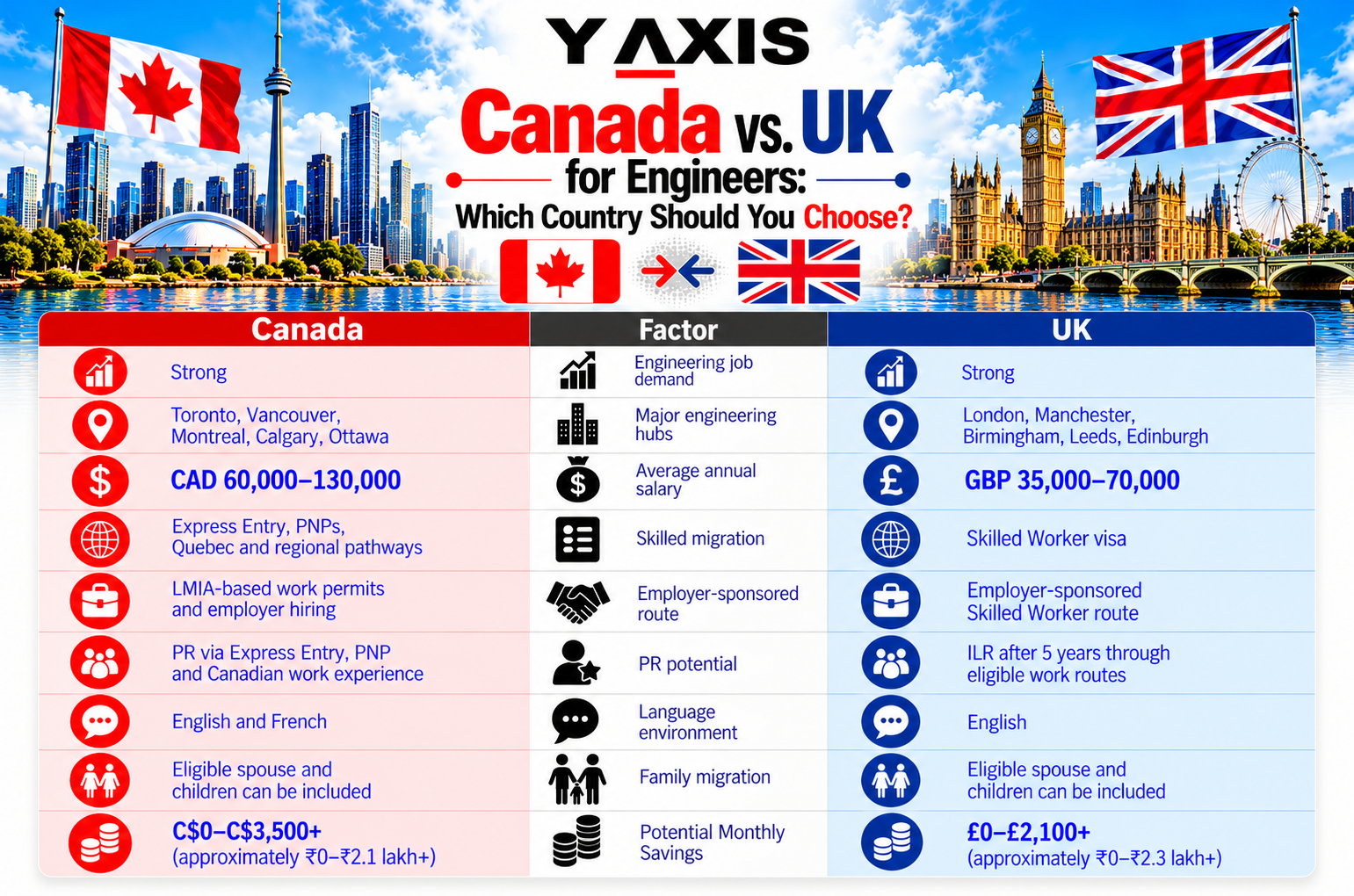
Canada vs. UK for Engineers: Which Country Should You Choose?