

Don't know what to do ?
Get Free Counseling
Last Updated: 16 July 2026
Canada Student Direct Stream (SDS)
The Canada Student Direct Stream (SDS) was a fast-track study permit program introduced by Immigration, Refugees and Citizenship Canada (IRCC) to help eligible international students, including those from India, obtain study permits faster. The program required applicants to meet specific financial, language, and educational criteria and offered expedited processing compared to the regular study permit stream.
IMPORTANT UPDATE: The Canada Student Direct Stream (SDS) was permanently discontinued by IRCC on 08 November 2024. You can no longer apply for a Canadian study permit through SDS. All applicants, including students from India, must now apply through the standard study permit process.
What Replaced the Canada SDS?
The Canada Student Direct Stream (SDS) has been replaced by the standard Canada study permit process for all international students, including those from India. This means there is now only one study permit application process for everyone. Under the standard process, you must show that you have enough money to pay for your first year's living expenses, which is currently CAD 22,895. While purchasing a Guaranteed Investment Certificate (GIC) is no longer compulsory, you can still use it as one of the documents to prove that you have enough funds.
Most students also need to submit a Provincial Attestation Letter (PAL) or Territorial Attestation Letter (TAL). This letter confirms that your application falls within Canada's international student cap. However, some applicants are exempt from this requirement. Another major change is the processing time. Under the former SDS program, eligible applications were often processed in about 20 calendar days. Under the current standard study permit process, study permit applications from India generally take around 7 to 10 weeks, although the actual processing time may vary depending on the number of applications received and individual case details. Although the SDS program has ended, Indian students can still study in Canada by applying through the standard study permit process, provided they meet all eligibility and documentation requirements.
Benefits of Studying in Canada
Canada is one of the most popular study destinations for international students because it offers high-quality education, excellent career opportunities, and a welcoming environment. Some of the key benefits of studying in Canada include:
- World-renowned universities with degrees that are recognized globally.
- Industry-focused courses that help students gain practical skills and improve their career prospects.
- Post-Graduation Work Permit (PGWP), which allows eligible graduates to work in Canada after completing their studies.
- Globally recognized qualifications, making it easier to find jobs in Canada and other countries.
- Affordable tuition fees compared to many other popular study destinations such as the US and the UK.
- Opportunities to work while studying, allowing eligible students to earn income and gain Canadian work experience.
- Pathways to permanent residence (PR) through various immigration programs for eligible graduates.
- Safe, multicultural environment, where students from different countries feel welcome and supported.
*Want to study in Canada? Y-Axis is here to help you with all the necessary requirements.
Canada's International Student Cap
To manage the rapid growth in the number of international students, the Government of Canada introduced an international student cap in January 2024. Since then, the number of study permits issued each year has been reduced to help ease pressure on housing, healthcare, and other public services.
The study permit targets have changed as follows:
| Year | Study Permit Issuance Target | Key Change |
|---|---|---|
| 2024 | 485,000 | International student cap introduced; approved study permits reduced by about 35%. Most applicants were also required to submit a Provincial Attestation Letter (PAL). |
| 2025 | 437,000 | Study permit target reduced by another 10%. The cap was extended to include most master's and PhD applicants. |
| 2026 | 408,000 (around 155,000 for new international students) | Study permit target reduced by a further 7%. From 01 January 2026, master's and doctoral students at public Designated Learning Institutions (DLIs) are exempt from the PAL/TAL requirement. |
What does this mean for Indian students?
The international student cap has made admission and study permit approval more competitive than before. Most undergraduate and college applicants must obtain a Provincial Attestation Letter (PAL) or Territorial Attestation Letter (TAL) before applying for a study permit. Since fewer study permits are available each year, submitting a complete, accurate, and well-prepared application with all required documents is more important than ever to improve your chances of approval.
Current Canada Study Permit Process (2026)
Since the Student Direct Stream (SDS) ended, all international students, including those from India, must apply through the standard Canada study permit process. To improve your chances of approval, you must meet the eligibility requirements, provide sufficient financial proof, and submit all required documents.
Canada Study Permit Eligibility and Requirements
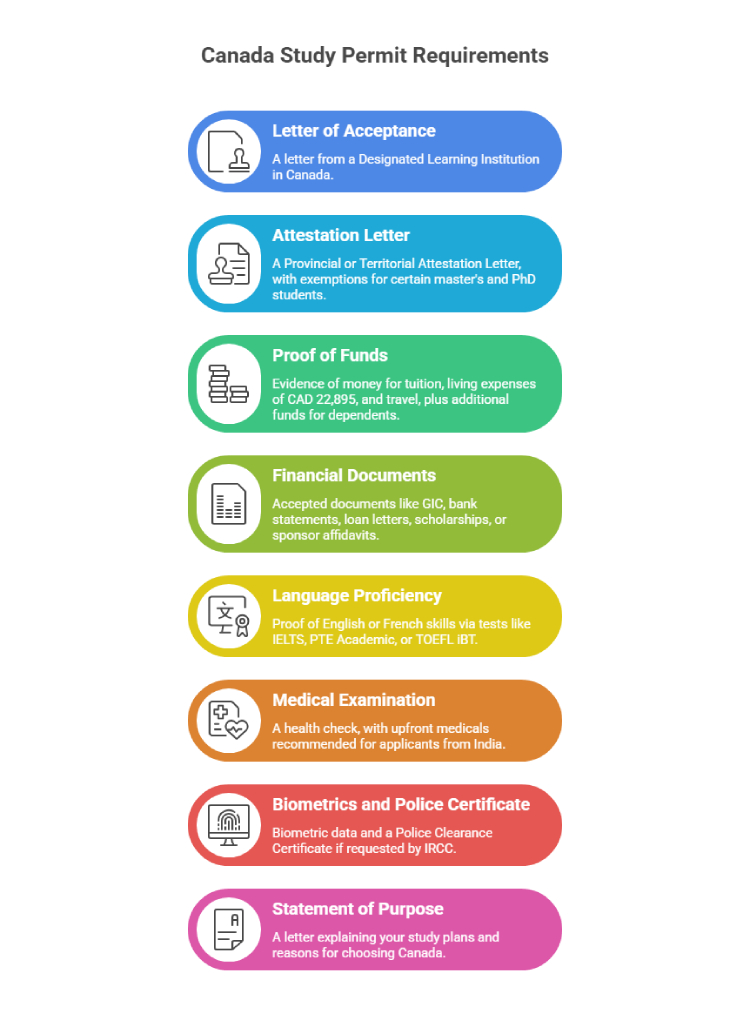
To apply for a Canada study permit, you generally need:
- A Letter of Acceptance (LOA) from a Designated Learning Institution (DLI) in Canada.
- A Provincial Attestation Letter (PAL) or Territorial Attestation Letter (TAL), which is required for most applicants. However, master's and PhD students admitted to public DLIs are exempt from the PAL/TAL requirement from 01 January 2026.
- Proof of Funds: You must show that you have enough money to pay for your first-year tuition fees, annual living expenses of CAD 22,895 outside Quebec, and your travel costs to Canada. If your spouse or dependent children are accompanying you, you must also provide additional funds. You need to show CAD 4,000 for your spouse and CAD 3,000 for each dependent child.
- Acceptable Proof of Funds: You can demonstrate your financial capacity using one or more accepted documents, such as a Guaranteed Investment Certificate (GIC), bank statements from the last four months, an education loan approval letter, a scholarship or sponsorship letter, or a sponsor's affidavit and supporting financial documents. While a GIC is no longer mandatory, it is still accepted as valid proof of funds for a Canada study permit application.
- Proof of English or French language proficiency as required by your university or college. Most institutions accept IELTS, PTE Academic, TOEFL iBT, or other approved tests.
- A medical examination (upfront medicals are recommended for applicants from India).
- Biometrics and a Police Clearance Certificate (if requested by IRCC).
- A Statement of Purpose (SOP) or Letter of Explanation explaining your study plans and reasons for choosing Canada.
Financial Proof Required (Outside Quebec)
| Family Size | Minimum Living Funds Required (Per Year) |
|---|---|
| Student only | CAD 22,895 |
| Student + spouse | CAD 28,502 |
| Three family members | CAD 35,040 |
| Four family members | CAD 42,543 |
Note: These amounts cover living expenses only. You must also show proof of first-year tuition fees and travel expenses. IRCC updates the required living funds periodically, so always check the latest requirements before applying.
How to Apply for a Canada Study Permit (2026)
Step 1: Apply to a Designated Learning Institution (DLI) and receive your Letter of Acceptance (LOA).
Step 2: Obtain your Provincial Attestation Letter (PAL) or Territorial Attestation Letter (TAL), if required.
Step 3: Prepare your financial documents showing tuition fees, living expenses, and travel costs.
Step 4: Submit your study permit application online through the IRCC portal and pay the required fees.
Step 5: Complete your biometrics appointment and medical examination.
Step 6: Wait for your application to be processed. Study permit applications from India generally take about 7–10 weeks, although processing times may vary.
Step 7: If your application is approved, you will receive your Port of Entry (POE) Letter of Introduction. Present this letter when you arrive in Canada to receive your study permit.
Canada Study Permit Fees and Processing Time (2026)
| Item | Details |
|---|---|
| Processing Time (India) | Approximately 7–10 weeks (apply at least 4–6 months before your intake) |
| Study Permit Fee | CAD 150 per applicant |
| Biometrics Fee | CAD 85 per person |
| Main Intakes | September (Fall), January (Winter), and May (Summer) |
Post-Graduation Work Permit (PGWP) After Studying in Canada (2026)
The Post-Graduation Work Permit (PGWP) allows eligible international students to work in Canada after completing their studies. Depending on the length of your eligible study program, you may receive a PGWP for up to three years, helping you gain valuable Canadian work experience and improving your chances of qualifying for permanent residence. To be eligible for a PGWP, you must complete a program that is at least eight months long at an eligible Designated Learning Institution (DLI) and submit your PGWP application within 180 days of receiving confirmation that you have completed your studies.
Since November 2024, applicants must also meet a minimum language requirement. University degree graduates (bachelor's, master's, and PhD) must demonstrate CLB 7, while most college program graduates must meet CLB 5. Accepted language tests include IELTS General Training, CELPIP, and PTE Core. Students graduating from non-degree (college) programs must complete a program listed under the eligible field of study requirements. As of 2026, more than 1,100 programs qualify for the PGWP. However, graduates with bachelor's, master's, or doctoral degrees are exempt from the field-of-study requirement.
Looking to Study in Canada? Here's What to Do Instead of SDS
Although the Student Direct Stream (SDS) has been discontinued, Indian students can still study in Canada by applying through the standard study permit process. To improve your chances of receiving a study permit, it is important to plan your application early. Start by shortlisting Designated Learning Institutions (DLIs) and choosing programs that support your career goals and, where applicable, meet the PGWP eligibility requirements. Prepare for an accepted English language test such as IELTS or PTE and obtain your Letter of Acceptance (LOA) as early as possible, since study permit caps have made admissions more competitive.
Next, arrange your finances by ensuring you have enough funds to cover your first-year tuition fees, CAD 22,895 for living expenses (outside Quebec), and your travel costs. You should also apply for your study permit at least 4–6 months before your intended intake to allow enough time for processing.
How can Y-Axis assist you?
Y-Axis is the right mentor to advise you on studying in Canada. It helps you with
- Free Counseling: avail professional counseling to help you choose the right course and college in Canada
- Campus Ready Program is a Y-Axis initiative that counsels every student to navigate in the right direction during and after the study program.
- Coaching servicesassist you in acing your IELTS, TOEFL, and PTE test scores.
- Canada Student Visa, get free counseling and advice from proven experts to advise you in all the steps.
- Course Recommendation: get unbiased advice with Y-Path that puts you on the right path to success.
Don't know what to do ?
Get Free Counseling
Looking for Inspiration
Explore what Global Indians have to say about Y-Axis in shaping their future