


Don't know what to do?
Get Free Counselling
Last Updated 18 August 2026
Why apply for a Schengen Visa?
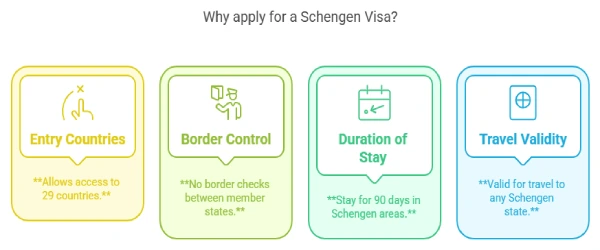
- Allows you to enter 29 countries
- No border control between member states
- Stay for 90 days in the Schengen area
- Valid to travel to any Schengen state
A Schengen Visa allows travelers to visit 29 countries, which is valid for up to 90 days within a short-term period of 180 days.
What is a Schengen Visa and What Does It Allow Indians to Do?
A Schengen Visa is a short-term entry permit that allows non-EU nationals to travel freely within the 29 countries of the Schengen Area for up to 90 days within 180 days. It eliminates border controls between member states, enabling seamless travel across multiple countries in Europe.
Types of Schengen Visas:
- Single-entry visa: Permits one entry into the Schengen Area.
- Multiple-entry visa: Allows multiple visits for as long as the visa is valid.
- Airport transit visa: Enables travelers to transit through the international zone of an airport in a Schengen country without entering the country itself.
List of Schengen Visa Countries
There are 29 Schengen countries, each with its own immigration rules, policies, conditions, and timelines for visa application.
| Austria | Liechtenstein |
| Belgium | Lithuania |
| Bulgaria | Luxembourg |
| Croatia | Malta |
| The Czech Republic | The Netherlands |
| Denmark | Norway |
| Estonia | Poland |
| Finland | Portugal |
| France | Romania |
| Germany | Slovakia |
| Greece | Slovenia |
| Hungary | Spain |
| Iceland | Sweden |
| Italy | Switzerland |
| Latvia | |
Bulgaria and Romania joined the Schengen Area for air and sea travel in March 2024 (land border integration is ongoing). Croatia joined in January 2023. Two EU countries are not part of Schengen — Ireland (which issues its own Irish visa) and Cyprus. Four non-EU countries are Schengen members — Iceland, Norway, Switzerland, and Liechtenstein.
Benefits of obtaining a Schengen visa
- You can travel to 29 countries
- 6-month validity on your passport
- You can enter multiple times based on your purpose
- Can travel freely within the Netherlands and other Schengen countries
Which Embassy Should Indians Apply at for a Multi-Country Schengen Trip?
For a multi-country Schengen trip, apply at the embassy of the country where you will spend the most nights. If you have equal nights in multiple countries, apply at the country of your first entry into the Schengen Area.
Example: 5 nights in Paris + 3 nights in Rome + 2 nights in Berlin → apply at the French Embassy via TLScontact India, since France has the most nights.
Equal-nights example: 4 nights in Paris + 4 nights in Barcelona → apply at the French Embassy if you're flying into Paris first.
Once issued, your Schengen visa is valid for travel to all 29 Schengen countries, regardless of which embassy issued it.
Tip: Structure your accommodation bookings so the country with the most nights matches the embassy you intend to apply to — this strengthens your application.
What Are the Types of Schengen Visas for Indians?
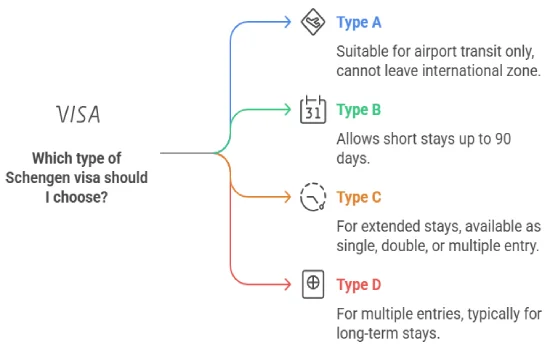
There are three active Schengen visa types (a fourth, Type B, was abolished in 2010 and no longer exists).
Type A – Airport Transit Visa
Required only for transiting through the international zone of certain Schengen airports without entering the country. You do not clear border control and cannot leave the airport's international zone.
Type C – Short-Stay Visa
This is the primary Schengen visa for Indian tourists. It allows a stay of up to 90 days in any 180-day period and is issued as single-entry, double-entry, or multiple-entry depending on your travel history and purpose.
Type D – National Long-Stay Visa
Issued by an individual Schengen country (not Schengen-area-wide) for stays beyond 90 days — for example, study, work, or long-term residence. A Type D visa only grants entry rights tied to the issuing country's own national rules, unlike the Schengen-wide Type C.
Eligibility for a Schengen Visa
- You must be a citizen of a non-European country that is not in the European Union.
- The reason for traveling, as well as the time frame, must be justified.
- You must have a valid passport for at least 3 months after the date of your visa application.
- You must have a minimum of €30,000 in medical travel insurance to apply for a European visa.
Schengen Visa Requirements
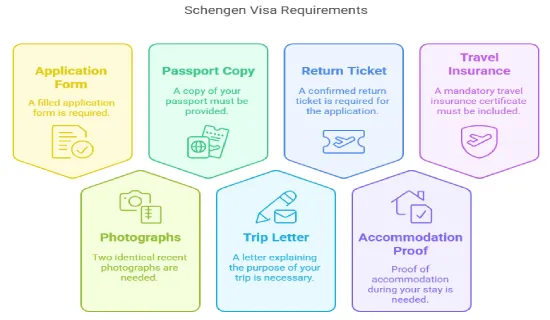
- Schengen visa application form that is filled out
- Recent 2 identical Photographs
- A copy of your passport with an expiry date
- A letter explaining your trip
- Confirmed return ticket
- Proof of accommodation
- A mandatory travel insurance certificate
Documents required for a Schengen visa application
The Schengen tourist visa is a unique document that allows you access to several European countries with a single visa. To apply for it, you must submit the following:
- Valid passport
- Completed Schengen visit visa application form
- Travel itinerary including countries you plan to visit, accommodation & flight details
- Evidence of financial sufficiency
- Evidence of your employment or student status to prove you will not be staying on
- Proof of adequate health insurance
How Much Bank Balance Is Needed for a Schengen Visa from India?
Most Schengen embassies apply a guideline of EUR 45–75 per day of stay (approximately INR 4,950–8,250 per day at current rates). For a 15-day trip, that works out to roughly EUR 675–1,125 (approximately INR 74,250–1,23,750), in addition to prepaid return tickets and confirmed accommodation. There's no single official fixed minimum — this is a case-officer guideline, and consistent income history matters more than one large balance. Bring 3–6 months of consistent bank statements, ITR for 2 years, and salary slips for 3 months; sudden large deposits shortly before applying are a common red flag. France-specific guideline: EUR 65/day with confirmed accommodation, or EUR 120/day without.
How do you apply for a Schengen Visa from India?
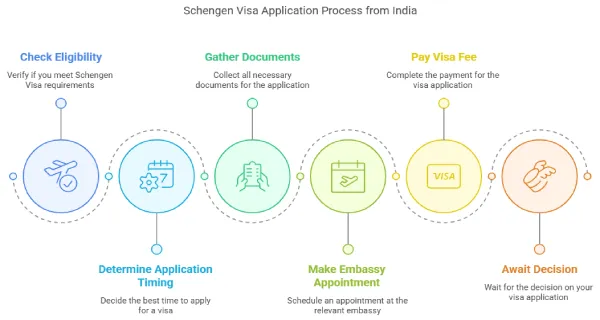
- Step 1: Ensure you’re eligible for a Schengen Visa for tourists. Because there are numerous Schengen visas, you must be certain of the required visa. Find out where you need to submit your application.
- Step 2: Determine the optimal time to apply for a tourist visa.
- Step 3: Gather the necessary documents for a tourist Schengen Visa.
- Step 4: Book your biometrics appointment at your destination country's Visa Application Centre — VFS Global India (vfsglobal.com) for most countries, or TLScontact India.
- Step 5: Pay the cost of the visa.
- Step 6: Wait for your visa application decision.
Schengen Visa processing time
The waiting time for a Schengen visa is at least 15 days, but it completely depends on you. Sometimes, in certain areas, the processing time is 30 days; in extreme cases, it can be more than 60 days.
Schengen Visa Fees
The Schengen Visa costs range from €45 to €90 and is free for children under 6 years.
| Type | Cost (EUR) | Approx. INR* |
|---|---|---|
| Adult | € 90 | ~INR 9,900 |
| Children aged 6 to 12 | € 45 | ~INR 4,950 |
| Children under age 6 | Free | Free |
| VFS Global / TLScontact service fee (add-on) | — | ~INR 1,800–2,500 |
*Approximate conversion at 1 EUR ≈ INR 110 (August 2026) — always verify the current rate at xe.com, since it moves daily. The EUR 90/45 embassy fee itself has been stable since June 2024.
Schengen Visa Application Processing Time
It takes 15 days to process a Schengen Visa application after it is submitted and reaches the consulate. It is suggested to apply one month before your travel date.
What Are the New Schengen Rules for Indians in 2026?
What Is the Schengen Cascade Visa Regime for Indians?
Step 1: After using at least 2 Schengen visas in the past 3 years (any Schengen country), Indian applicants qualify for a 2-year multiple-entry Schengen visa on their next application.
Step 2: After appropriately using the 2-year Cascade visa — respecting the 90/180 rule with no overstays — applicants qualify for a 5-year multiple-entry visa (passport validity permitting).
Eligibility: 2+ Schengen visas used in the past 3 years, no visa violations or overstays, and a consistent travel purpose. Inform your embassy or VAC of your prior Schengen visas at the application stage to be assessed for Cascade eligibility.
How Many Schengen Days Do I Have Left?
Use the official EU Schengen Days Calculator: ec.europa.eu/assets/home/visa-calculator/calculator.htm. Worked example: entered Schengen on January 1 for 20 days; checking availability on May 1, count back 180 days to November 2 — 20 days were used in that window, leaving 70 of the 90 days available.
- Digital Transformation—The EU is replacing traditional visa stickers with a fully digital process, including online application submission, document submission, and fee payment.
- Digital Delivery - The Schengen visa will be delivered digitally as a 2D barcode.
EES System and Biometrics - The EU's Entry-Exit System (EES) began a phased rollout on October 12, 2025, and became fully operational across all 29 Schengen countries on April 10, 2026. EES digitally records the entry, exit, and biometric data (fingerprints and facial image) of non-EU travellers, replacing the traditional passport stamp. EES does not change visa requirements — Indian nationals still apply for a Schengen visa exactly as before. Check current status at eu-lisa.eu.
ETIAS — The European Travel Information and Authorisation System (ETIAS) is a separate, pre-travel authorisation for nationals of visa-exempt countries visiting the Schengen Area. Indian nationals, who already require a Schengen visa, are not affected by ETIAS. ETIAS has not yet launched and is expected later in 2026 — verify current status at travel-europe.europa.eu.
Schengen Visa Validity & Stay Rules
- 90/180 Rule – Schengen Visa Holders can stay in the Schengen Area for a maximum of 90 days in any 180 days. The period starts from the date you enter the area.
- Difference between Visa Validity and. Duration of Visit
- Validity - The period for which your visa is valid for travel. The period starts from when the visa was issued and continues to its expiration date.
- Duration of Visit - The total number of days you can stay in the Schengen area within the validity of the visa.
- Overstaying— If you exceed the 90-day limit of the 180-day period, you can face severe penalties, such as a ban from the Schengen area for 3 years or above.
Why Does a Schengen Visa Get Rejected for Indian Applicants?
The most common reasons include:
- Incomplete or inaccurate documents
- Insufficient financial proof below the EUR 45–75/day guideline
- Weak ties to India
- Travel insurance below EUR 30,000 or not Schengen-compliant
- A prior Schengen overstay or violation; an unclear purpose of visit
- Travel details inconsistent with flight or hotel bookings
- Applying at the wrong embassy for a multi-country trip
If refused: You can reapply immediately — there's no mandatory waiting period. Review your refusal letter carefully and address each stated reason directly in your reapplication.
How can Y-Axis help you?
The Y-Axis team has been the best solution to assist you with your Schengen visit visa.
- Evaluate the appropriate visa type for your application
- Guide documentation
- Assist in filling out online application forms
- Review all your documents
- Assist in the visa application process
Y-Axis snapshot
1M
Successful applicants
1500+
Experienced counselors
25Y+
Expertise
50+
Offices
Don't know what to do?
Get Free Counselling
Looking For Inspiration
Explore What Global Indians have to say about Y-axis