


Posted on October 14 2026
Russia–India Employment Pact, opens 100,000 Job Opportunities for Skilled Indian Professionals. Apply Now!

By , Editor & Director
Updated October 14 2026
Highlights: Russia Boosts Work Opportunities Indians with upto 100,000 Job Openings
- Russia ratifies an employment agreement with India to facilitate the temporary employment of citizens in each other’s territories.
- Russian President Vladimir Putin officially signed the law on October 12, 2026, following approval by both houses of Parliament.
- The India-Russia agreement was earlier signed in New Delhi on December 5, 2025, establishing a framework for temporary cross-border employment.
- Around 70,000 Indian citizens are currently working in Russia, with the number potentially reaching 100,000 by the end of 2026.
- Demand for Indian workers continues to grow in Russia across construction, textile, engineering and electronics sectors.
*Want to work in Russia? Sign up with Y-Axis for end-to-end assistance.
Russia Ratifies Employment Agreement With India to Expand Work Opportunities
Russia has made an official agreement with India to establish a framework for the temporary employment of citizens in each other’s territories. Russian President Vladimir Putin signed the relevant law on October 12, 2026, after the State Duma adopted it on October 1 and the Federation Council approved it on October 2.
The agreement was earlier signed by the Indian and Russian governments in New Delhi on December 5, 2025. It aims to provide a formal framework for citizens of both countries to take up temporary employment in the other country. The ratification marks an important step in strengthening bilateral labour mobility and employment cooperation to work abroad.
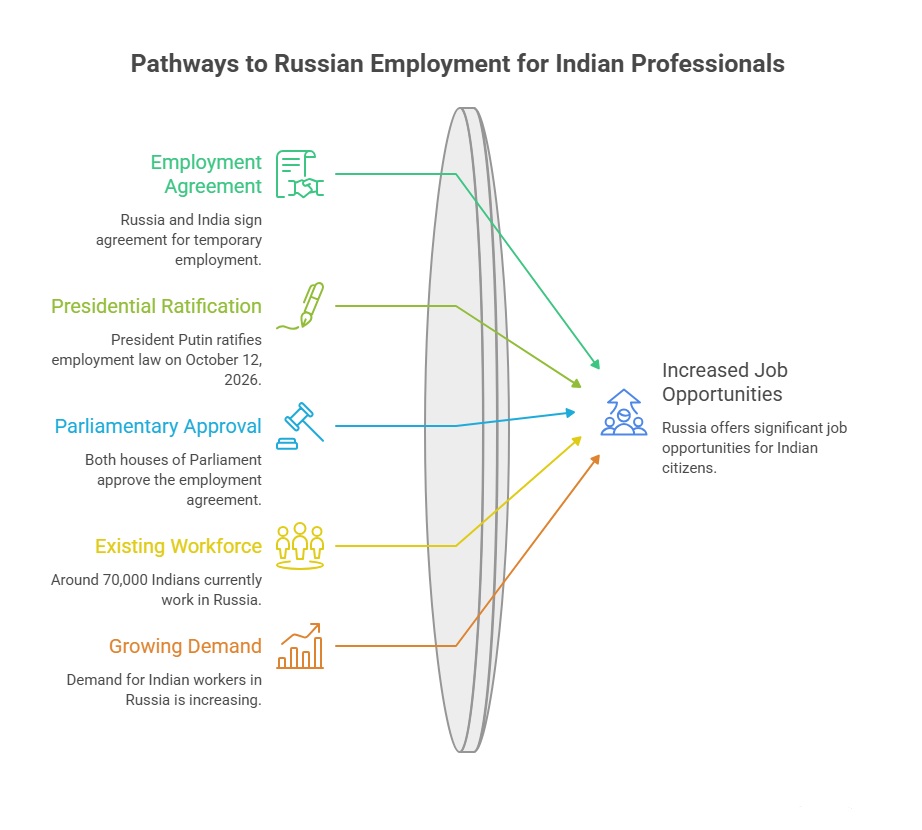
Around 70,000 Indian citizens are currently employed in Russia, across sectors like construction and textile-related industries. This number is estimated to increase upto 100,000 by the end of 2026, reflecting the potential for greater labour mobility between the two countries.
|
Key detail |
Information |
|
Countries involved |
India and Russia |
|
Latest development |
Russia ratifies the temporary employment agreement |
|
Date signed into law |
October 12, 2026 |
|
Agreement signed |
December 5, 2025, in New Delhi |
|
Indian workers currently in Russia |
Approximately 70,000 |
|
Potential number by end of 2026 |
1,00,000 |
|
Major employment sectors |
Construction and textiles |
|
Other sectors seeing demand |
Engineering and electronics |
Also, read...
Russia Needs 11 Million Workforce by 2030. A New Chance for Indians. Apply now!
How India-Russia Bilateral Agreement Benefits Indian Professionals in 2027?
Russia’s ratification of the employment agreement could strengthen opportunities for Indian citizens seeking overseas work, particularly as demand for workers and specialists grows across several Russian industries. The practical benefits will depend on how the agreement is implemented and the employment pathways made available to Indian applicants.
- More overseas employment opportunities: The agreement creates a formal framework to support temporary employment between India and Russia.
- Growing demand for Indian workers: Construction and textile industries already employ substantial numbers of Indian citizens in Russia.
- Opportunities for skilled professionals: Rising demand in engineering and electronics could benefit suitably qualified Indian specialists.
- Potential expansion of labour mobility: The framework may make it easier for both countries to coordinate temporary employment arrangements.
- Access to an expanding job market: The potential increase from 70,000 to 100,000 Indian workers by the end of 2026 indicates scope for further employment growth.
- Stronger India-Russia cooperation: Formalising temporary employment arrangements can support closer bilateral ties and workforce collaboration.
*Are you looking for step-by-step assistance with overseas immigration? Contact Y-Axis, the world’s No. 1 immigration consultancy!
For recent immigration updates, check out the Y-Axis News Page!
FAQs
What is the latest Russia-India employment agreement?
Russia has ratified an agreement with India to establish a framework for the temporary employment of citizens in each other’s territories. Russian President Vladimir Putin signed the relevant law on October 12, 2026, following its adoption by the State Duma and approval by the Federation Council. The agreement aims to strengthen labour mobility between the two countries and support temporary employment opportunities for eligible Indian and Russian citizens.
When did Russia ratify the employment agreement with India?
Russian President Vladimir Putin signed the ratification law on October 12, 2026. Before this, the State Duma adopted the legislation on October 1, and the Federation Council approved it on October 2. The agreement itself was signed by the Indian and Russian governments in New Delhi on December 5, 2025. Ratification represents an important step towards formalising temporary employment cooperation between the two countries.
How many Indians are currently working in Russia?
Approximately 70,000 Indian citizens were working in Russia at the time of the announcement, primarily in the construction and textile industries. The number could reach 100,000 by the end of 2026, according to the reported figures. This potential increase reflects growing employment links between India and Russia. However, the projected figure is not a guarantee of new vacancies or an indication that all applicants will qualify for employment.
Which sectors in Russia have demand for Indian workers?
Indian workers are employed in Russia mainly in construction and textile-related industries. Demand for Indian specialists is also growing in engineering and electronics. These sectors could offer opportunities for suitably qualified workers as employment cooperation develops. However, the agreement does not automatically guarantee jobs in these industries. Indian applicants should verify vacancies, qualification requirements, employer credentials and work authorisation procedures before accepting an offer or making arrangements to move abroad.
Does the Russia-India agreement allow Indians to work in Russia?
The agreement establishes a framework for the temporary employment of Indian and Russian citizens in each other’s territories. It represents a step towards facilitating cross-border employment, but ratification alone does not mean every Indian citizen can immediately work in Russia. Applicants must follow the applicable recruitment, immigration and work authorisation procedures. The specific implementation details and eligibility conditions should be confirmed through official announcements from the relevant Indian and Russian authorities.
When was the Russia-India employment agreement signed?
The agreement between the Indian and Russian governments was signed in New Delhi on December 5, 2025. Russia subsequently completed its ratification process in October 2026, with the State Duma adopting the relevant legislation on October 1, the Federation Council approving it on October 2, and President Vladimir Putin signing the law on October 12. These steps establish the legal basis for the bilateral temporary employment framework.
Could the number of Indian workers in Russia reach 100,000 in 2026?
The reported projection suggests that the number of Indian citizens working in Russia could increase from approximately 70,000 to 100,000 by the end of 2026. This remains a potential outcome rather than a confirmed target or guaranteed employment figure. Actual growth will depend on employer demand, recruitment activity, implementation of the agreement and the relevant work authorisation procedures. Applicants should rely on verified vacancies rather than projections when planning overseas employment.
How could the agreement benefit skilled Indian professionals?
The agreement could strengthen opportunities for Indian professionals as demand grows in Russia’s engineering and electronics sectors. It may also support broader temporary employment cooperation between the two countries. Skilled candidates could explore relevant openings if their qualifications and experience match employer requirements. However, the practical benefits will depend on how the framework is implemented, which occupations are covered and what application procedures are introduced. Official guidance will be important for prospective applicants.
Does the agreement guarantee a Russian work visa for Indian citizens?
No. The ratification of the employment agreement does not, by itself, guarantee a Russian work visa, a job offer or permission to enter employment. Indian citizens must comply with the applicable immigration and work authorisation rules. They should confirm whether their prospective employer is legitimate, understand the conditions of the job offer and check official visa requirements before travelling. The agreement provides a bilateral framework, while individual eligibility and approvals remain important.
What should Indian jobseekers do before applying for jobs in Russia?
Indian jobseekers should research legitimate employers, check whether vacancies match their skills and qualifications, and verify the applicable work permit and visa requirements. They should also review salary terms, employment contracts, accommodation arrangements and recruitment fees before accepting an offer. As the Russia-India agreement’s implementation details may determine how candidates access opportunities, applicants should monitor official government announcements and avoid relying on unverified claims that the agreement guarantees employment or simplified visa approval.
Tags:
Work in Russia
Russia work visa
work abroad
overseas immigration
migrate to Russia
Indian workers in Russia
India-Russia bilateral temporary work agreement
Russia–India Employment Pact
Indian skilled professionals in Russia
overseas immigration
Share
Options for you by Y-Axis

Get it on your mobile

Get News alerts

Contact Y-Axis
Latest Article
Related Post
Trending Article
Posted On October 14 2026
Russia–India Employment Pact, opens 100,000 Job Opportunities for Skilled Indian Professionals. Apply Now!