

Posted on October 13 2026
US Green Card Crackdown: What Indian IT Workers Need to Know

By , Editor & Director
Updated October 13 2026
The US has suspended major technology companies from a key employment-based green-card programme, raising fresh concerns for Indian professionals seeking permanent residency. Could the restrictions also accelerate high-value technology jobs in India?
US immigration crackdown puts Indian IT workers on alert
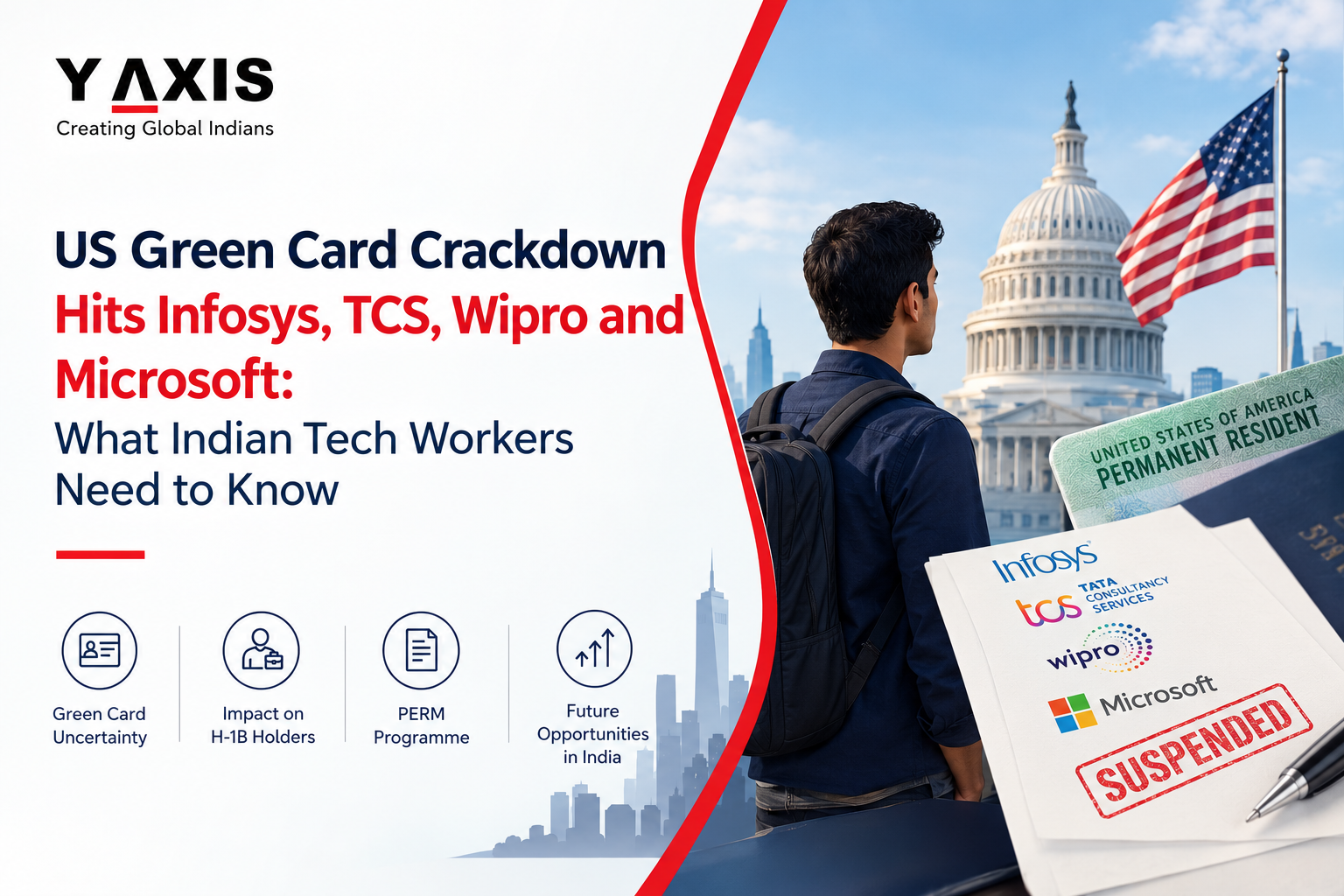
Indian technology professionals pursuing permanent residency in the United States face fresh uncertainty after the Trump administration suspended several major technology companies from participating in the Permanent Labor Certification (PERM) programme. The companies affected include Infosys, Tata Consultancy Services (TCS), Wipro, HCLTech, Cognizant, Capgemini, Microsoft and Adobe, according to reports published on October 8 and 9.
The move is part of a broader US government effort to scrutinise employment-based immigration programmes and protect American workers. However, the immediate implications extend beyond hiring: the PERM process is an important step for many employer-sponsored employment-based green-card applications. For Indian professionals working in the US on H-1B visas, the development raises an important question: What happens to their long-term settlement plans if their employers can no longer use this pathway?
Why did the US suspend these technology companies?
US Vice President JD Vance criticised Microsoft's employment practices, pointing to reported layoffs of approximately 6,000 American workers in 2025 alongside the company's use of foreign-worker visa programmes. Vance cited approximately 6,300 H-1B visas and nearly 3,000 green cards when arguing that the system needed greater scrutiny.
Microsoft disputed the implication that its visa filings represented a comparable number of new foreign hires. In a statement dated October 8, the company said approximately 6,000 of its H-1B applications in the previous fiscal year were largely associated with existing employees. Microsoft said around 80% of those applications were intended to extend or change the status of current employees, rather than recruit new workers. It added that applications for new employees represented approximately 1% of its US workforce.
The distinction matters: visa applications, visa approvals, individual workers and new hires are different measures. The figures cited by the administration should not automatically be interpreted as evidence that foreign workers replaced employees who were laid off. The administration has also targeted Adobe and major IT services companies, including Indian outsourcing firms. The restrictions are associated with scrutiny of their use of employment-based immigration programmes.
Source: Microsoft’s official statement, October 8, 2026; reporting by Reuters and The Washington Post.
The numbers behind the US green-card controversy
The following figures help explain the scale of the dispute and its potential implications.
|
Statistic |
What it means |
|
Approximately 6,000 |
American workers reportedly laid off by Microsoft in 2025, according to Vance |
|
Approximately 6,300 |
H-1B visas cited by Vance in his criticism of Microsoft |
|
Around 6,000 applications |
H-1B filings reported by Microsoft for the previous fiscal year |
|
80% |
Share of Microsoft's reported H-1B applications used to extend or change the status of existing employees |
|
Nearly 3,000 |
Green cards cited by Vance in discussing Microsoft's use of the system |
Important: These are figures attributed to the respective speakers and reports, not a single independently reconciled dataset. In particular, Microsoft's application figure and the administration's visa figure should not be treated as interchangeable.
What is PERM, and why does it matter to Indian professionals?
PERM stands for Program Electronic Review Management. It is the US Department of Labor's process for labour certification, which many employers must complete before sponsoring a foreign worker for an employment-based green card. The process generally requires an employer to demonstrate that there are not sufficient able, willing, qualified and available US workers for the position and that employing the foreign worker will not adversely affect the wages and working conditions of similarly employed US workers.
For eligible professionals, the PERM process can form part of the route towards permanent residence through certain employment-based immigration categories. The latest suspensions could therefore affect workers whose employers depend on PERM to sponsor their green-card applications.
However, the development does not automatically cancel existing H-1B visas, terminate every affected employee's job or revoke green cards already granted. The reported restrictions concern participation in a specific green-card sponsorship process. The practical impact on individual workers will depend on their immigration category, application stage, employer and any further government action. Indian professionals should obtain advice specific to their circumstances rather than assume that every pending application has the same outcome.
Will Indian IT companies move more jobs to India?
The restrictions could strengthen the case for expanding technology development, research and engineering operations in India, although that outcome is not guaranteed. Karnataka IT Minister Priyank Kharge said on October 9 that restrictions on employment-based immigration could create opportunities for India to attract more high-value technology work, including research and development, product engineering and advanced technology development.
The opportunity is significant in strategic terms. Instead of relying exclusively on traditional IT services and outsourcing, Indian technology centres could seek to attract more complex work involving artificial intelligence, deep technology, analytics and product development. However, there are also risks. Indian IT service providers with US operations could face additional compliance costs, workforce-planning challenges and uncertainty when assigning employees to international projects.
NASSCOM, India's IT industry association, said immigration and skilled talent mobility should be treated as distinct issues. It also noted that Indian technology companies have reduced their dependence on H-1B visas while increasing local hiring in the US. Whether the new restrictions result in more jobs in India will depend on business decisions, client demand, operating costs and the ability of Indian centres to undertake higher-value work.
What should Indian professionals on H-1B visas do now?
Professionals employed by affected companies should take the following steps:
- Check your green-card stage: Establish whether your employer has initiated PERM, whether a labour certification is pending or approved, or whether your case has progressed to a later immigration stage.
- Speak to your employer's immigration team: Ask how the suspension affects your specific case and whether the company has issued formal guidance.
- Do not confuse H-1B status with permanent residence: They are different immigration pathways. A PERM restriction does not, by itself, mean an existing H-1B status has been cancelled.
- Avoid making rushed job or relocation decisions: A change of employer can affect immigration planning and should be assessed with qualified immigration counsel.
- Monitor official announcements: Further instructions, legal challenges or changes in the scope of the restrictions could alter the situation.
Professionals considering US employment should also assess the long-term immigration implications of a prospective employer's ability to sponsor permanent residence.
FAQs
1. Which Indian IT companies are affected by the US green-card suspension?
Reports published on October 8–9, 2026, identify Infosys, Tata Consultancy Services, Wipro, HCLTech, Cognizant and Capgemini among the affected companies. Microsoft and Adobe are also affected. The precise scope and duration of the restrictions should be checked against subsequent official announcements.
2. Does the US suspension mean H-1B visas are cancelled?
No. The reported action concerns participation in the PERM labour-certification programme. It does not automatically cancel existing H-1B visas or prevent every affected company from employing H-1B workers.
3. Can Indian professionals still apply for a US green card?
Eligibility depends on the immigration category, employer and applicable rules. Workers whose cases require a PERM certification from an affected employer may face additional obstacles. Other employment-based categories can have different requirements.
4. Will this restriction create more technology jobs in India?
It could encourage some companies to expand research, engineering and technology operations in India. However, additional jobs are not guaranteed, and the outcome will depend on corporate investment, client requirements and the wider technology market.
5. What is the difference between an H-1B visa and a green card?
An H-1B is a temporary, employment-based non-immigrant status for eligible specialty-occupation workers. A green card grants lawful permanent resident status. Some employment-based green-card routes require employer-sponsored PERM labour certification, while others do not.
The bigger picture
The US decision highlights a growing tension between immigration restrictions and the technology industry's demand for specialised talent. For Indian professionals, the immediate concern is the uncertainty surrounding employer-sponsored permanent residence. For India, the longer-term question is whether global companies will invest more heavily in domestic research, engineering and product development.
The key takeawa
Indian IT workers should distinguish restrictions on the PERM process from changes to H-1B status, while companies and policymakers assess how the latest US measures could reshape global technology hiring.
Sources and further reading
- Reuters - Trump administration freezes green cards for Microsoft, IT firms, probes universities, October 8, 2026.
- Microsoft - Microsoft Comment on Recent Immigration Questions, October 8, 2026.
- The Washington Post - Trump officials block Microsoft’s access to program for employee green cards, October 8, 2026.
- Business Standard - Immigration and skilled talent mobility are distinct issues: Nasscom, October 9, 2026.
- Moneycontrol - US green card curbs could push high-value tech jobs to India: Priyank Kharge, October 9, 2026.
~ Dr. Serah Vinodini Vilvaraj
Tags:
US Immigration News
US Green Card Suspension
H-1B Visa
PERM Labour Certification
Infosys
Tata Consultancy Services
Wipro
Indian IT Professionals
US Immigration Policy
Jobs in India
Share
Options for you by Y-Axis

Get it on your mobile

Get News alerts

Contact Y-Axis
Latest Article
Popular Post
Trending Article
Posted On October 13 2026
US Green Card Crackdown: What Indian IT Workers Need to Know