

Posted on September 03 2026
Canada vs. Germany for Engineers: Which Country Should You Choose?

By , Editor & Director
Updated September 05 2026
If you are an engineer planning to work and settle abroad, Canada and Germany are two strong destinations to consider. Both countries have well-developed engineering sectors, demand for skilled professionals, competitive salaries and pathways for international workers to build long-term careers. However, the better choice depends on your engineering specialisation, work experience, qualifications, salary expectations, age, language skills, family plans and preferred immigration pathway.
Canada can be attractive because of its Express Entry system, category-based selection and Provincial Nominee Programs (PNPs). Germany can be particularly appealing to engineers because of its strong manufacturing and engineering industries, EU job market access and skilled-worker immigration pathways.
*Want to migrate abroad? Contact Y-Axis for complete guidance and assistance
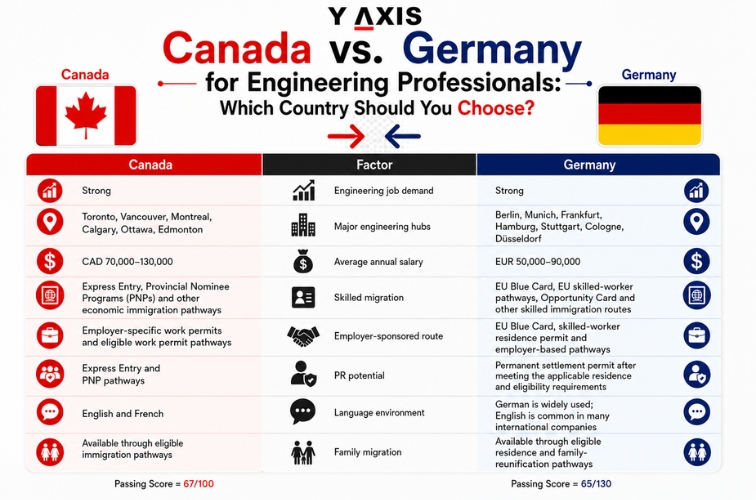
Canada vs. Germany for Engineers: Quick Comparison
|
Factor |
Canada |
Germany |
|
Engineering job demand |
Strong |
Strong |
|
Major engineering hubs |
Toronto, Vancouver, Montreal, Calgary, Ottawa, Edmonton |
Berlin, Munich, Frankfurt, Hamburg, Stuttgart, Cologne, Düsseldorf |
|
Popular engineering roles |
Mechanical Engineers, Civil Engineers, Electrical Engineers, Electronics Engineers, Software Engineers, Industrial Engineers, Chemical Engineers, Environmental Engineers, Aerospace Engineers, Automotive Engineers, Manufacturing Engineers, Petroleum Engineers |
Mechanical Engineers, Electrical Engineers, Civil Engineers, Automotive Engineers, Industrial Engineers, Software Engineers, Electronics Engineers, Mechatronics Engineers, Chemical Engineers, Aerospace Engineers, Manufacturing Engineers, Environmental Engineers, Energy Engineers |
|
Average annual salary |
CAD 70,000–130,000 |
EUR 50,000–90,000 |
|
Skilled migration |
Express Entry, Provincial Nominee Programs (PNPs) and other economic immigration pathways |
EU Blue Card, EU skilled-worker pathways, Opportunity Card and other skilled immigration routes |
|
Employer-sponsored route |
Employer-specific work permits and eligible work permit pathways |
EU Blue Card, skilled-worker residence permit and employer-based pathways |
|
PR potential |
Express Entry and PNP pathways |
Permanent settlement permit after meeting the applicable residence and eligibility requirements |
|
Language environment |
English and French |
German is widely used; English is common in many international companies |
|
Family migration |
Available through eligible immigration pathways |
Available through eligible residence and family-reunification pathways |
|
Best suited for |
Engineers prioritising immigration options, English-speaking opportunities and long-term settlement |
Engineers prioritising engineering and manufacturing careers, European opportunities and technical industries |
*Check your eligibility to Canada through the Y-Axis Canada CRS Score Calculator.
Canada vs. Germany: Which Country Offers Better Opportunities for Engineers?
Both Canada and Germany offer promising career opportunities for engineers. However, the better destination depends on your engineering discipline, qualifications, professional experience, language proficiency, career objectives and long-term settlement plans.
Canada may be a better option if you:
- Have a strong Express Entry or PNP profile.
- Possess relevant experience in an in-demand engineering occupation.
- Have strong English or French language proficiency.
- Hold a recognised engineering qualification.
- Have several years of relevant professional experience.
- Meet the eligibility requirements for an economic immigration pathway.
- Prefer to work in an English-speaking professional environment.
- Prioritise permanent residence and long-term settlement.
- Want access to Canada's large infrastructure, energy, construction, technology and engineering sectors.
- Prefer to build your career in the North American market.
Germany may be a better option if you:
- Have an engineering qualification recognised or accepted for the relevant German employment or immigration route.
- Work in an engineering field with strong demand, such as mechanical, automotive, electrical, electronics, civil, industrial or mechatronics engineering.
- Have relevant professional experience.
- Can meet the applicable German or English language requirements for your job and visa route.
- Qualify for the EU Blue Card or another skilled-worker pathway.
- Want to work in Germany's strong automotive, manufacturing, engineering, energy and industrial sectors.
- Are interested in gaining access to the broader European employment market.
- Prefer Germany's central location within Europe and its established industrial economy.
- Are willing to learn German to improve your long-term career and integration opportunities.
- Yes. Since this is for an SEO article, I’d keep the table compact and add potential monthly savings without making it too detailed.
.webp)
*Check your eligibility through the Germany Immigration Points Calculator
Canada vs. Germany: Salary, Living Costs & Savings for Engineers
Engineering salaries can vary based on experience, engineering field, location and employer. Canada can offer higher salaries for experienced engineers, while Germany has strong opportunities in areas such as automotive, manufacturing and technology. The table below compares salaries, take-home pay and potential savings in both countries. Actual figures can vary based on taxes, rent and lifestyle.
|
Factor |
Canada |
Germany |
|
Engineering Salary Range |
₹42 lakh–₹1.03 crore/year |
₹52 lakh–₹73 lakh/year |
|
Entry-Level Salary |
₹42–₹55 lakh/year |
₹52–₹58 lakh/year |
|
Mid-Level Salary |
₹55–₹75 lakh/year |
₹58–₹66 lakh/year |
|
Senior-Level Salary |
₹75 lakh–₹1.03 crore+/year |
₹66–₹73 lakh+/year |
|
Monthly Gross Salary |
₹3.5–₹8.6 lakh |
₹4.3–₹6.0 lakh |
|
Estimated Monthly Take-Home |
₹2.8–₹5.9 lakh |
₹2.8–₹3.9 lakh |
|
Estimated Monthly Living Costs |
₹1.8–₹2.7 lakh |
₹1.7–₹2.5 lakh |
|
Potential Monthly Savings |
₹1.0–₹3.2 lakh+ |
₹0.8–₹2.2 lakh+ |
|
Popular Engineering Fields |
Mechanical, Civil, Electrical, Software |
Mechanical, Automotive, Electrical, Civil |
|
Major Engineering Cities |
Toronto, Calgary, Vancouver |
Munich, Stuttgart, Berlin |
Engineering Salary and Career Growth
Engineers in Canada can earn around ₹42 lakh to more than ₹1 crore per year, depending on their experience, skills and engineering field. Senior engineers and professionals in specialised roles can have higher earning potential. In Germany, engineering salaries generally range from around ₹52 lakh to ₹73 lakh per year. Germany has strong opportunities in automotive, mechanical, electrical and manufacturing engineering. When it comes to savings, Canada may offer higher potential savings for senior engineers, especially in cities with lower housing costs. Germany can also provide good savings opportunities because living costs can be more manageable in some cities. Your actual savings will depend on your salary, taxes, rent and lifestyle.
*Looking for assistance with overseas immigration? Contact Y-Axis world’s number one immigration consultant for job search support and visa assistance.
FAQs
Which country is better for engineers, Canada or Germany?
Both Canada and Germany offer excellent opportunities for engineers, but the better choice depends on your career goals. Canada may suit engineers who prefer an English-speaking environment, immigration options and North American career opportunities. Germany may be better for professionals interested in automotive, manufacturing, mechanical and industrial engineering. Your qualifications, experience, language skills, salary expectations and preferred lifestyle should be considered before making a decision.
Is Canada good for Indian engineers?
Yes, Canada is a popular destination for Indian engineers because of its demand for skilled professionals across construction, infrastructure, manufacturing, energy, technology and other industries. Engineers with recognised qualifications, relevant experience and strong English or French skills may explore different immigration pathways. Canada can also be attractive for professionals who want permanent residence and long-term settlement opportunities in an English-speaking country.
Is Germany good for Indian engineers?
Yes, Germany offers strong career opportunities for Indian engineers, particularly in mechanical, automotive, electrical, electronics, manufacturing and industrial engineering. Engineers with relevant qualifications and professional experience may qualify for skilled-worker immigration pathways. Knowledge of German can improve employment opportunities and workplace integration, although some international companies offer positions where English is the primary working language. Germany is also attractive for engineers seeking opportunities within the European market.
Which country has higher engineering salaries, Canada or Germany?
Engineering salaries are competitive in both Canada and Germany, but the actual amount depends on your specialisation, experience, location and employer. Canada may offer higher salaries in certain engineering and energy-related roles, while Germany provides strong salaries in automotive, mechanical and industrial engineering. Engineers should compare gross and net income, taxes, housing and other living expenses before deciding which country provides better financial opportunities.
Is it easier to get PR in Canada or Germany as an engineer?
The easier permanent residence pathway depends on your individual profile. Canada offers Express Entry, Provincial Nominee Programs and other economic immigration options. Germany provides pathways through skilled-worker residence permits and other routes that can lead to permanent settlement. Factors such as qualifications, work experience, language skills, salary, age and employment status can affect your eligibility. Engineers should compare both systems based on their specific circumstances.
Can engineers get jobs in Germany without speaking German?
Yes, engineers can find some jobs in Germany without strong German language skills, particularly with multinational companies where English is commonly used. However, learning German can significantly improve your employment options, workplace communication and long-term integration. Some employers and regulated professions may have specific language requirements. Engineers should check the language expectations for their particular occupation, employer and location before applying for jobs in Germany.
Can engineers work in Canada without a Canadian engineering licence?
Some engineering jobs in Canada may be available without immediately holding a professional engineering licence, depending on the position and province. However, using the professional title P.Eng. and performing certain regulated engineering activities generally requires licensing through the relevant provincial or territorial engineering regulator. Engineers planning to practise professionally should check the licensing requirements for their specific province and engineering discipline before starting work.
Which country has more engineering jobs, Canada or Germany?
Both Canada and Germany have large engineering employment markets. Canada has opportunities in construction, infrastructure, energy, manufacturing, technology and environmental engineering. Germany has a particularly strong industrial base, with major opportunities in automotive, mechanical, electrical, manufacturing and automation engineering. Job availability depends on your specialisation, experience, qualifications and location. Engineers should research demand for their specific occupation rather than comparing the overall number of engineering jobs.
Which is better for mechanical engineers, Canada or Germany?
Germany can be particularly attractive for mechanical engineers because of its globally recognised automotive, manufacturing, machinery and industrial sectors. Canada also offers opportunities in manufacturing, energy, construction, mining and other industries. Germany may be preferable for engineers seeking industrial and automotive careers, while Canada may suit professionals prioritising English-speaking opportunities and immigration pathways. Your experience, qualifications, language skills and long-term career objectives should guide the decision.
Which country should engineers choose for long-term settlement?
The right country for long-term settlement depends on your professional and personal priorities. Canada may be suitable if you prioritise English-language opportunities, permanent residence pathways and North American career prospects. Germany may be better if you want to build a career in Europe's engineering and manufacturing industries and are willing to learn German. Before deciding, compare immigration eligibility, career opportunities, salary, taxes, living costs and family requirements.
Tags:
Canada vs Germany for Engineers
Engineering Jobs in Canada
Engineering Jobs in Germany
Canada Immigration for Engineers
Germany Immigration for Engineers
Engineering Salaries in Canada
Engineering Salaries in Germany
Canada vs Germany Salary
Share
Options for you by Y-Axis

Get it on your mobile

Get News alerts

Contact Y-Axis
Latest Article
Popular Post
Trending Article
Posted On October 22 2026
Canada vs. UK for Engineers: Which Country Should You Choose?