

Posted on September 02 2026
Canada vs. Australia for IT Professionals: Which Country Should You Choose?

By , Editor & Director
Updated September 05 2026
If you are an IT professional planning to work and settle abroad, Canada and Australia are two of the strongest options to consider. Both countries have established technology sectors, demand for skilled IT workers, competitive salaries and pathways to permanent residence. However, the better choice depends on your IT occupation, work experience, salary expectations, age, English-language ability, family plans and preferred immigration pathway.
For many IT professionals, Canada can be attractive because of its Express Entry system, STEM-focused immigration categories and technology-focused work permit options. Australia can be particularly attractive for professionals who want high salaries, a strong technology sector and skilled or employer-sponsored pathways to permanent residence.
*Want to migrate abroad? Contact Y-Axis for complete guidance and assistance
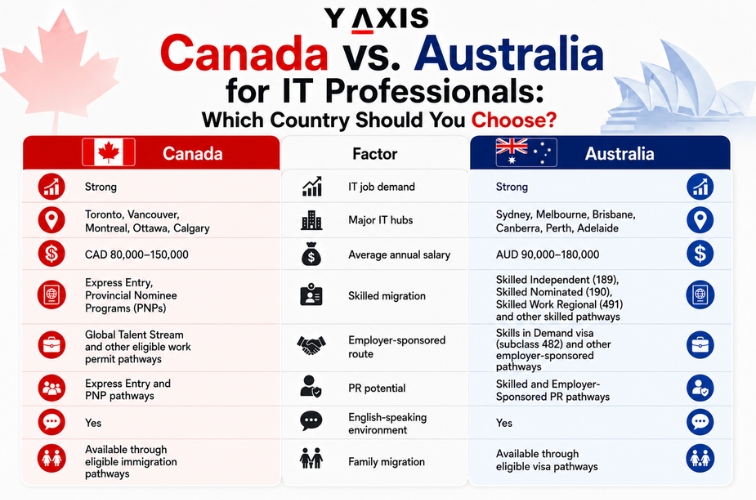
Canada vs. Australia for IT Professionals: Quick Comparison
|
Factor |
Canada |
Australia |
|
IT job demand |
Strong |
Strong |
|
Major IT hubs |
Toronto, Vancouver, Montreal, Ottawa, Calgary |
Sydney, Melbourne, Brisbane, Canberra, Perth, Adelaide |
|
Popular IT roles |
Software Engineers, Software Developers, Data Scientists, Data Engineers, AI/ML Engineers, Cybersecurity Specialists, Cloud Engineers, DevOps Engineers, Solutions Architects, IT Project Managers, Business Analysts, Database Administrators |
Software Engineers, Software Developers, Data Scientists, Data Engineers, AI/ML Engineers, Cybersecurity Specialists, Cloud Engineers, DevOps Engineers, Solutions Architects, IT Project Managers, Business Analysts, Systems Analysts, Database Administrators |
|
Average annual salary |
CAD 80,000–150,000 |
AUD 90,000–180,000 |
|
Skilled migration |
Express Entry, Provincial Nominee Programs (PNPs) |
Skilled Independent (189), Skilled Nominated (190), Skilled Work Regional (491) and other skilled pathways |
|
Employer-sponsored route |
Global Talent Stream and other eligible work permit pathways |
Skills in Demand visa (subclass 482) and other employer-sponsored pathways |
|
PR potential |
Express Entry and PNP pathways |
Skilled and employer-sponsored PR pathways |
|
English-speaking environment |
Yes |
Yes |
|
Family migration |
Available through eligible immigration pathways |
Available through eligible visa pathways |
|
Best suited for |
Skilled IT professionals prioritising immigration options and long-term settlement |
Skilled IT professionals prioritising salary, lifestyle and skilled migration opportunities |
*Check your eligibility to Canada through the Y-Axis Canada CRS Score Calculator.
Canada vs. Australia: Which Country Offers Better Opportunities for Indian IT Professionals?
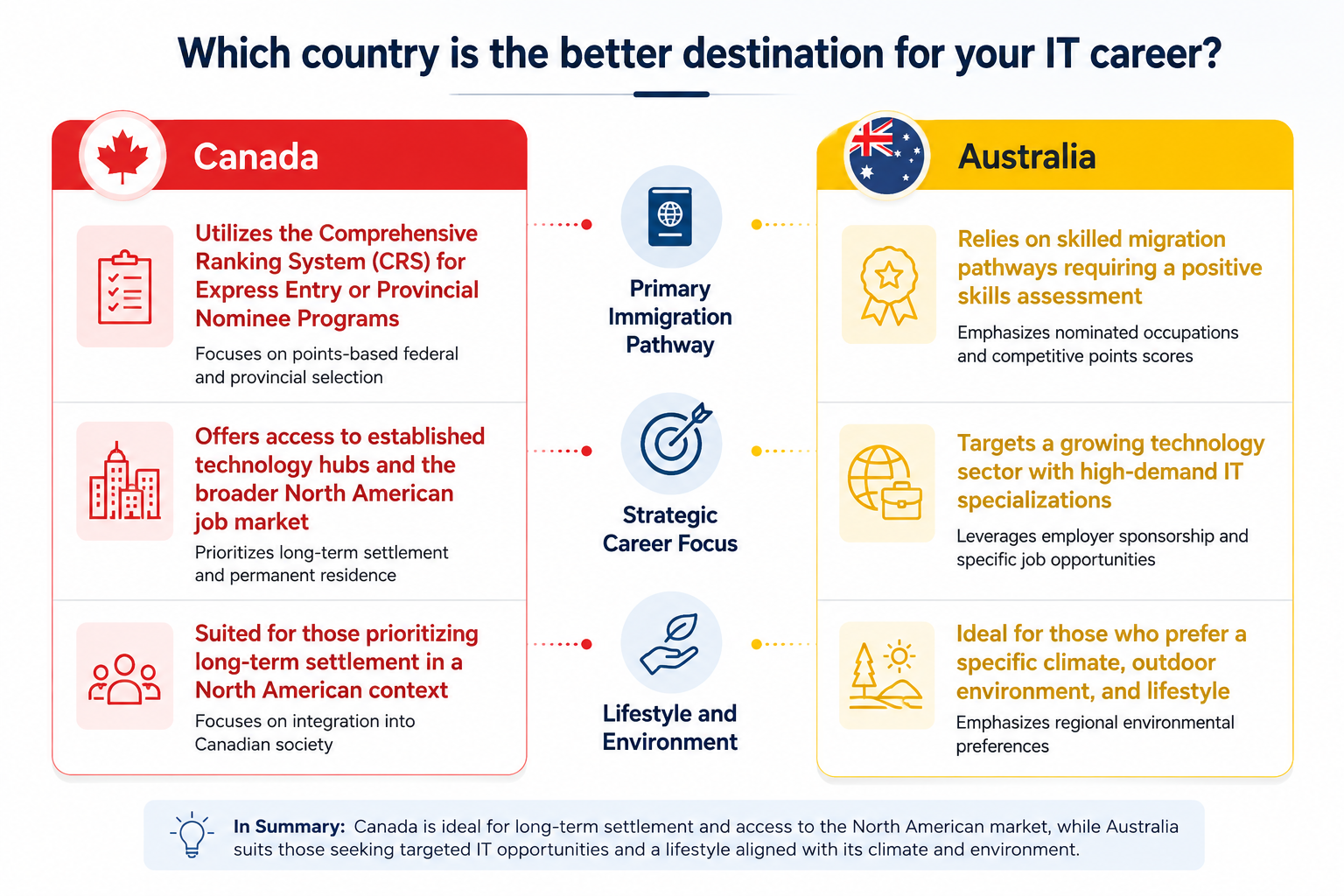
Both Canada and Australia offer promising career and migration opportunities for Indian IT professionals. However, the better destination depends on your professional experience, qualifications, language proficiency, immigration score, career goals and preferred lifestyle.
Canada may be a better option if you:
- Have a strong Comprehensive Ranking System (CRS) score for Express Entry.
- Possess relevant experience in an eligible STEM or technology occupation.
- Have strong English or French language proficiency.
- Hold a recognised educational qualification.
- Have several years of relevant skilled work experience.
- Meet the eligibility requirements for Express Entry or a Provincial Nominee Program (PNP).
- Prioritise permanent residence and long-term settlement in Canada.
- Want to explore opportunities within Canada's established technology hubs and North American job market.
Australia may be a better option if you:
- Work in an occupation eligible for Australia's skilled migration pathways.
- Have strong English-language proficiency and can meet the applicable visa requirements.
- Can obtain a positive skills assessment for your nominated occupation.
- Have a competitive points score for skilled migration.
- Have access to Australian employer sponsorship or an eligible job opportunity.
- Have substantial professional experience in a high-demand IT specialisation.
- Prefer Australia's climate, lifestyle and outdoor environment.
- Are looking for opportunities to build a long-term career in Australia's growing technology sector.
*Get evaluated instantly with the Y-Axis Australia immigration points calculator for free. Check your eligibility right away for your Australia work visa.
Canada vs. Australia: Salary, Living Costs & Savings for IT Professionals
For IT professionals, the financial benefit of working abroad depends on more than just salary. Taxes, housing, groceries, transportation and other daily expenses can significantly affect how much you can save each month. The table below shows a comparison of IT salaries, take-home pay, housing and daily living expenses in Canada and Australia. It also highlights the potential savings for IT professionals at different income levels. Actual costs and savings can vary depending on experience, job role, location, tax rates and individual lifestyle.
|
Factor |
Canada |
Australia |
|
Median IT Salary |
₹42 lakh–₹1.30 crore/year |
₹70 lakh–₹1.10 crore/year |
|
Monthly Gross Salary |
₹3.5–₹10.9 lakh |
₹4.0–₹10.2 lakh |
|
Estimated Monthly Take-Home Salary |
₹2.8–₹7.4 lakh |
₹3.4–₹7.9 lakh |
|
1-Bedroom City-Centre Rent |
₹1.36–₹1.91 lakh/month |
₹1.70–₹2.42 lakh/month |
|
Monthly Grocery Expenses |
₹27,000–₹41,000 |
₹20,400–₹34,000 |
|
Public Transport Expenses |
₹6,800–₹10,600/month |
₹10,200–₹14,800/month |
|
Utilities + Internet + Mobile |
₹12,300–₹20,900/month |
₹13,600–₹29,200/month |
|
Estimated Monthly Living Costs |
₹1.84–₹2.66 lakh |
₹2.24–₹3.26 lakh |
|
Potential Monthly Savings |
₹1.0–₹5.5 lakh+ |
₹1.0–₹5.0 lakh+ |
|
Lower-Cost IT Cities |
Calgary, Edmonton, Montreal |
Brisbane, Adelaide, Perth |
|
Major Expensive IT Cities |
Toronto, Vancouver |
Sydney, Melbourne |
Salary and Savings Potential
IT professionals in Canada can earn approximately CAD 100,000–145,000 per year, while experienced IT professionals in Australia may earn around AUD 120,000–180,000 per year. However, the amount you can actually save depends heavily on your location, tax bracket, housing costs and lifestyle. Canada can offer higher savings potential in cities such as Calgary, Edmonton and Montreal, where housing costs may be lower than Toronto and Vancouver. Australia can provide higher salaries for some specialised IT roles, but cities such as Sydney and Melbourne generally have higher housing and living expenses.
*Looking for assistance with overseas immigration? Contact Y-Axis world’s number one immigration cosultant for job search support and visa assistance.
FAQs
Which country is better for Indian IT professionals, Canada or Australia?
Both Canada and Australia offer good opportunities for Indian IT professionals. Canada may be suitable for professionals with strong Express Entry or Provincial Nominee Program potential. Australia may be better for applicants with an eligible occupation, positive skills assessment and competitive points score. Your age, education, work experience, English proficiency, occupation and long-term settlement plans should be considered before choosing the right country.
Is Canada good for software engineers?
Yes, Canada is a good destination for software engineers because it has a well-established technology sector and opportunities across software development, cloud computing, DevOps, cybersecurity, artificial intelligence and data. Software engineers and designers are also included in Canada's Global Talent Stream framework, subject to eligibility requirements. Professionals with relevant qualifications and experience may also explore Express Entry and Provincial Nominee Programs for permanent residence.
Is Australia good for software engineers?
Yes, Australia offers strong opportunities for software engineers and other technology professionals. Software and Applications Programmers are recognised under Australia's official occupational classification and include software engineers, developer programmers, analyst programmers and software testers. Experienced professionals may explore skilled migration or employer-sponsored visa options, depending on their occupation, qualifications, skills assessment, English proficiency and other eligibility requirements. Major technology hubs include Sydney, Melbourne, Brisbane and Canberra.
Which country has higher IT salaries, Canada or Australia?
Both Canada and Australia offer competitive salaries for IT professionals. Australia can provide particularly strong earning potential for experienced professionals in software engineering, cybersecurity, cloud computing and other specialised roles. However, salary varies based on occupation, experience, location and employer. IT professionals should compare their expected take-home salary after tax with housing, transportation, healthcare and other living expenses before deciding which country offers better financial opportunities.
Is Canada PR easier than Australia PR for IT professionals?
Neither country can be considered universally easier for permanent residence. Canada offers pathways such as Express Entry, STEM category-based selection and Provincial Nominee Programs. Australia provides skilled and employer-sponsored migration pathways. Your chances depend on factors such as age, occupation, qualifications, work experience, English-language ability, points score and other eligibility requirements. Comparing your individual profile against the latest immigration criteria is essential before choosing between Canada and Australia.
Can software engineers get PR in Canada?
Yes, eligible software engineers may apply for Canadian permanent residence through pathways such as Express Entry or Provincial Nominee Programs. Depending on their profile, they may benefit from Canada's economic immigration programs and applicable category-based selection. However, having a software engineering background does not automatically guarantee PR. Candidates must meet the relevant eligibility requirements and, where applicable, receive an invitation before submitting a permanent residence application.
Can software engineers get PR in Australia?
Yes, eligible software engineers can potentially obtain Australian permanent residence through skilled migration or employer-sponsored pathways. The appropriate pathway depends on factors such as the applicant's occupation, skills assessment, age, qualifications, English-language proficiency, work experience and points score. Some pathways require an invitation or employer sponsorship. Because Australian immigration requirements and occupation arrangements can change, applicants should check the latest criteria before beginning their application.
Which is better for AI engineers, Canada or Australia?
Both Canada and Australia offer opportunities for AI engineers and other professionals working in artificial intelligence and related technologies. Canada may appeal to professionals whose occupation and profile align with current STEM-focused immigration pathways. Australia also provides skilled and employer-sponsored migration options for eligible technology professionals. AI engineers should carefully identify the occupation classification that best matches their actual duties, as immigration eligibility can depend on the nominated occupation rather than the job title alone.
Can I move to Canada without a job offer as an IT professional?
Yes, it is possible to immigrate to Canada through certain economic immigration programs without having a Canadian job offer. Express Entry, for example, does not universally require a job offer for all participating programs. However, candidates must still meet the relevant eligibility requirements and compete for an invitation based on factors such as their Comprehensive Ranking System score, education, language ability and work experience. A job offer can provide additional advantages in some circumstances.
Can I move to Australia without a job offer as an IT professional?
Yes, some Australian skilled migration pathways allow eligible IT professionals to apply without an Australian job offer. The Skilled Independent visa, subclass 189, is one example of a points-tested pathway for eligible skilled workers. However, applicants must satisfy the applicable requirements and receive an invitation where required. Factors such as age, occupation, skills assessment, English proficiency, qualifications and work experience can influence eligibility and competitiveness.
Which country has better work-life balance for IT professionals?
Both Canada and Australia can provide good work-life balance for IT professionals, although the experience varies by employer, industry, job role and location. Australia may appeal to professionals who prefer warmer weather, beaches and outdoor activities. Canada offers multicultural cities, a diverse technology sector and access to the wider North American market. Professionals should also consider working hours, annual leave, commuting, housing costs and workplace culture when comparing both countries.
Which country has more technology jobs, Canada or Australia?
Both Canada and Australia have established technology sectors and offer opportunities for skilled IT professionals. Canada's major technology hubs include Toronto, Vancouver, Montreal, Ottawa and Calgary. Australia's key technology centres include Sydney, Melbourne, Brisbane, Canberra, Perth and Adelaide. Job availability depends heavily on your specialisation, experience and location. Professionals should research opportunities for their specific role, such as software development, cybersecurity, cloud computing, DevOps, AI or data.
What is Australia's main work visa for skilled IT professionals?
The Skills in Demand visa, subclass 482, is an important employer-sponsored pathway for skilled IT professionals in Australia. It allows eligible skilled workers to work for an approved sponsoring employer under the applicable visa stream. The Core Skills stream can allow eligible applicants to stay for up to four years, subject to the visa requirements. Eligibility depends on factors such as occupation, skills, salary, English proficiency and employer sponsorship.
Tags:
Canada vs Australia for IT Professionals
IT Jobs in Canada
IT Jobs in Australia
Canada Immigration for IT Professionals
Australia Immigration for IT Professionals
IT Salaries in Canada
IT Salaries in Australia
Canada vs Australia Salary
Share
Options for you by Y-Axis

Get it on your mobile

Get News alerts

Contact Y-Axis
Latest Article
Popular Post
Trending Article
Posted On October 22 2026
Canada vs. UK for Engineers: Which Country Should You Choose?