


Posted on April 11 2026
Can I Study in Europe for Free?

By , Editor & Director
Updated April 19 2026
Yes, it is possible to study in Europe for free. Some European countries offer very low-cost or no tuition fees at public universities, even for international students like Indians. Countries such as Germany, Norway, Finland, and Austria have universities where you do not have to pay tuition fees. Instead of tuition fees, students usually pay a small semester fee of around €150–€400. If you also get a scholarship to cover living expenses, you can complete your studies at a much lower cost compared to countries like the United States, the United Kingdom, or Australia.
*Want to study in Europe for free? Contact Y-Axis for complete guidance
Top European Countries with Free or Affordable Education
Many European countries offer free or low-cost education, but the fees and rules can vary for international students. Some countries provide free education at public universities, while others charge low tuition fees. In a few cases, courses are free only if you study in the local language. The table below shows the best countries for Indian students in 2026, along with their tuition fees and basic charges.
| Country | Tuition Fee (International Students) | Semester/Admin Fee |
|---|---|---|
| Germany | Free (public universities) | €150–€350 |
| Norway | Free (public universities) | ~€30–€60 |
| Finland | Free (EU/EEA); €8,000–€15,000 (non-EU) | Minimal |
| Austria | €726/semester (non-EU) | Minimal |
| France | €170–€380/year (public) | Minimal |
| Czech Republic | Free (Czech-taught); fees for English programs | Minimal |
| Greece | Free (public universities) | Minimal |
| Poland | Free (Polish-taught); low fees for English programs | Minimal |
*Want to study in Europe? Contact Y-Axis for end-to-end support
Top Free or Low-Cost Universities in Europe for Indian Students
Europe has many well-known universities that offer free or low-cost education for international students, including Indians. Most public universities charge little to no tuition fees, especially in countries like Germany and Norway. In some countries, fees depend on the language of study or the student's nationality. The table below shows some of the top universities, their rankings, and tuition fees to help you choose the right option.
| University | Country | QS Ranking 2026 | Tuition Fee |
|---|---|---|---|
| Technical University of Munich | Germany | 22 | Free |
| Ludwig Maximilian University of Munich | Germany | 58 | Free |
| Sorbonne University | France | 72 | €170–€380/year |
| Heidelberg University | Germany | 80 | Free |
| RWTH Aachen University | Germany | 105 | Free |
| University of Helsinki | Finland | 116 | Free (EU); fees for non-EU |
| University of Oslo | Norway | 119 | Free |
| University of Vienna | Austria | 152 | €726/semester |
| Charles University | Czech Republic | 279 | Free (Czech-taught) |
| University of Warsaw | Poland | 308 | Free (Polish-taught) |
*Read more....
Most affordable Universities in Europe
Steps to Study in Europe for Free
Step 1: Find countries with free tuition. Shortlist universities that match your course and career goals. Use trusted sites like DAAD and NOKUT.
Step 2: Some countries need a local language (German, Norwegian, French) for bachelor’s courses. Many master’s programs are in English, especially in Germany and the Netherlands.
Step 3: Get good marks and prepare your documents.
- IELTS (6.5+ for English programs)
- SOP (Statement of Purpose)
- LOR (Letters of Recommendation)
Step 4: Check country requirements and make sure your degree is accepted.
Step 5: Apply to university websites or through uni-assist for Germany.
Step 6: Apply for scholarships that you are eligible for. Most deadlines are between January and May.
Step 7: Show proof that you can cover your living costs.
Step 8: After getting admission, apply for your student visa. Processing time is usually 6–12 weeks.
*Read more.....
Top Scholarships for Indian Students to Study in Europe
Application Tips for Studying in Europe for Free
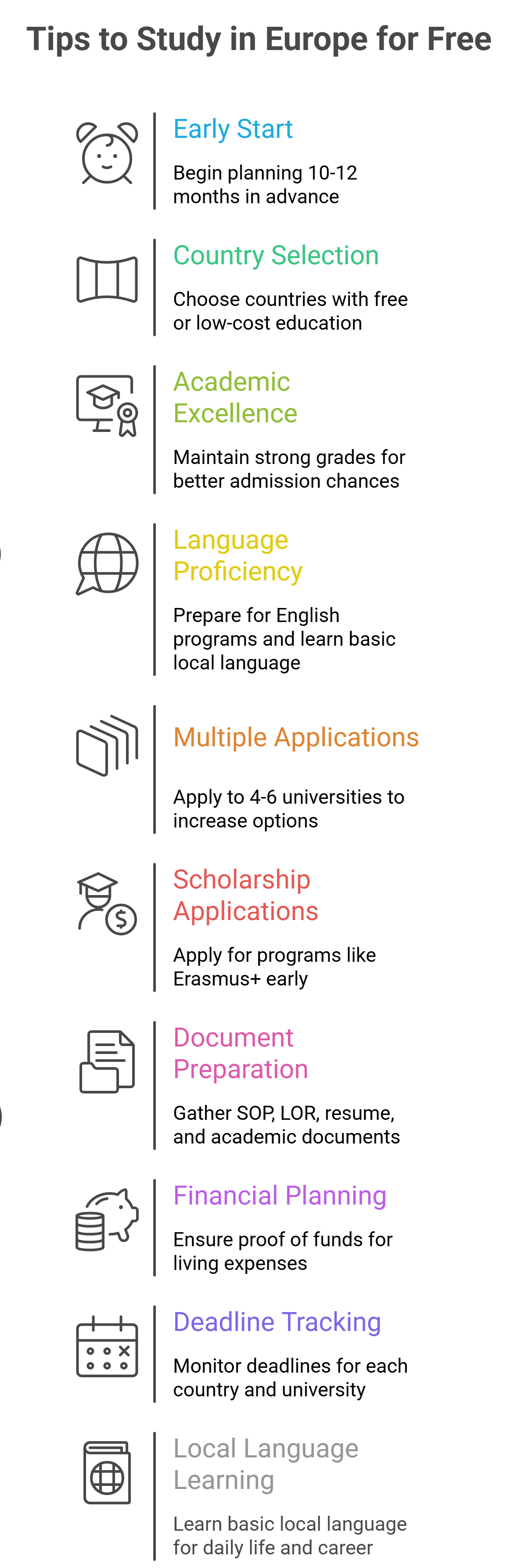
Studying in Europe for free is possible, but you need good planning and the right approach. Here are some simple tips to help you:
- Start early: Begin at least 10–12 months before your intake. This gives you enough time for exams, applications, and visa steps.
- Choose the right country: Countries like Germany and Norway offer free or low-cost education, but living costs can be different.
- Focus on strong academics: Good marks improve your chances of getting admission and scholarships.
- Prepare language scores: Take IELTS or TOEFL for English programs. If needed, learn basic local language for better opportunities.
- Apply to multiple universities: Do not depend on one option. Apply to at least 4–6 universities to increase your chances.
- Apply for scholarships early: Programs like Erasmus+ can cover your expenses. Deadlines are early, so plan ahead.
- Keep documents ready: Prepare SOP, LOR, resume, and academic documents in advance to avoid last-minute stress.
- Plan your finances: Even if tuition is free, you must show proof of funds for living expenses.
- Track deadlines carefully: Each country and university has different deadlines. Missing one can delay your plans.
- Learn basic local language: It helps in part-time jobs, daily life, and future career options.
*Planning to study in abroad? Contact Y-Axis, the world's No. 1 overseas immigration consultancy, for expert guidance on university selection, scholarships, and visa applications.
FAQs
Can Indian students study in Europe for free?
Yes, Indian students can study in Europe for free. Countries like Germany and Norway offer free education at public universities, even for international students. You do not need to pay tuition fees. However, you still need to pay a small semester fee of around €150–€400. You also need to cover your living expenses, which can cost around €700–€1,500 per month depending on the city. Applying for scholarships can help cover these costs and make your education almost completely free.
Which European country is best for free education?
Germany is the best European country for free education for Indian students. Public universities in Germany charge no tuition fees for international students. You only pay a semester administration fee of €150–€350. Germany also offers over 2,000 English-taught programs, so you do not need to know German for many master's courses. Norway is another good option with free tuition, but living costs are higher. Germany offers the best combination of free education, English programs, and good job opportunities after graduation.
Do I need to learn German to study for free in Germany?
Not necessarily. Many master's programs in Germany are fully taught in English, especially in engineering, computer science, and business. You do not need German for these programs. However, for most undergraduate programs, German language skills are required. Learning basic German (A1–B1 level) is still recommended because it helps in daily life, part-time jobs, and finding work after graduation. German employers prefer candidates who can communicate in German, even for technical roles.
What is the semester fee in Germany, and what does it include?
In Germany, even though tuition is free, students pay a semester contribution of €150–€350 every six months. This fee usually includes administrative charges, student services, and most importantly a semester ticket. The Semesterticket gives you free or heavily discounted public transport across the city and nearby regions. This saves a lot of money on daily travel. Some universities also include access to the university gym, library, and student canteen discounts in this semester's fee.
Is Norway free for Indian students?
Yes, Norway offers free tuition at public universities for all students, including Indians. You do not pay tuition fees regardless of your nationality. However, Norway is one of the most expensive countries to live in. Monthly living costs can be €1,200–€1,800, which is significantly higher than in Germany or Poland. You also need to show proof of sufficient funds for your visa. Despite the high living costs, scholarships and part-time work can help manage expenses during your studies.
What documents do I need to apply to free European universities?
To apply to free universities in Europe, you generally need your academic transcripts from Class 10, 12, and your bachelor's degree, English language scores (IELTS 6.5+ or TOEFL), a Statement of Purpose (SOP), Letters of Recommendation (LOR), an updated CV, a valid passport, and proof of financial means. For Germany specifically, Indian students also need an APS certificate to verify their academic documents. Each university may have additional requirements, so always check the official university website carefully before applying.
Can I get a scholarship to cover living costs in Europe?
Yes, several scholarships cover living costs for Indian students in Europe. The Erasmus+ scholarship covers tuition, travel, and a monthly living stipend. The DAAD scholarship in Germany covers monthly living expenses of €850–€1,300 for master's and PhD students. The Swedish Institute Scholarship covers full living costs in Sweden. The Eiffel Excellence Scholarship covers living expenses in France. These scholarships are competitive and require strong academic records, so applying early and maintaining good grades significantly improves your chances of selection.
How much does it cost to live in Europe as a student?
Living costs in Europe vary by country and city. Germany is relatively affordable, with monthly costs of €850–€1,200. Norway is expensive at €1,200–€1,800 per month. Poland and the Czech Republic are among the cheapest at €600–€900 per month. Your main expenses include rent, food, health insurance, transport, and personal costs. University canteens (Mensa) in Germany offer subsidized meals for €2–€4, which helps reduce food expenses. Student discounts on transport and entertainment also help manage monthly costs effectively.
Which European country is the cheapest for Indian students to live in?
Poland and the Czech Republic are among the cheapest European countries for Indian students. Monthly living costs in Poland and the Czech Republic range from €600–€900, significantly lower than in Germany or Norway. Both countries also offer free education in the local language and low-cost English programs. Cities like Warsaw, Krakow, and Prague are student-friendly with good public transport, affordable food, and active Indian student communities. While living costs are low, always check whether your degree from these countries is recognized globally before applying.
Can I work part-time while studying in Europe for free?
Yes, international students, including Indians, can work part-time in most European countries. In Germany, students can work up to 20 hours per week during the semester and full-time during semester breaks. The minimum wage in Germany is approximately €12 per hour. Norway also allows international students to work part-time. Part-time work helps cover living expenses like food, transport, and personal costs. Working also gives you valuable international work experience that improves your resume and increases your chances of finding a full-time job after graduation.
What is the best way to find English-taught free programs in Europe?
The best way to find English-taught free programs in Europe is to use the DAAD database (daad.de) for Germany, which lists over 2,000 English-taught programs. For other European countries, check national higher education portals like NOKUT for Norway, StudyinFinland.fi for Finland, and Study.eu for a broad European search. Filter programs by language of instruction and tuition fee. Most English-taught master's programs in Germany are free at public universities. Always apply at least 10–12 months before your intended intake to meet all application and scholarship deadlines comfortably.
Tags:
Study in Europe for free
Free education in Europe for Indian students
Tuition-free universities in Europe
Europe free education countries
Study abroad for free
Free universities in Europe 2026
No tuition fee Europe
Europe public universities free
Share
Options for you by Y-Axis

Get it on your mobile

Get News alerts

Contact Y-Axis
Latest Article
Popular Post
Trending Article

Posted On October 13 2026
US Green Card Crackdown: What Indian IT Workers Need to Know