

Posted on September 02 2026
What Is the Average Salary in Ireland? A Complete 2026 Guide

By , Editor & Director
Updated September 05 2026
The average salary in Ireland is approximately €52,600 per year, based on CSO earnings data. This is an average income estimation, pulled higher by strong pay in technology, pharmaceuticals, and finance. Earnings vary widely by sector, experience, and location, with Dublin salaries running 10% to 20% above the national average. Ireland's salary figures come from the Central Statistics Office (CSO), which tracks earnings every quarter. The gap between the average and the median is one of the widest in Europe, driven by high-paying multinational jobs concentrated in Dublin and Cork.
Several factors such as sectors (technology, pharmaceuticals, and finance pay far above the national average), location and experience plays a major role with earnings typically peaking between the ages of 40 and 49.
*Want to work in Ireland? Let Y-Axis guide you through the process.
Top 10 High-Paying Occupations in Ireland
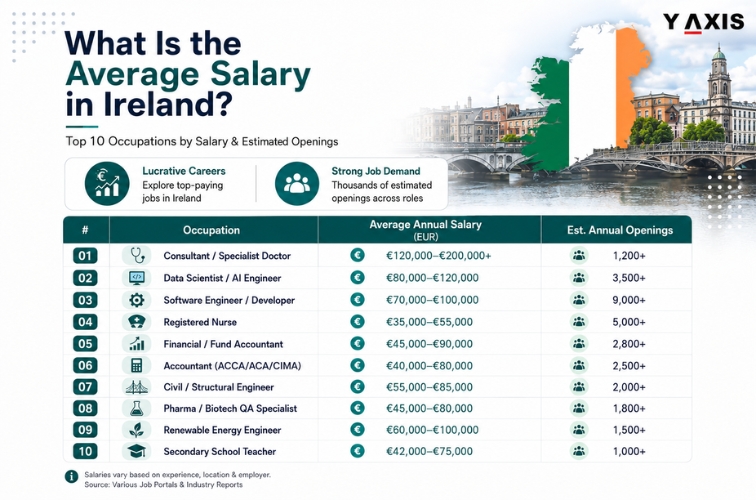
Ireland's job market runs on a few key sectors: technology, pharmaceuticals, finance, healthcare, and construction. Salaries vary widely between these sectors, and some roles face more demand than others due to ongoing skill shortages. The table below shows ten occupations with strong salaries and steady hiring demand in Ireland.
|
Occupation |
Average Annual Salary (EUR) |
Est. Annual Openings |
Sector Note |
|
Software Engineer / Developer |
€70,000-€100,000 |
9,000+ |
Tech hub with 170,000+ employed |
|
Data Scientist / AI Engineer |
€80,000-€120,000 |
3,500+ |
Fast-growing across all sectors |
|
Registered Nurse |
€35,000-€55,000 |
5,000+ |
HSE public health system, Critical Skills List |
|
Consultant / Specialist Doctor |
€120,000-€200,000+ |
1,200+ |
HSE hospitals and private practice |
|
Financial / Fund Accountant |
€45,000-€90,000 |
2,800+ |
Dublin's IFSC, asset management |
|
Civil / Structural Engineer |
€55,000-€85,000 |
2,000+ |
Construction and infrastructure growth |
|
Pharma / Biotech QA Specialist |
€45,000-€80,000 |
1,800+ |
9 of the world's top 10 pharma firms are based here |
|
Accountant (ACCA/ACA/CIMA) |
€40,000-€80,000 |
2,500+ |
Big 4 and multinational finance teams |
|
Renewable Energy Engineer |
€60,000-€100,000 |
1,500+ |
Offshore wind, 70% renewable target by 2030 |
|
Secondary School Teacher |
€42,000-€75,000 |
1,000+ |
Public sector, STEM subject shortages |
Also, read...
Average Lifestyle Expenses in Ireland for Immigrants
Ireland offers strong salaries, but the cost of living is comsiderably higher, especially in Dublin. Housing is a significant expense for most residents, followed by transport, groceries, and utilities. Knowing these costs in advance helps you comprehend whether a salary offer is genuinely competitive.
- Rent (1-bed apartment, Dublin city centre): €1,800-€2,500 per month
- Rent (1-bed apartment, outside Dublin, e.g. Cork, Galway, Limerick): €1,100-€1,500 per month
- Groceries (single person): €250-€400 per month
- Utilities (electricity, heating, and water): €150-€200 per month
- Public transport (monthly Leap card): €115-€130 per month
- Private health insurance (optional, average premium): Approximately €1,900 per year (~€160 per month)
- Internet and mobile plan: €40-€60 per month
- Dining out (casual meal for two): €60-€80
- Overall monthly budget, single person, excluding rent: €950-€1,150
- Overall monthly budget, single person in Dublin, including rent: €2,800-€3,600
Note: Many professionals manage Dublin's rent by sharing accommodation, choosing commuter towns with good transport links, or negotiating a hybrid work arrangement that allows them to live further from the city centre.
Also, read...
Highest paying Jobs in Ireland for Indians
Income Tax and Take-Home Pay in Ireland
Ireland uses a progressive income tax system, plus two additional charges: USC and PRSI. Together, these reduce your gross pay significantly, especially once you cross into the higher tax band.
The table below shows approximate take-home pay for a single PAYE employee in 2026.
|
Gross Annual Salary |
Approx. Take-Home Pay |
Effective Tax Rate |
|
€35,000 |
€29,500 |
~16% |
|
€45,000 |
€36,500 |
~19% |
|
€55,000 |
€42,000 |
~24% |
|
€75,000 |
€54,000 |
~28% |
|
€100,000 |
€68,000 |
~32% |
Note: PRSI contributions fund state benefits such as the state pension, illness benefit, and maternity or paternity benefit, so this deduction also builds your entitlement to future support. Employers pay a separate PRSI contribution on top of your salary, which does not reduce your take-home pay.
Also, read...
Ireland Strengthens Post-Study Work Pathways for International Graduates. Apply Now!
How Ireland's Average Salary Compares to Other Countries?
Ireland's average salary ranks among the highest in the European Union, ahead of major economies such as Germany, France, and Spain. This is largely due to Ireland's low corporate tax rate, which has attracted global technology and pharmaceutical giants to base their European operations in Dublin and Cork. Countries like Luxembourg and Switzerland still pay more on average, but Ireland's earnings growth has consistently outpaced the Eurozone average over the past few years.
When comparing job offers between Ireland and other countries, it helps to look at take-home pay after tax and after rent, rather than the headline salary figure alone. This gives a more accurate picture of what a role in Ireland is really worth compared to opportunities elsewhere.
*Are you looking for step-by-step assistance with Ireland immigration? Contact Y-Axis, the world's No. 1 overseas immigration consultancy, for end-to-end assistance!
FAQs
What is the average salary in Ireland in 2026?
The average salary in Ireland is approximately €52,600 per year, based on CSO earnings data. This is a mean figure that includes very high earners in tech and pharma, so it sits above what most workers actually earn. The median salary, a more typical figure, is closer to €44,800 per year. Weekly earnings average around €1,012, based on the latest quarterly release from the Central Statistics Office.
What is the difference between average and median salary in Ireland?
The average (mean) salary adds up all earnings and divides by the number of workers, so a small number of very high earners pull the figure upward. Ireland's average is about €52,600. The median is the middle value, meaning half of workers earn more and half earn less. Ireland's median is closer to €44,800, making it a more realistic picture of typical pay.
Which jobs pay the highest salaries in Ireland?
The highest-paying roles in Ireland include consultant doctors, senior finance directors, and technology leaders, often earning over €120,000 per year. Software engineers, data scientists, and pharmaceutical specialists also earn well above the national average, typically between €70,000 and €120,000. These roles cluster around Dublin's technology, finance, and life sciences sectors, where multinational companies compete for skilled talent.
Is Dublin salary higher than the rest of Ireland?
Yes. Salaries in Dublin run roughly 10% to 20% above the national average, driven by the concentration of multinational technology, finance, and pharmaceutical companies. However, Dublin's cost of living, especially rent, is also significantly higher than the rest of Ireland. Cities like Cork, Galway, and Limerick offer lower salaries but a considerably lower cost of living, which can balance out overall affordability.
What is the minimum wage in Ireland?
Ireland's national minimum wage is €14.15 per hour from 1 January 2026, one of the highest minimum wage rates in the European Union. For a full-time worker on 39 hours per week, this works out to approximately €28,700 per year before tax. Lower rates apply to workers under 20 years of age. The minimum wage is reviewed annually by the Irish government.
How much tax do I pay on an average salary in Ireland?
On the average salary of about €52,600, you pay income tax at 20% up to €44,000 and 40% on the remainder, plus USC and PRSI. This brings your approximate take-home pay to around €40,000 to €41,000 per year for a single PAYE employee. Exact figures depend on your tax credits, so use Revenue's online calculator for a precise number.
Is average salary in Ireland enough to live comfortably?
It depends on where you live. The average salary comfortably covers living costs in cities like Cork, Galway, or Limerick. In Dublin, high rent takes up a large share of income, so the average salary offers a more modest lifestyle there. Sharing accommodation, choosing suburbs over the city centre, and budgeting for rent early can make the average salary stretch further.
Do foreign workers earn less than Irish nationals in Ireland?
Not necessarily. CSO data shows that some foreign nationals, including Indian workers, have among the highest median weekly earnings in Ireland, reflecting their concentration in high-skill multinational roles. Pay depends more on sector, qualifications, and job role than nationality. Roles requiring specialised skills, such as technology or healthcare, tend to pay well regardless of the employee's country of origin.
What is a good salary in Ireland for a single person?
A good salary for a single person in Ireland is generally considered to be €45,000 or more per year, which covers rent, groceries, transport, and some savings comfortably outside Dublin. In Dublin, €55,000 or more is a more realistic threshold due to higher rent. Salaries above €70,000 place you well above the median and allow for a comfortable lifestyle in most Irish cities.
How does Ireland's average salary compare to other European countries?
Ireland's average salary is among the highest in the European Union, comparable to Luxembourg and higher than most Eurozone countries, including Germany and France. This is largely due to Ireland's concentration of multinational technology and pharmaceutical companies. However, Ireland's cost of living, particularly housing, is also among the highest in Europe, which offsets some of this salary advantage.
Tags:
average salary in Ireland
Ireland salary guide
cost of living in Ireland
Ireland income tax
highest paying jobs in Ireland
work in Ireland
Ireland job market
salary after tax Ireland
Share
Options for you by Y-Axis

Get it on your mobile

Get News alerts

Contact Y-Axis
Latest Article
Popular Post
Trending Article
Posted On October 22 2026
Canada vs. UK for Engineers: Which Country Should You Choose?