

Posted on September 03 2026
What Is the Average Salary in Dubai?

By , Editor & Director
Updated September 13 2026
The average salary in Dubai is approximately AED 15,800 to AED 18,000 per month, which is roughly around AED 190,000 to AED 216,000 per year, based on 2026 recruitment industry salary guides. The median salary is closer to AED 13,800 per month, since a small number of very high earners in finance and technology pull the average upward. Dubai has no personal income tax levied on your income , so most of your gross salary is take-home pay. Salaries can vary widely by sector, experience, and employer type, with finance, technology, and real estate paying well above the city average. Professionals should also consider the type of company they are working in since multinational firms and DIFC-based companies typically pay a premium salary over smaller local businesses.
*Want to work in Dubai? Let Y-Axis guide you through the process.
Top 10 Highest-Paying Occupations in Dubai
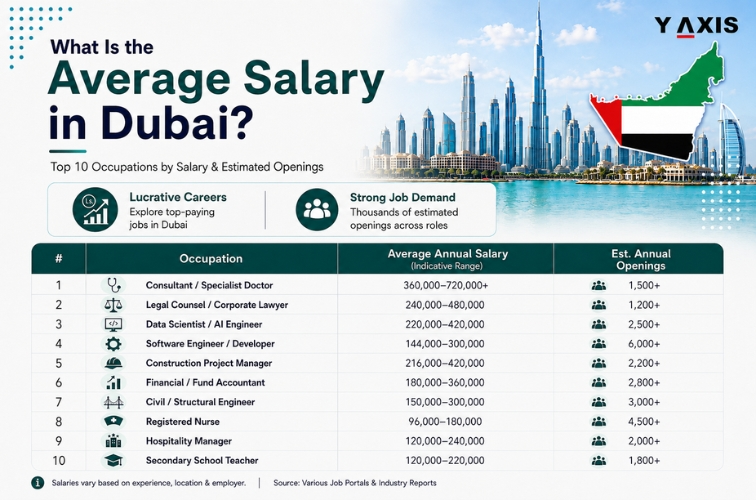
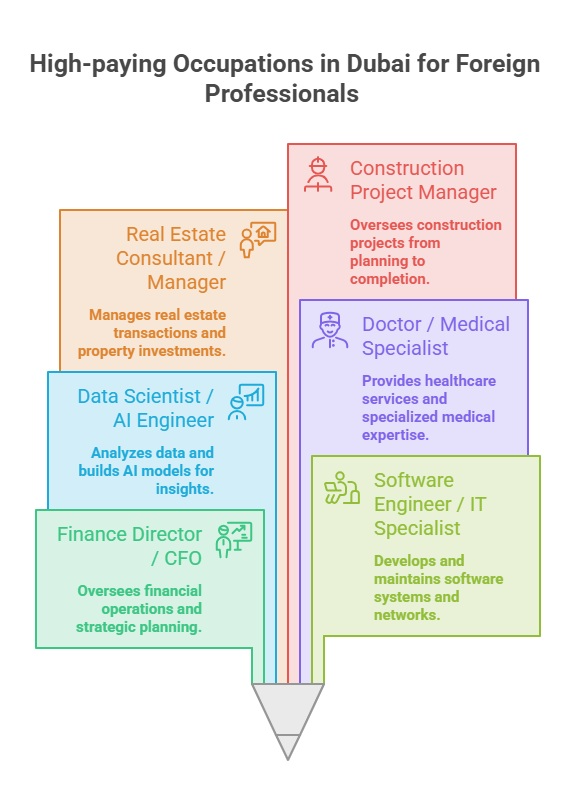
Dubai's job market runs on a few key sectors: finance, technology, real estate, healthcare, and construction. Salaries vary widely between these sectors, and some roles face more demand than others due to ongoing skill shortages. The table below shows ten occupations with strong salaries and steady hiring demand in Dubai.
|
Occupation |
Average Annual Salary (AED) |
Est. Annual Openings |
Sector Note |
|
Finance Director / CFO |
AED 480,000-1,080,000+ |
800+ |
DIFC financial hub premium |
|
Software Engineer / IT Specialist |
AED 180,000-336,000 |
12,000+ |
Dubai Internet City & DIFC tech hub |
|
Data Scientist / AI Engineer |
AED 240,000-420,000 |
4,000+ |
Fast-growing, smart city investment |
|
Doctor / Medical Specialist |
AED 300,000-720,000 |
1,500+ |
Private hospitals and clinics expansion |
|
Real Estate Consultant / Manager |
AED 180,000-480,000 |
5,000+ |
Commission-based, booming property market |
|
Construction Project Manager |
AED 216,000-360,000 |
2,500+ |
Infrastructure and mega-project pipeline |
|
Registered Nurse |
AED 96,000-180,000 |
3,500+ |
Growing hospital and clinic network |
|
Civil / Structural Engineer |
AED 120,000-240,000 |
3,000+ |
Ongoing construction demand |
|
Digital Marketing Manager |
AED 144,000-300,000 |
2,000+ |
80%+ of UAE firms raising digital budgets |
|
Accountant / Finance Analyst |
AED 96,000-216,000 |
4,500+ |
Big 4 and multinational finance teams |
Also, read...
Dubai issues over 167,000 Golden Visas to the families of skilled professionals. Apply now!
Average Lifestyle Expenses in Dubai for Immigrants
Dubai offers strong tax-free salaries, but the cost of living, especially housing, has risen considerably in prime areas. Housing is the biggest expense for most residents, followed by transport, groceries, and utilities. Knowing these costs in advance helps you judge whether a salary offer is genuinely competitive.
- Rent (1-bed apartment, prime area, e.g. Downtown Dubai, Dubai Marina): AED 7,500-10,800 per month
- Rent (1-bed apartment, affordable area, e.g. JLT, Al Nahda): AED 3,500-6,000 per month
- Groceries (single person): AED 1,000-2,000 per month
- Utilities (electricity, water, and cooling, DEWA): AED 600-1,000 per month
- Public transport (monthly Metro/Nol pass): AED 300-400 per month
- Mobile and internet plan: AED 400-500 per month combined
- Health insurance (basic cover, if not employer-provided): AED 650-2,500+ per year
- Dining out (casual meal for two): AED 150-250
- Overall monthly budget, single person, excluding rent: AED 4,000-4,200
- Overall monthly budget, single person, including rent (comfortable baseline): AED 12,000-15,000
Note: Many professionals manage Dubai's rent by choosing outer communities over prime areas, using the Metro instead of a car, and negotiating a multi-cheque rent payment plan instead of one lump sum.
Also, read...
Highest Paying Jobs in Dubai for Indians
Salary Structure and Take-Home Pay in Dubai
The UAE has no personal income tax, so Dubai's salary structure works differently from most countries. Your gross salary and your take-home pay are effectively the same, since expatriate employees do not pay income tax or social security contributions.
The table below shows how a gross monthly salary converts to take-home pay for an expatriate employee in Dubai.
|
Gross Monthly Salary |
Mandatory Employee Deductions |
Approx. Take-Home Pay |
|
AED 10,000 |
None (no income tax for expats) |
AED 10,000 (100%) |
|
AED 20,000 |
None |
AED 20,000 (100%) |
|
AED 30,000 |
None |
AED 30,000 (100%) |
|
AED 50,000 |
None |
AED 50,000 (100%) |
Also, read...
UAE Golden Visa: Eligibility, Benefits & Application
How Dubai's Average Salary Compares to Other Countries
Dubai's average salary trails higher-cost cities such as Zurich, Geneva, or San Francisco in absolute terms, but its zero personal income tax changes the comparison. A gross salary in Dubai converts almost entirely to take-home pay, while an equivalent salary in Ireland, the UK, or most of Europe loses 20% to 40% to income tax and social contributions. This tax advantage often makes Dubai's real purchasing power competitive with much higher-paying Western cities.
When comparing job offers between Dubai and other countries, it helps to compare net income after rent, rather than the headline salary or tax rate alone. This gives a clearer picture of what a role in Dubai is really worth compared to opportunities elsewhere.
*Are you looking for step-by-step assistance with UAE immigration? Contact Y-Axis, the world's No. 1 overseas immigration consultancy, for end-to-end assistance!
FAQs
What is the average salary in Dubai in 2026?
The average salary in Dubai is approximately AED 15,800 to AED 18,000 per month, based on 2026 recruitment industry salary guides from firms such as Michael Page and Hays. This works out to roughly AED 190,000 to AED 216,000 per year. The median salary is closer to AED 13,800 per month, since high earners in finance and technology pull the average upward. Because the UAE has no personal income tax, this gross figure is effectively your take-home pay.
What is the difference between average and median salary in Dubai?
The average (mean) salary adds up all earnings and divides by the number of workers, so a small number of very high earners pull the figure upward. Dubai's average is about AED 15,800 to AED 18,000 per month. The median is the middle value, meaning half of workers earn more and half earn less. Dubai's median is closer to AED 13,800 per month, making it a more realistic picture of typical pay.
Which jobs pay the highest salaries in Dubai?
The highest-paying roles in Dubai include finance directors, senior technology leaders, and specialist doctors, often earning AED 40,000 to AED 90,000 per month. Software engineers, data scientists, and real estate professionals also earn well above the city average. These roles cluster around DIFC's financial sector, Dubai Internet City's technology cluster, and the city's large private healthcare and property sectors, where multinational companies compete for skilled talent.
Is there a minimum wage in Dubai?
Dubai and the wider UAE do not have a universal minimum wage covering all workers. Salaries are largely determined by the employment contract agreed between employer and employee. From January 2026, a minimum wage of AED 6,000 per month applies specifically to UAE nationals in the private sector. Separately, MOHRE's skilled-worker visa classification sets a basic salary threshold of around AED 4,000 for certain work permit categories, though this is not binding for all expatriate professionals.
How much tax do I pay on my salary in Dubai?
The UAE has zero personal income tax for individuals, regardless of nationality or residency status. This means your gross salary in Dubai is effectively your take-home pay, since expatriate employees also do not pay social security contributions. Only UAE and GCC nationals contribute 5% to 17.5% of their salary to the General Pension and Social Security Authority (GPSSA). Employers separately fund an end-of-service gratuity, which does not reduce your monthly salary.
Is the average salary in Dubai enough to live comfortably?
It depends on your lifestyle and where you live. Most expats consider AED 12,000 to AED 15,000 per month a reasonable baseline for a comfortable single lifestyle, covering a decent one-bedroom apartment, groceries, transport, and some dining out. Choosing outer communities over prime areas like Downtown Dubai or Dubai Marina, using the Metro instead of a car, and negotiating a multi-cheque rent plan can help the average salary stretch further.
Do foreign workers earn less than UAE nationals in Dubai?
Not necessarily. Pay in Dubai is largely determined by sector, qualifications, job role, and employer type, rather than nationality alone. However, UAE and GCC nationals working in the private sector benefit from a mandated minimum wage of AED 6,000 per month from January 2026, a protection that does not extend to expatriate workers. Foreign professionals in high-skill roles, such as finance, technology, or healthcare, often earn salaries comparable to or higher than many local roles.
What is a good salary in Dubai for a single person?
A good salary for a single person in Dubai is generally considered to be AED 15,000 or more per month, which comfortably covers rent, groceries, transport, and some savings. In prime areas like Downtown Dubai or Dubai Marina, AED 18,000 or more is a more realistic threshold due to higher rent. Salaries above AED 25,000 per month place you well above the median and allow for a comfortable lifestyle in most parts of the city.
How does Dubai's average salary compare to other cities?
Dubai's average salary trails higher-cost cities such as Zurich, Geneva, or San Francisco in absolute terms, but its zero personal income tax changes the comparison. A gross salary in Dubai converts almost entirely to take-home pay, while an equivalent salary in Ireland, the UK, or most of Europe loses 20% to 40% to income tax and social contributions. This tax advantage often makes Dubai's real purchasing power competitive with much higher-paying Western cities.
What salary do I need to qualify for the UAE Golden Visa?
To qualify for the UAE Golden Visa as a skilled professional, you generally need a basic salary of at least AED 30,000 per month, along with a relevant degree and job role. This long-term visa offers residency validity of 5 to 10 years without needing an employer sponsor. Investors, entrepreneurs, and exceptional talents may qualify for the Golden Visa through separate criteria that do not depend on a minimum salary.
Tags:
Average salary in Dubai
Dubai salary guide
cost of living in Dubai
Dubai tax-free income
highest paying jobs in Dubai
work in Dubai
Dubai job market
take-home pay Dubai
Share
Options for you by Y-Axis

Get it on your mobile

Get News alerts

Contact Y-Axis
Latest Article
Popular Post
Trending Article

Posted On October 22 2026
Canada PR in 2026: PTE Core Scores, CLB Requirements and the English-Test Mistake Applicants Must Avoid