

Posted on October 07 2026
Australia Has Changed the Skilled Visa Queue. Here’s What That Means

By , Editor & Director
Updated October 07 2026
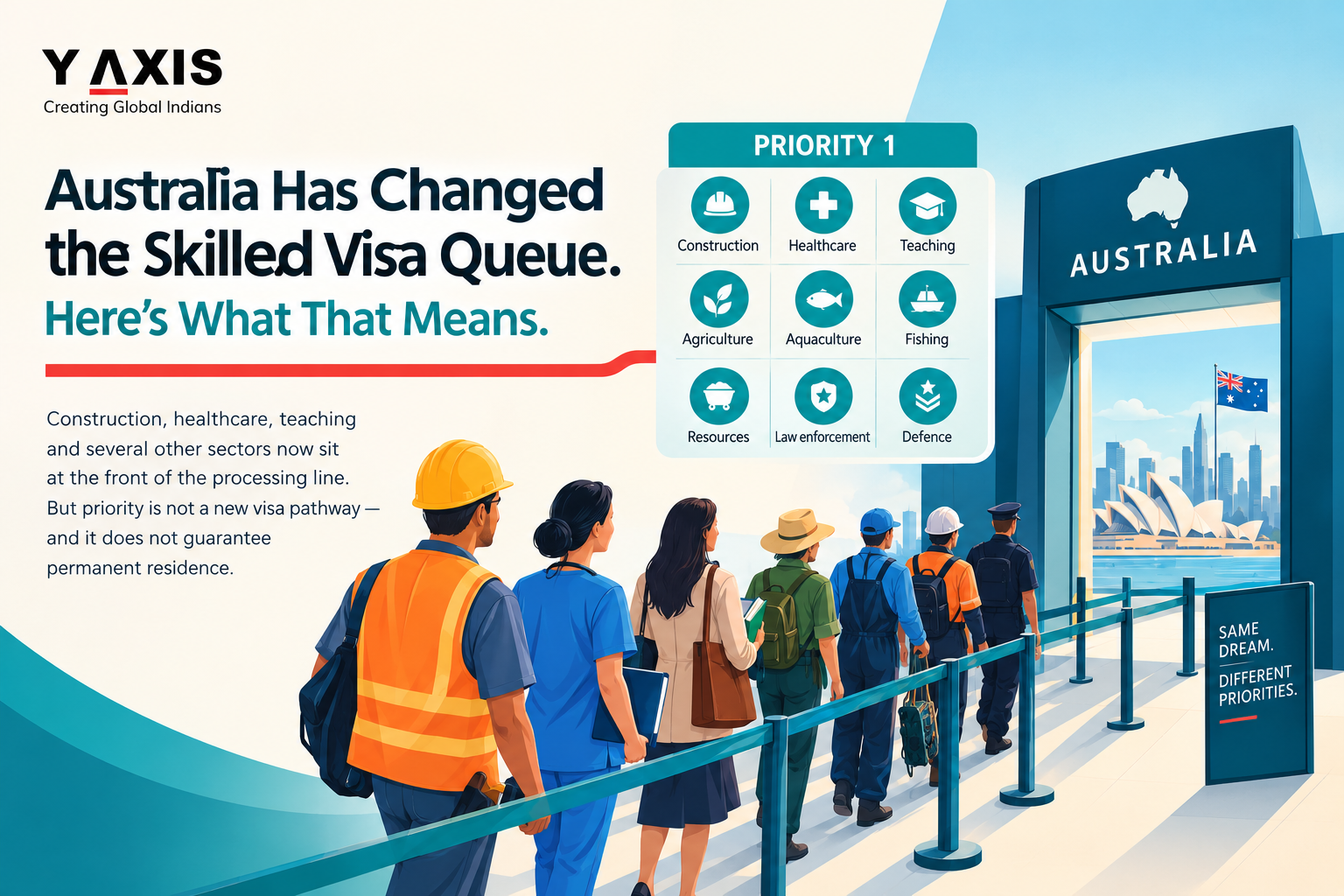
Construction, healthcare, teaching and several other sectors now sit at the front of Australia’s skilled visa processing queue. But higher priority does not mean automatic visa approval or permanent residence.
For years, Australia’s skilled migration system has largely been discussed as a question of eligibility.
Is your occupation on the relevant list?
Do you have the required skills?
Do you meet the points requirements?
Do you have an employer or nomination?
Australia’s latest change introduces another question:
If thousands of people are eligible to apply, whose application gets processed first?
That is the real significance of Australia’s new skilled visa processing framework.
From 19 September 2026, Ministerial Directions 121 and 122 replaced the processing priorities that had operated under Direction 119. The changes cover certain temporary skilled visas as well as specified provisional and permanent skilled visas. But one distinction matters more than any other:
Australia has changed the order of the queue. It has not removed the gate.
Australia’s skilled visa processing changes: 5 quick answers
What changed?
Australia changed the processing priority order for certain skilled visa applications from 19 September 2026.
Which sectors receive the highest priority?
Construction, healthcare, teaching, agriculture, aquaculture, fishing, resources, and Australia’s law enforcement and defence interests are included in Priority 1.
Does Priority 1 guarantee a visa?
No. Processing priority does not replace the eligibility requirements of the relevant visa.
Does Priority 1 guarantee faster processing?
No. A higher processing priority does not come with a guaranteed decision timeframe.
Does location affect processing priority?
For applicable categories, the applicant’s location when the application is lodged can affect which processing priority applies.
How did Australia’s skilled visa processing priorities change in 2026?
The September 2026 reform is about processing order, rather than the creation of a new skilled visa. Ministerial Direction 121 establishes processing priorities for certain temporary skilled visa applications, while Ministerial Direction 122 establishes priorities for specified provisional and permanent skilled visa applications.
That means an applicant now has to consider two separate questions:
Do I qualify for the visa?
and
If I qualify, where does my application sit in the processing order?
Those are not the same question.
Which sectors receive Priority 1 under Australia’s new skilled visa rules?
The most visible part of the change is the introduction of a Priority 1 category covering specified sectors and Australia’s law enforcement and defence interests.
The Priority 1 areas include:
- Construction
- Healthcare
- Teaching
- Agriculture
- Aquaculture
- Fishing
- Resources
- Australia’s law enforcement interests
- Australia’s defence interests
These areas sit in Priority 1 under both Directions 121 and 122.
That makes the reform broader than a simple story about Australia needing more nurses, teachers or construction workers. The government is placing processing priority across a mixture of essential services, productive sectors, resource industries and national-interest areas.
Priority 1 at a glance
Construction | Healthcare | Teaching | Agriculture | Aquaculture | Fishing | Resources | Law enforcement | Defence
How does Australia’s new skilled visa priority system work?
There is not one universal queue for every skilled visa application. The two new directions establish different processing structures.
Ministerial Direction 122: four priority groups
Direction 122 covers specified provisional and permanent skilled visa applications and establishes four priority groups.
Priority 1
Applications relating to the specified sectors and Australia’s law enforcement and defence interests.
Priority 2
Applications where the applicant was in Australia when the application was lodged.
Priority 3
Certain applications where the primary applicant was outside Australia when the application was lodged and the application has not been combined with another person’s application.
Priority 4
All other applications.
This means the date an application was submitted is not the only factor relevant to its place in the processing system. The nature of the application and the applicant’s circumstances at lodgement can also matter.
Which visa subclasses are covered by Ministerial Direction 122?
Direction 122 covers 10 visa subclasses:
|
Subclass |
Visa |
|
186 |
Employer Nomination Scheme |
|
187 |
Regional Sponsored Migration Scheme |
|
189 |
Skilled Independent |
|
190 |
Skilled Nominated |
|
191 |
Permanent Residence (Skilled Regional) |
|
489 |
Skilled Regional (Provisional) |
|
491 |
Skilled Work Regional (Provisional) |
|
494 |
Skilled Employer Sponsored Regional (Provisional) |
|
887 |
Skilled Regional |
|
888 |
Business Innovation and Investment (Permanent) |
The list includes both permanent and provisional pathways, meaning the change is not confined to one type of skilled migration application.
Direction 122 at a glance
Specified provisional and permanent skilled visas
186 | 187 | 189 | 190 | 191 | 489 | 491 | 494 | 887 | 888
What is the processing priority for temporary skilled visas?
Temporary skilled applications follow a different structure under Ministerial Direction 121.
The five priority groups are:
Priority 1
Specified sectors and national interests.
Priority 2
Applications in the Specialist Skills stream of the Skills in Demand visa.
Priority 3
Applications where the applicant was in Australia when the application was lodged.
Priority 4
Certain offshore applications where the primary applicant was outside Australia at lodgement and the application was not combined with another person’s application.
Priority 5
All other applications.
The Department lists the Skills in Demand visa, subclass 482, under this direction. The former Temporary Skill Shortage subclass 482 was replaced by the Skills in Demand subclass 482 on 7 December 2024.
| The two processing structures |
Direction 121 |
Direction 122 |
|
Applies to |
Certain temporary skilled applications |
Specified provisional and permanent skilled applications |
|
Priority groups |
5 |
4 |
|
Highest priority |
Specified sectors/national interests |
Specified sectors/national interests |
|
Location can affect priority |
Yes |
Yes |
|
Effective from |
19 September 2026 |
19 September 2026 |
Does your location affect Australia skilled visa processing priority?
Yes, for applicable priority categories.
Australia’s new framework is not simply about what occupation you work in.
Under Direction 122, once the Priority 1 category is considered, the applicant’s location at the time of lodgement can influence the processing category. An applicant in Australia at lodgement falls into Priority 2, while certain offshore applications fall into Priority 3. That creates an important distinction.
Two people could be pursuing the same broad skilled migration system while falling into different processing categories because of the circumstances surrounding their applications. This is why describing the September reform simply as “Australia is prioritising certain occupations” misses part of the story. It is also a change in how applications are sequenced.
Does Priority 1 guarantee an Australian visa?
No.
Processing priority is not the same as visa eligibility, and it is not the same as visa approval. Consider the Skilled Nominated visa, subclass 190. Applicants still need to meet the requirements of that visa, including having an occupation on the relevant skilled list, a suitable skills assessment, an invitation to apply and the applicable points requirements. Working in healthcare, construction or teaching does not remove those requirements. The simplest way to understand the reform is:
Your sector can influence where your application is processed. It does not by itself determine whether you qualify for the visa. That distinction matters because “priority” can easily be mistaken for “preferred applicant.”
They are not the same thing.
Does Priority 1 guarantee faster visa processing?
No.
Australia has not announced a guaranteed number of days within which a Priority 1 application will be decided. The Department states that processing times can vary because of factors including:
- Whether supporting documents are complete
- Application volumes
- Application complexity
- Information required from external agencies
- Available places in the permanent migration program
- Changes to Ministerial Directions
The Department also states that applications are not always processed in the order they are received. So the safest description is not:
“Priority 1 applications will be processed within X days.”
It is:
“Priority 1 applications have been given higher processing priority.”
What changed - and what did not?
The easiest way to understand the September reform is to separate the things that changed from the things that did not.
|
What changed |
What did not change |
|
Processing priority |
Basic visa eligibility |
|
Order in which certain applications are handled |
Requirement to meet visa criteria |
|
Priority given to specified sectors and interests |
Automatic permanent residence |
|
Priority categories based partly on applicant location |
Guarantee of a particular processing time |
The new directions establish government processing priorities for the applications covered by them. They do not turn a processing category into a new visa.
Why does Australia’s new skilled visa queue matter?
The September reform is interesting precisely because it is not a dramatic announcement of a new visa.
There is no new “healthcare visa” hidden inside Direction 121. There is no automatic permanent residence route simply because someone works in construction. There is no rule saying that every teacher will now receive a decision within a fixed number of days. Instead, Australia has changed something more administrative — but potentially very consequential:
The order in which certain skilled visa applications are considered.
That makes the question for prospective migrants more sophisticated.
Not simply:
“Can I apply?”
But:
“Which visa am I applying for?”
“Which processing direction applies?”
“Which priority group does my application fall into?”
And ultimately:
“Do I still meet every requirement of the visa itself?”
What should skilled visa applicants understand about the new priorities?
The September changes make four checks particularly important.
1. Identify the visa
The processing rules differ depending on the visa and the direction that applies.
2. Identify the relevant priority structure
Direction 121 and Direction 122 do not have identical priority ladders.
3. Understand your circumstances at lodgement
For applicable categories, whether an applicant is in Australia or outside Australia when the application is lodged can affect processing priority.
4. Separate priority from eligibility
Even a Priority 1 application must still satisfy the requirements of the relevant visa.
The last point is perhaps the most important.
Being closer to the front of the queue does not mean the entry requirements have disappeared.
FAQs
What changed in Australia’s skilled visa processing in 2026?
From 19 September 2026, Ministerial Directions 121 and 122 replaced the previous processing priorities under Direction 119 for the applications covered by the new directions.
Which sectors receive Priority 1?
Priority 1 includes construction, healthcare, teaching, agriculture, aquaculture, fishing, resources, and Australia’s law enforcement and defence interests.
Does Priority 1 guarantee visa approval?
No. Processing priority does not replace the eligibility requirements of the relevant visa. For example, applicants for subclass 190 must still satisfy the applicable occupation, skills assessment, invitation and points requirements.
Does Priority 1 guarantee a particular processing time?
No. Processing times can vary according to factors such as application volumes, completeness, complexity, external information requirements, available places and changes to the Ministerial Directions.
Does being in Australia affect processing priority?
For the applicable categories, yes. Under Direction 122, applicants in Australia at the time of lodgement are placed in Priority 2, subject to the direction's framework. Certain offshore applications fall into Priority 3.
Which visas are covered by Direction 122?
Direction 122 covers subclasses 186, 187, 189, 190, 191, 489, 491, 494, 887 and 888.
Are lower-priority applications still considered?
The new directions establish a processing order for the applications they cover. They do not mean that applicants outside Priority 1 have simply disappeared from consideration.
A queue can change without the destination changing
Australia’s skilled migration system is larger than the September reform. The new directions do not replace the broader migration planning process, nor do they mean that applicants outside Priority 1 have simply disappeared from consideration. They establish a processing order for the applications covered by the directions.
That is why the most accurate way to describe Australia’s September 2026 change is not that Australia has suddenly “opened its doors” to particular professions. It has done something subtler. It has changed who moves through the processing queue first. For skilled migrants, that can matter enormously. But the final lesson is simple:
Australia has changed the queue. It has not removed the gate.
Tags:
Australia skilled visa priority 2026
Australia visa processing priorities
Ministerial Direction 121
Ministerial Direction 122
Australia Priority 1 skilled visas
Australia skilled migration 2026
Share
Options for you by Y-Axis

Get it on your mobile

Get News alerts

Contact Y-Axis
Latest Article
Popular Post
Trending Article

Posted On October 08 2026
The Things Indians Abroad Export That Never Appear on a Customs Form